LetsExchange is one of the larger instant-swap aggregators, a service designed to find a route between crypto assets without requiring the customer to trade through a visible order book. It belongs in the same broad category as ChangeNOW, SwapSpace, SimpleSwap, and StealthEX, but its pitch is wider coverage and route selection rather than a single internal market. For a user holding coins in a wallet, that can be a much less intimidating route than depositing into a traditional exchange.
The site supports a large list of cryptocurrencies and networks, which is both its strongest selling point and the first thing to approach with discipline. A long asset list does not mean every pair has deep liquidity or equally reliable routing. Major conversions such as BTC, ETH, USDT, USDC, SOL, LTC, and XRP are the natural use case. Exotic token pairs may be available, but customers should expect wider spreads, higher minimums, and more dependence on third-party liquidity.
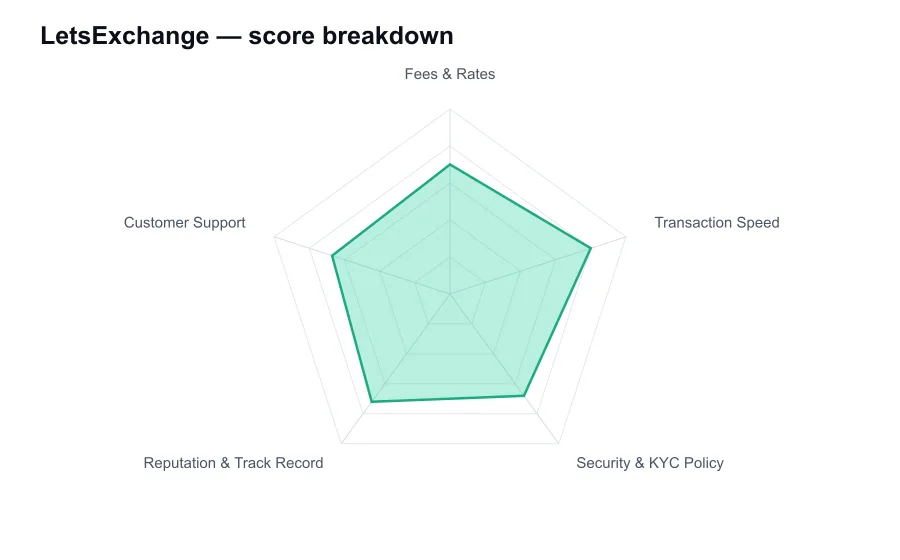
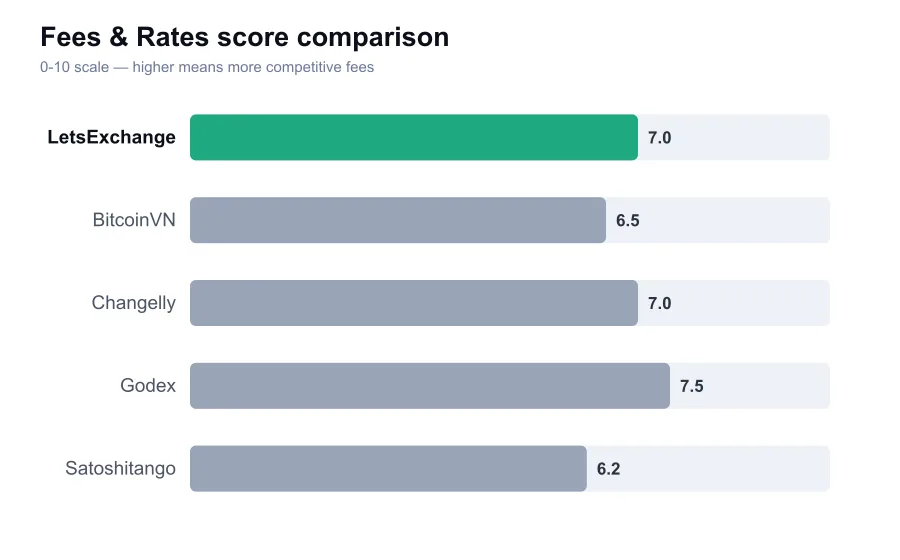
LetsExchange advertises no extra service fee in some of its exchange flows. That wording needs careful reading. Nobody is exchanging assets for free. The customer pays through the rate, network fees, and potentially the price supplied by a liquidity partner. On a quote screen, the only number that really matters is the final amount expected to arrive. Comparing that output with a spot-market conversion at Kraken, Binance, Coinbase Advanced, or a DEX is more honest than chasing a headline fee claim.
For small and medium-sized swaps, the quotes can be fair. LetsExchange is often competitive because it can source routes from multiple partners rather than relying on one pool. It is particularly handy for users who value a simple conversion over manually bridging, wrapping, swapping, then unwrapping assets. The catch is that a quote that looks good at first glance can change by the time the deposit lands if the customer chooses a variable-rate exchange.
The platform offers both fixed and variable rate options. Variable rate is usually the better choice for calm markets and liquid pairs because it leaves less margin for price protection. Fixed rate is preferable when volatility is high or the precise output matters, such as covering a payment or topping up a wallet by a known amount. Fixed quotes can cost more, and customers should view that premium as insurance against movement, not as an automatic upgrade.
Its transaction speed is normally strong. After the incoming transfer is confirmed, many routine swaps finish in a matter of minutes, and fast chains can make the whole process feel close to instant. But the actual timing rests on several moving parts: the origin chain, destination chain, network mempool, confirmation requirements, and liquidity partner. A BTC to ETH order and a USDT on Tron to SOL order should not be expected to behave the same way.
LetsExchange does a decent job of presenting order status, which is more valuable than it sounds. Instant exchanges become stressful when users can't tell whether a deposit has been detected, whether it is waiting on confirmations, or whether the payout has been sent. A status page and transaction identifier don't solve a delay, but they reduce needless uncertainty. Customers should still record every address and transaction hash themselves, because blockchain explorers remain the best source for chain-level facts.
The service is commonly used without account registration, and that lower-friction setup is a major reason people choose it. There is no standing balance to maintain and no need to entrust a platform with funds before a trade. Yet LetsExchange is not outside compliance obligations. Its terms reserve the ability to request KYC or other documentation where an order triggers anti-money-laundering controls. The practical meaning is simple: a swap may begin with no identity check, but it is not guaranteed to remain anonymous.
That policy is not unique to LetsExchange. Nearly every credible instant-exchange provider screens transactions now, partly because failing to do so would invite abuse and banking problems. What matters is how clearly the company explains the process and how efficiently it handles exceptions. LetsExchange has public AML and terms documentation, but users facing a hold still report the same frustration found across the sector: the money is already in transit, while the resolution timeline is difficult to predict.
Security is better understood as a custody question than a marketing badge here. LetsExchange does not ask customers to keep a long-term exchange balance, which removes a major centralized-exchange risk. The user sends funds for a specific order and receives the output to a chosen wallet. Still, a swap is not trustless. The platform and its routing partners are involved between deposit and payout, so a large transaction deserves the same caution as any other third-party transfer.
LetsExchange has built a more visible market presence than many small anonymous swap sites. It has operated through multiple market cycles, has affiliate and API relationships, and appears regularly in comparison lists for instant exchanges. That gives it a meaningful track record. It does not put it in the same credibility class as a long-regulated exchange with audited controls, named executives, financial disclosures, and major licensing. This is a mature convenience service, not a bank substitute.
The public feedback profile is reasonably good, especially from users making standard transactions on supported networks. Positive reviews frequently mention quick completion and an easy interface. Critical reviews tend to focus on a rate changing on variable orders, a payout taking longer than expected, or an AML check. Those complaints are not proof of misconduct, but they are a reminder to select fixed rate where needed, avoid sending funds from questionable sources, and never use an unfamiliar platform for a first transaction worth more than one can tolerate having delayed.
Support is available through live chat and ticket-style contact options, and LetsExchange is generally more reachable than a bare-bones swap widget. Routine questions and order tracking are handled adequately. The quality test is an unusual problem, and this is where a large exchange's formal support structure still has the advantage. There is little comfort in a quick chatbot reply if a complex cross-chain transaction needs manual investigation, although the service does provide order references that make a proper case easier to document.
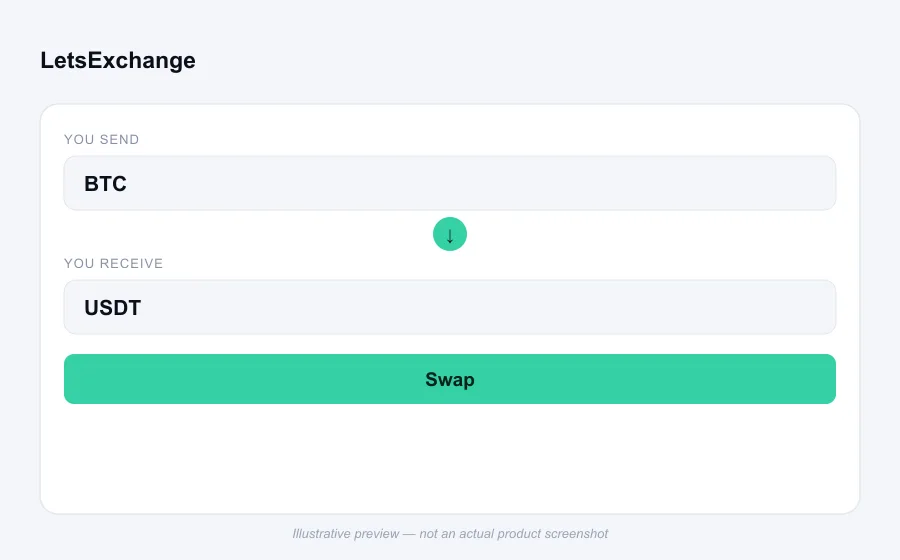
The interface is one of LetsExchange's better decisions. It focuses users on send amount, receive amount, wallet address, and rate type. That sounds obvious, but plenty of crypto services make a simple conversion needlessly complicated. It also integrates well with wallet and partner services, which explains why many people encounter LetsExchange through another crypto product rather than seeking it out directly. Convenience is the product, and in that respect it succeeds.
I would use LetsExchange for a normal-sized conversion between widely traded assets when I wanted to remain in self-custody and did not want to navigate an order book. I would not use it as my default route for repeated trading, large transfers, or a coin with unclear liquidity. The service has earned a solid place among instant exchanges, but it should be judged against the actual amount received, not its marketing vocabulary. Compare quotes, choose the rate mode deliberately, and send a test amount for an unfamiliar route.