Godex is a long running instant cryptocurrency exchange service that targets users who want coin to coin conversions without creating a conventional trading account. It belongs to the older generation of swap providers, alongside names such as Changelly and ChangeNOW, and has built its identity around privacy, fixed rate exchanges, and broad altcoin support. The service is simple to use, but its age does not automatically make every part of the experience modern.
The basic process is familiar. Select the asset you are sending, select the asset you want back, enter a receiving wallet address, and deposit to the generated address. Godex then completes the conversion and sends the output to your wallet. There is no spot market to study and no custodial dashboard where your coins sit for months. For someone who only wants to exchange assets, that stripped down approach is refreshing.
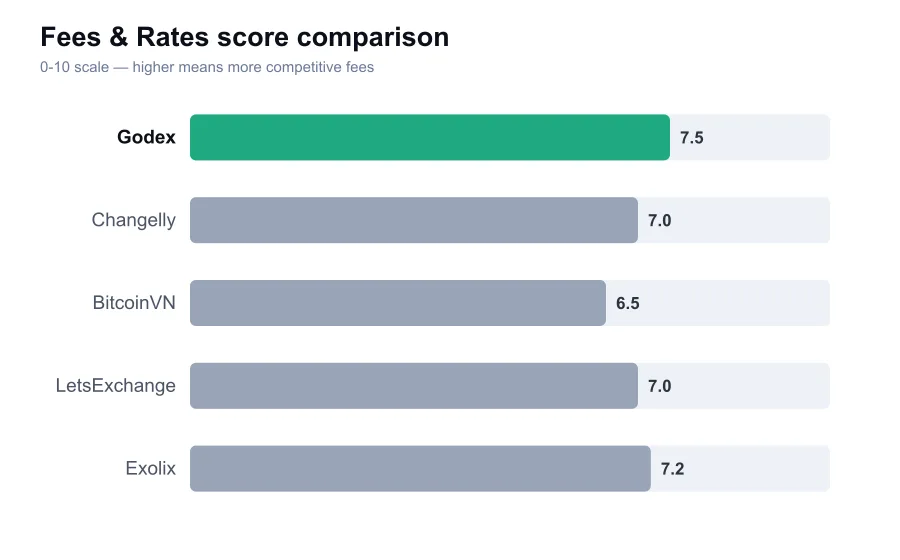
Godex has traditionally marketed itself around a fixed fee of 0.5 percent, with the practical cost also reflecting network fees and the rate available from its liquidity sources. A visible base percentage is better than a completely unexplained quote. It gives users a starting point for comparison. Still, it should not be treated as the full cost of every trade, because exchange spreads and blockchain costs can alter the received amount materially.
The price question is especially important with Godex because its fixed rate positioning can look more attractive than it is. Locking a rate removes uncertainty, and that has real value in a fast moving market. But fixed rate protection is not free in economic terms. Compare the final output against a floating quote from Godex and against at least one competitor. Sometimes the certainty is cheap. Sometimes you are paying noticeably for it.
For common pairs, Godex is usually a reasonable convenience option rather than a price leader. It can be perfectly acceptable for converting Litecoin to Bitcoin, BTC to stablecoins, or a major altcoin to Ether. On less common pairs, the wide asset catalog becomes less impressive because liquidity can be thin and the effective spread can grow. Listing hundreds of assets is useful, but it does not turn every obscure route into a good deal.
Speed is adequate, not spectacular. Godex can process a clean, liquid transaction efficiently, and many swaps finish after the normal confirmations required by the sending network. Fast chains can make the whole process feel quick. Bitcoin and Ethereum congestion will slow things down, as they do everywhere. I would not choose Godex specifically for raw speed if a Lightning capable alternative or a highly automated exchange offers a better route.
Its fixed rate model does provide a form of timing comfort. Users know the intended output before sending, within the stated terms, instead of watching a floating payout change while a Bitcoin transaction waits for blocks. That makes Godex practical for users who care more about a predictable result than shaving every basis point. The caveat is obvious but important, send the correct amount promptly. Underpayments and late deposits can turn a simple order into a support case.
Godex is often described as anonymous because it does not generally require an account, email registration, or routine identity verification for standard swaps. That is a meaningful privacy advantage over Coinbase, Kraken, or a fiat connected exchange. But no account should not be read as no compliance. Godex publishes AML related restrictions and can review transactions considered suspicious. In the modern exchange market, unconditional no KYC guarantees are rarely credible.
The noncustodial label has the same practical limitation found across this sector. Godex does not hold an account balance for you before or after a normal swap. During the order, the platform receives your deposit and coordinates the conversion. This reduces exposure compared with leaving funds on a centralized venue, but it does not eliminate it. You are trusting the company and its liquidity process for the period between deposit and payout.
Godex has been around since the middle of the 2010s, and that longevity is one of its strongest arguments. It has outlasted many short lived instant exchangers, which matters in a sector full of cloned websites and fleeting brands. Its public profile is still smaller than the biggest global exchanges, and it does not offer their regulatory structure or balance sheet visibility. But it has a longer operating history than many no signup alternatives.
That history does not make it immune from the normal complaints seen in the instant exchange sector. Users who experience a delayed order can become frustrated because they have already sent funds and cannot simply cancel from an account page. Online reviews should be read with care. Some complaints reflect blockchain delays or customer errors, while others reveal weak communication during unusual cases. The useful question is how clearly support handles the exception, not whether every review is glowing.
Godex offers around the clock support through online channels, and it has generally been more visible in its support posture than the most anonymous exchange widgets. The service is best contacted with an order ID and transaction hash ready. Clear documentation makes a real difference. A message saying a swap is missing without the sending hash slows everyone down. Support can often solve a tagged transaction or status question, but it cannot undo a confirmed transfer to a wrong address.
I also like that Godex remains focused. It has not tried to become a pretend bank, an NFT marketplace, a leveraged casino, and a social network at the same time. That restraint makes its core purpose easy to assess. The tradeoff is that you won't get the conveniences of a full exchange, such as limit orders, tax reporting, fiat conversion, or detailed account controls. Godex is a tool, not an ecosystem.
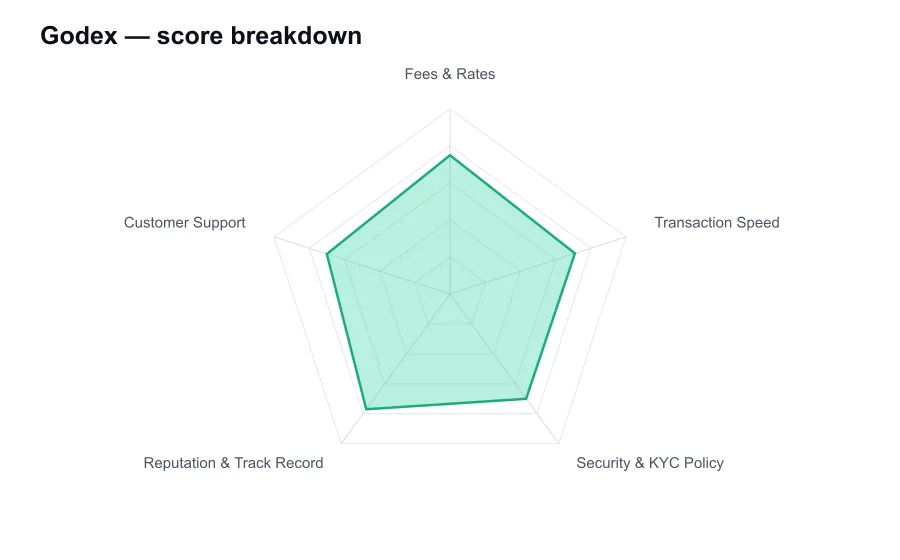
My judgment is that Godex is a decent middle ground for privacy minded users who value a fixed rate and a provider with a longer history than most small swap sites. It is not the cheapest route by default, and it is not the fastest technology in the category. Its sensible use case is a normal sized self custody conversion where predictability matters more than advanced trading features. Compare its quote, verify every address, and don't mistake a smooth standard order for a guarantee that exceptions will be painless.