Trocador is a crypto swap aggregator built for people who prefer self-custody and do not want to open an account at every instant exchange. It searches offers from multiple exchange partners, displays routes and lets the user choose a conversion. In practical terms, it is closer to a comparison layer for instant swaps than to Binance or Kraken. That distinction shapes both its strengths and its limits.
The appeal is obvious. Instead of visiting several swap providers, entering the same pair repeatedly and trying to calculate their spreads, a user can compare options in one place. Trocador supports a wide range of assets and networks, including privacy-oriented coins that are unavailable at many regulated centralized exchanges. For users moving between bitcoin, monero, stablecoins and mainstream altcoins, that breadth is a genuine advantage.
Trocador is non-custodial in the account sense. It does not ask users to create a conventional custodial trading account or leave a balance sitting in a platform wallet. You provide a receiving address, send crypto to the selected partner route, and receive the converted asset at your destination address. That sharply reduces the risk of an exchange collapse trapping your long-term holdings. It does not mean the swap is risk-free.
The selected exchange partner still handles the conversion after the user sends funds. That means route quality matters. A Trocador quote can be excellent because one partner has strong liquidity for the pair, while another route may be slower or have stricter compliance controls. The aggregator helps comparison, but it cannot erase the operational policies of every underlying provider. Users should inspect the partner name and route conditions instead of choosing solely by the largest displayed payout.
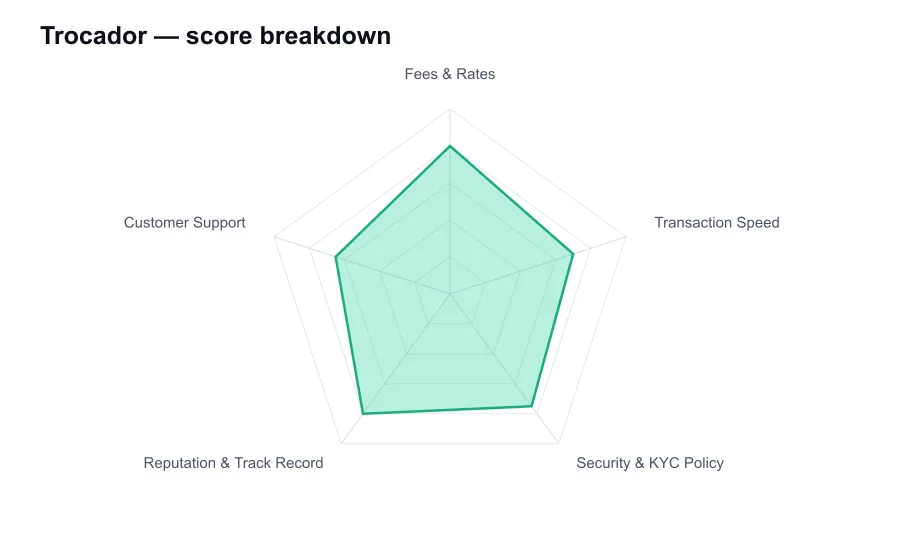
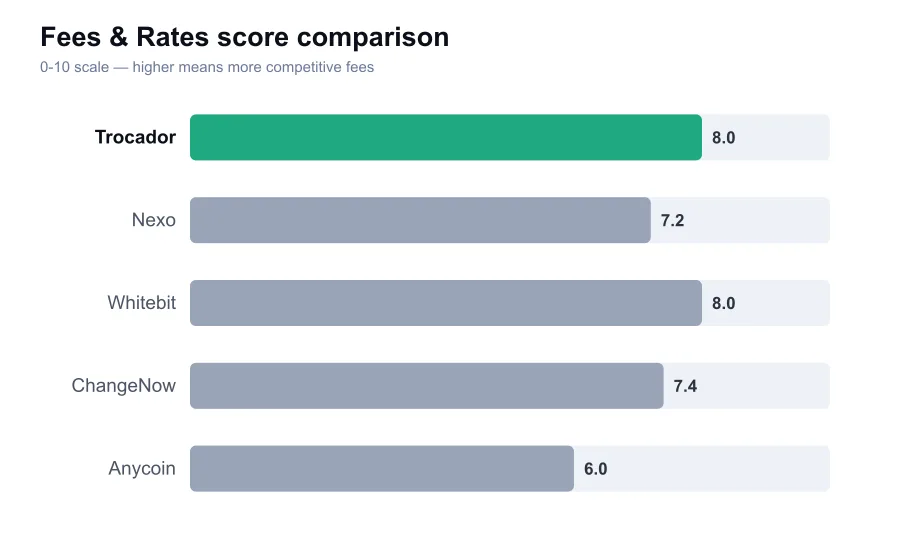
Fees are one of Trocador's better features, provided users understand how the model works. The platform typically earns through partner relationships and can show a Trocador service fee depending on the selected option or mode. Its privacy-focused options may add a visible charge, often around 0.5 percent, in exchange for reducing linkability between incoming and outgoing transactions through its routing design. The exact quote, not a generic percentage, remains the figure to judge.
That privacy option is unusual and meaningful, especially for users who do not want an exchange partner directly associating their source and destination addresses. It is not magic invisibility, and it is not a reason to ignore legal obligations or blockchain analysis risk. It is a paid routing feature with tradeoffs. If privacy is not important for a particular swap, paying extra for it may not make sense. If it is important, the fee can be easier to justify.
Trocador is generally competitive for the kind of medium-sized, one-off swap where avoiding exchange registration has value. It is less compelling for active traders. An order-book exchange with maker fees below 0.2 percent will usually beat an instant-swap route for liquid pairs if the user is willing to deposit, trade and withdraw. Trocador is paying for simplicity and routing, not attempting to be the cheapest execution venue in every scenario.
Transaction speed depends largely on the partner and the chains involved. A straightforward Litecoin, Bitcoin Cash or low-fee stablecoin route can often complete after the required confirmations and exchange processing, commonly within minutes to an hour. Bitcoin and privacy-coin routes may require more patience. Network congestion, unusual deposits and compliance review can turn a quick swap into a much longer wait. Trocador's interface makes route comparison easy, but it cannot guarantee partner settlement.
One practical strength is that the service provides tracking information and keeps the transaction flow relatively understandable. Save the order ID, input address, output address and transaction hashes. If a swap stalls, those details are the starting point for both Trocador support and the underlying provider. Do not send a second deposit to the same address unless the order instructions explicitly permit it. That is a common way users create a problem that support has to untangle.
Trocador's security posture is stronger than that of a small custodial broker because it does not invite users to warehouse funds in an account. There is no traditional login balance to drain, and no normal KYC profile to expose at the aggregator level. Still, users must verify the real trocador.app domain, secure their own wallet and understand that blockchain transactions are irreversible. A fake Trocador ad or cloned site can defeat all of the platform's structural advantages.
The no-account experience should also not be described as an unconditional no-KYC guarantee. Trocador itself is designed around privacy and minimal data collection, but its partnered exchange providers can request verification when their compliance systems flag a transaction. This is especially relevant for large amounts, sanctioned exposure, suspicious transaction history or certain assets. Anyone who needs certainty that identification will never be requested should not send funds based on an assumption.
Trocador has built a solid reputation in privacy-conscious crypto communities over several years. It is often mentioned alongside services such as ChangeNOW, SimpleSwap, SideShift and FixedFloat, though each has a different policy mix and partner structure. Trocador's public identity, longstanding domain and focus on comparison give it more credibility than an anonymous instant exchanger. It still does not have the regulatory backing, formal dispute protections or balance-sheet transparency of a large licensed exchange.
Support is functional but not luxurious. There is a support channel and transaction-specific assistance, and the team has a reputation for engaging with stuck-order reports. That is valuable. Yet support can only act as quickly as the selected partner responds, and privacy-oriented services naturally offer less account-level recovery than a bank or regulated broker. A clear, complete support request with hashes and order details gets further than an angry message with no evidence.
For the best result, compare several offers, check whether the rate is fixed or floating, and use a small test for an unfamiliar route. Pay close attention to minimums, maximums, destination tags and the output network. A cheap quote is worthless if you send USDT on the wrong chain or provide an exchange deposit address without its required memo. Trocador is easy to use, but its users still need to be precise.
Trocador is one of the more compelling choices for self-custody users who value route comparison, broad asset support and optional privacy features. It earns its place as a tool rather than a bank substitute. The service is not the cheapest route for disciplined active trading, and partner-dependent KYC or delay risk never disappears. But for a carefully checked swap, it offers a better blend of choice, usability and privacy awareness than many single-provider instant exchangers.