Curve is one of DeFi's foundational exchanges, built for traders who care less about chasing the newest token and more about moving between closely related assets with minimal slippage. Its specialty is stablecoin and wrapped-asset liquidity: USDC, USDT, DAI, crvUSD, ETH derivatives, and Bitcoin representations have long been its natural territory. It is not a beginner-friendly centralised exchange, and it makes little attempt to be one.
The central idea is simple but powerful. Curve's automated market maker uses custom bonding curves that keep pricing unusually efficient when assets should trade near the same value. Swapping USDC for USDT on a deep Curve pool can be materially cheaper than doing the same trade on a conventional constant-product DEX. That advantage is real, particularly for sizeable stablecoin rotations, treasury operations, and liquidity providers who understand the risks.
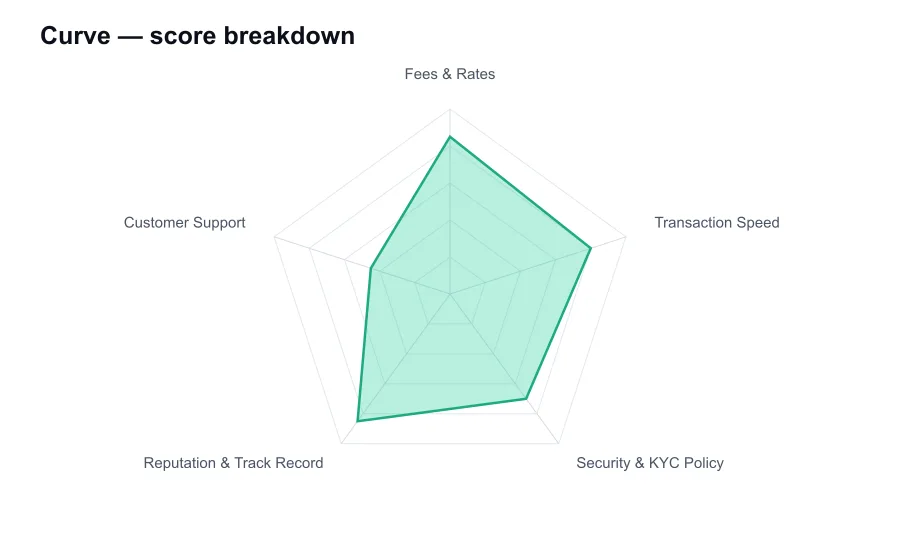
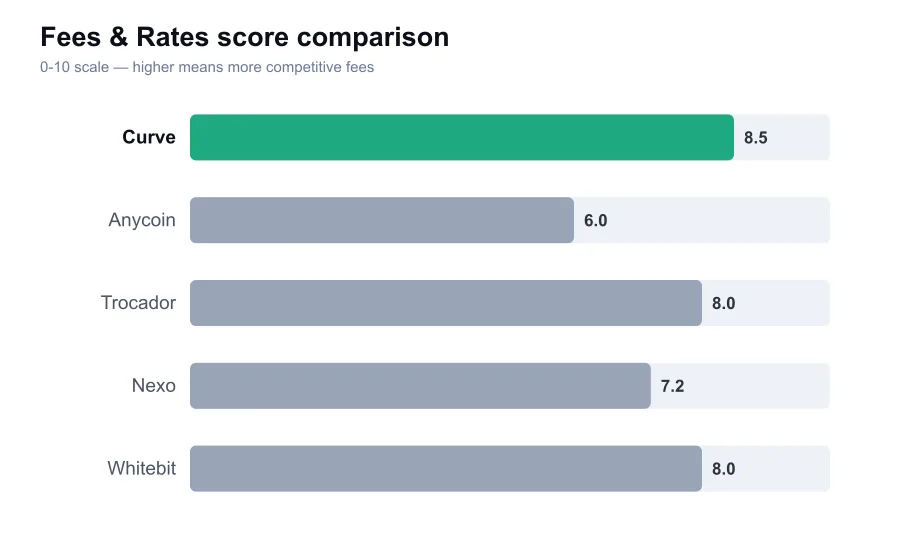
Fees are one of Curve's strongest arguments. Most classic pools charge a 0.04% swap fee, although individual pools and newer factory deployments can use different settings. Part of the fee goes to liquidity providers, and part has historically been directed toward veCRV holders under Curve's governance design. The visible pool fee is low, but a serious user should never stop there. Ethereum gas can turn a tiny on-chain trade into an expensive one during congestion.
The practical cost depends heavily on chain choice. Curve is deployed across Ethereum and several lower-cost networks, including Arbitrum, Optimism, Polygon, Base, Avalanche, and others as integrations evolve. On an inexpensive rollup, the protocol's low trading fee remains low in practice. On Ethereum mainnet, a $100 stablecoin swap can be hard to justify if gas is elevated. Large trades are the better fit for mainnet Curve, while small retail swaps often belong on an L2.
Curve does not add a conventional platform spread in the way many instant-swap services do. The quoted output is determined by the pool, the fee, price impact, and network costs. That is refreshingly transparent if you can read a transaction preview and understand token approvals. It also means users bear the responsibility of checking the route, token contract, and final amount. There is no customer service agent who can reverse a bad self-custody transaction.
Speed is largely a blockchain question, not a Curve question. A swap on Ethereum normally becomes dependable after a few block confirmations, though the wallet may show a submitted transaction much sooner. On Arbitrum or Base, the interaction usually feels near-instant once the transaction is included. Curve itself is not holding assets for manual review, so there is no withdrawal queue or compliance desk slowing a normal swap.
Still, calling it fast without qualification would be careless. Complex routes, congested chains, failed approvals, stale wallet simulations, and insufficient gas are common sources of delay. Liquidity withdrawal can also take longer than a simple swap if a user is unwinding a multi-asset LP position and wants a particular asset. The protocol is quick for people who know their wallet and chain. It can be painfully slow for someone trying to learn on a deadline.
Security is where Curve deserves respect without blind trust. It is an established, heavily scrutinised smart-contract protocol with years of production use, public code, audits, and a large community of technically capable users. Funds remain in the user's wallet until a transaction is signed, which removes the familiar centralised-exchange risk of a company freezing a custody account or becoming insolvent with client deposits.
That does not make Curve safe in the ordinary consumer sense. Smart contracts can fail, governance choices can be contentious, pool parameters can be misread, and liquidity providers can suffer losses that have nothing to do with an exploit. Curve has experienced a serious security incident, notably the 2023 Vyper compiler vulnerability that affected some pools and led to significant losses. The recovery efforts were substantial, but the episode is a permanent reminder that mature DeFi is not risk-free DeFi.
There is no KYC for a standard Curve swap. A wallet connection is the account. That privacy is a legitimate benefit for users who do not want to hand identification documents to another financial intermediary, but it comes with tradeoffs. Curve does not provide the protections, account recovery, dispute process, or regulated custodial framework that some users expect from a licensed exchange. Users must also consider the law and tax treatment in their own jurisdiction.
Curve's reputation is formidable, although not spotless. It helped define the stable-swap category and became deeply embedded in DeFi liquidity infrastructure. The CRV and veCRV system also gave it enormous influence, spawning the so-called Curve Wars as protocols competed for vote-directed emissions. That history proves relevance, but it has also made Curve complicated. The incentives can feel designed for professional liquidity managers and governance strategists rather than ordinary swappers.
Customer support is the weak point, because there is barely a conventional support model to evaluate. Documentation, Discord, governance forums, and community channels can be useful, especially for a technically literate user. They are not equivalent to a staffed help desk with guaranteed response times. Beware impersonators offering direct messages, fake recovery services, or approval-revocation links. In DeFi, a convincing fake support agent is often the most immediate risk.
For simple stablecoin swaps, Curve remains one of the best tools available if the relevant pool is deep and the route is sensible. Compare the final quote against Uniswap, 1inch, CoW Swap, and an aggregator on the same chain, because liquidity conditions change constantly. Curve often wins for correlated assets, but it is not automatically best for every token pair. Its edge narrows quickly once the trade leaves its core stable and wrapped-asset niche.
My view is that Curve is essential infrastructure, not a casual all-purpose exchange. Experienced DeFi users, DAOs, and traders moving meaningful stablecoin size should know how to use it. Beginners should start with small amounts, use the official interface, verify token addresses, and stay away from exotic pools until they understand LP risk. Curve earns a strong score for pricing efficiency and market importance, but its security history and thin human support keep it well short of being carefree financial software.