WhiteBIT is a substantial European-focused centralized crypto exchange, and it belongs in a different category from small instant exchangers. It offers spot markets, wallets, order types, fiat access, staking-style products, and a trading interface for users who want more than a one-time swap. The company has built particular visibility in Ukraine and across parts of Europe, helped by active marketing and partnerships. It is a serious retail platform, though not a risk-free one.
The exchange's strongest practical advantage is breadth. A newcomer can buy or convert crypto through a simplified interface, while an active user can move into the terminal and use market, limit, and stop orders. That progression is valuable. Many platforms either overwhelm beginners or become restrictive as users gain experience. WhiteBIT tries to bridge that gap, and for ordinary spot trading it does a competent job.
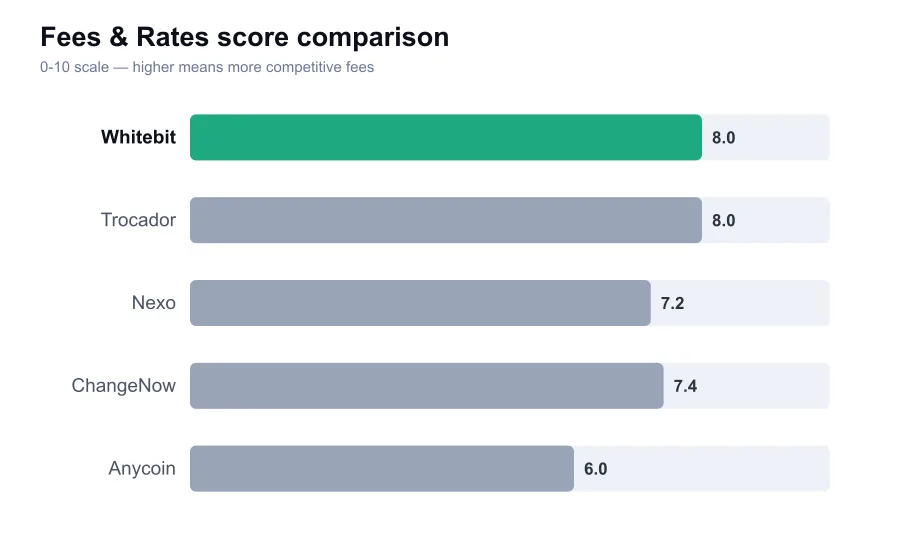
Its published spot trading fees have commonly started around 0.1 percent for makers and takers, with discounts or changes depending on account conditions, pair, and program. That base rate is competitive with mainstream centralized exchanges. It is not automatically the cheapest route, because the spread on less liquid pairs and the cost of deposit or withdrawal methods can matter more than the headline trade commission.
High-liquidity pairs are where WhiteBIT makes the best case for itself. If you are trading BTC, ETH, USDT, or another widely used asset, a 0.1 percent fee is straightforward and reasonable. Smaller tokens require closer attention. An apparently cheap trade can produce poor execution if the order book is thin. Use limit orders where possible, especially if you are buying an altcoin outside the main markets.
Withdrawal charges are the part that deserves regular checking. Crypto withdrawal fees vary by asset and blockchain, while fiat methods can introduce provider-specific charges, limits, and processing times. This is standard across the industry, but it means a low trading fee should not be treated as a complete price comparison. Before funding an account, calculate the cost of getting money back out through the method you actually intend to use.
For order execution, WhiteBIT is much faster and more predictable than an exchanger workflow. A market order in a liquid market can fill almost immediately. Internal balance transfers are generally quick, and blockchain withdrawals are processed subject to security checks and network conditions. The distinction matters. WhiteBIT can execute a trade in seconds, but it cannot make Bitcoin confirm faster or force a bank to clear a transfer on a weekend.
The platform has invested visibly in account protection. Two-factor authentication, anti-phishing tools, address controls, login notifications, and withdrawal security features are the sorts of controls users should activate immediately. WhiteBIT has also promoted cold-storage practices and security certifications. Those measures are positive, but a centralized exchange remains a custodian. Security is never only a question of whether the platform has good controls, it is also about whether the user limits exposure.
KYC is a real part of the WhiteBIT experience. This is not a casual no-identity swap service. Verification requirements vary by jurisdiction and product, and users should expect identity checks before accessing many functions, particularly fiat rails and higher limits. Some crypto users dislike that. I think the clearer compliance posture is a net positive for a platform handling significant retail volume, although document reviews can still be inconvenient.
WhiteBIT's track record is stronger than that of a small regional exchanger but shorter and less globally battle-tested than Coinbase, Kraken, or Binance. It has gained meaningful brand recognition, maintained a visible public presence, and attracted a large retail audience. It has also faced the ordinary skepticism that follows any exchange tied to a volatile industry and a region affected by geopolitical disruption. That scrutiny is healthy.
I would not give any centralized exchange a perfect security or reputation score, including WhiteBIT. Crypto history is full of firms that looked stable until they were not. The right response is not panic, but good custody hygiene. Keep trading capital on the exchange, use hardware or self-custody for long-term holdings, protect the account with unique credentials and strong two-factor authentication, and whitelist withdrawal addresses if that option is available.
Customer support is one of WhiteBIT's mixed areas. The platform provides help content, ticketing, and live-contact options, which puts it well ahead of a simple exchange desk. Yet users facing verification delays, withdrawal reviews, or account-access problems can still find the process slow and stressful. That criticism is not unique to WhiteBIT. It is a structural weakness of centralized exchanges, where security holds and compliance reviews do not always feel transparent to the person affected.
The mobile and web products are polished enough for regular retail use. The layout makes basic conversion accessible, and the exchange interface provides enough functionality for most spot traders. Professionals who need the deepest global liquidity, sophisticated API infrastructure, institutional reporting, or a vast derivatives ecosystem may still prefer larger international venues. WhiteBIT is strongest as a capable everyday exchange rather than a universal trading destination.
The platform is particularly sensible for verified European and Ukrainian users who want fiat access, a familiar interface, and a broader product range than an exchanger can provide. It can also suit a spot trader who values a competitive listed fee schedule and does not need to avoid KYC. It is a poor fit for someone determined to remain anonymous, someone holding assets for years without self-custody, or a trader who needs every exotic product under the sun.
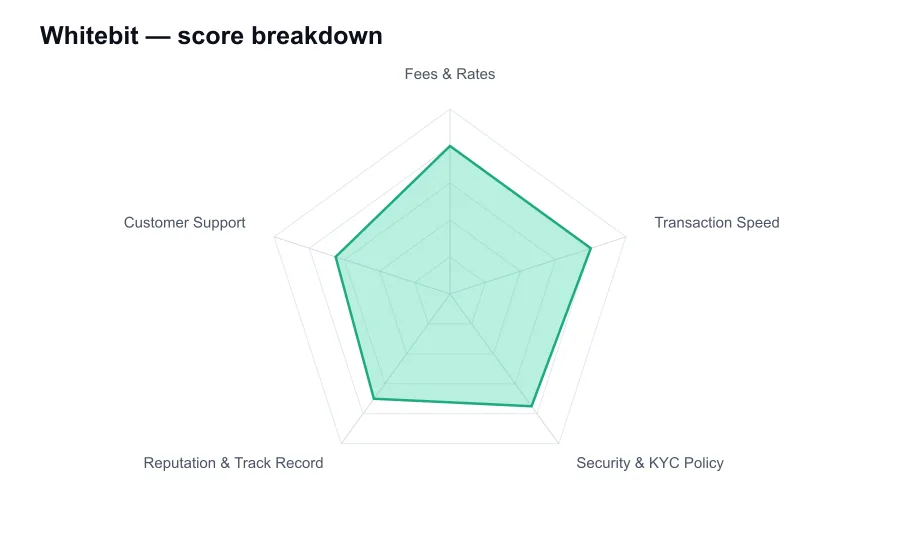
WhiteBIT earns a clearly higher score than local conversion desks because it has a real exchange infrastructure, published trading costs, deeper markets, and more developed security tooling. That does not mean it should be trusted unconditionally. Its support and compliance experience can be uneven, and the usual custodial risks remain. For verified retail users trading liquid assets, it is a credible choice. For long-term storage, the best exchange is still the one you withdraw from after the trade is done.