Coinalyze is a crypto market-data and derivatives analytics platform, not an exchange. It is built for people trying to read what is happening across futures markets through open interest, funding rates, liquidations, volume, long-short positioning, and price charts. That places it closer to TradingView, CoinGlass, Velo Data, and exchange analytics dashboards than to a venue where users deposit money and buy coins.
That distinction should shape any review. You don't open a Coinalyze account to hold Bitcoin, place a spot order, or move USDC off an exchange. The service aggregates and visualizes information from cryptocurrency markets. Its usefulness rises or falls on chart coverage, data freshness, interface quality, and whether the information helps a trader form a better view before risking capital elsewhere.
The appeal is easy to understand for derivatives traders. Price alone tells a limited story. A sharp move with rising open interest can suggest fresh positions entering the market, while a move accompanied by falling open interest may reflect closing or liquidation. Funding rates can show an overcrowded long or short trade. None of these metrics offers a magic signal, but they provide context that a plain candlestick chart lacks.
Coinalyze presents much of that context in an accessible way. Its futures pages, open-interest charts, liquidation data, funding information, and multi-exchange views can be useful for a trader who wants to compare market behavior rather than stare at one venue in isolation. The platform is particularly relevant for users watching perpetual swaps, where positioning and funding can become meaningful around volatile moves.
There is a trap here. Derivatives analytics can make a trader feel better informed than they really are. Open interest is not a directional oracle. A high funding rate can remain high longer than expected. Liquidation clusters are not guaranteed price targets. Anyone treating dashboard indicators as automatic buy and sell instructions is setting up an expensive lesson.
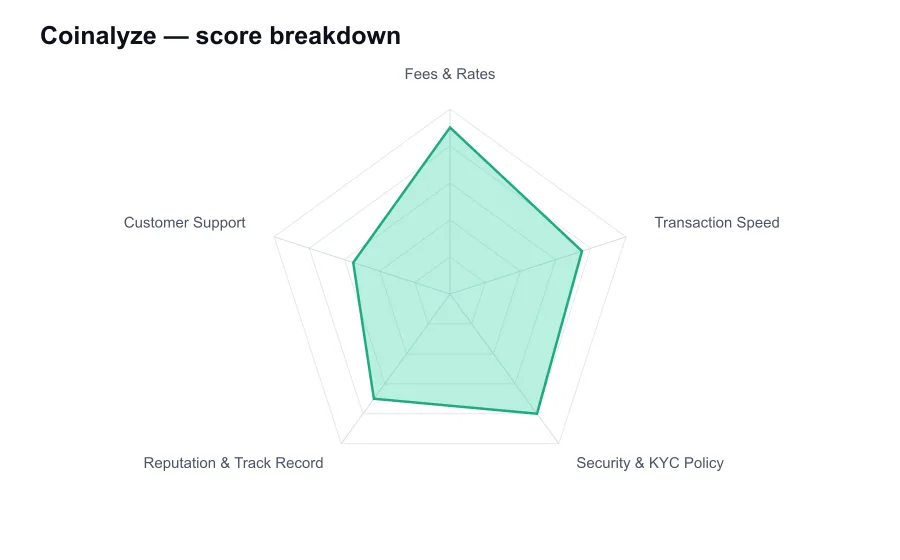
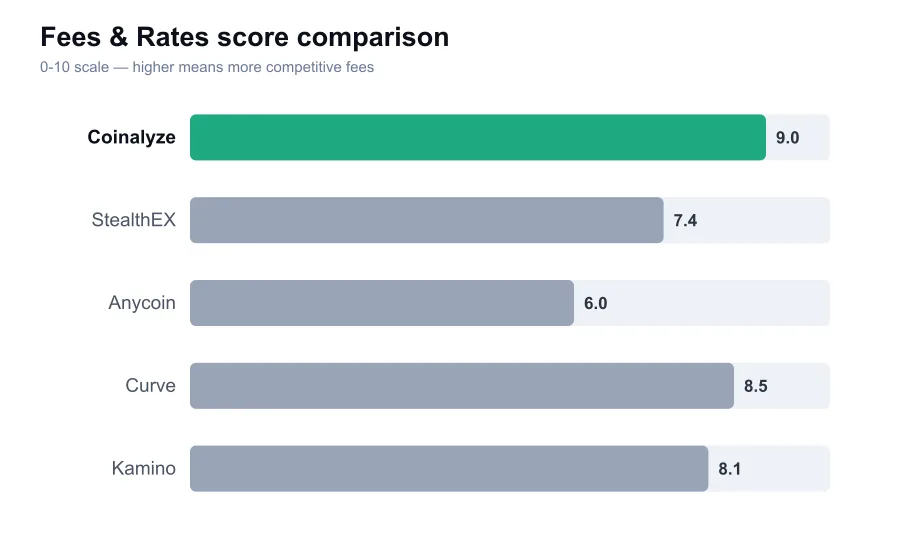
Fees are unusually favorable because much of Coinalyze's value is available without an exchange-style trading commission. There are no maker fees, taker fees, spreads, withdrawal charges, or on-chain network fees imposed by Coinalyze for the simple reason that it isn't taking custody or executing your trade. Access conditions and product availability can change, so regular users should still check the current site terms rather than assume every feature is permanently free.
For a serious trader, free access isn't the same as costless access. The hidden cost is reliance on a third-party data layer. If a chart is delayed, a venue feed is incomplete, a symbol mapping is confusing, or an indicator is misread, the resulting trade can cost far more than any subscription would. It is sensible to cross-check major decisions against the relevant exchange and at least one independent data source.
Speed is one of the more important qualities for a platform like this. Coinalyze is useful for monitoring market conditions, but it should not be treated as a high-frequency execution feed. Web dashboards can refresh rapidly while still being unsuitable for millisecond-sensitive decisions. If you trade short-term breakouts, the execution venue's order book, its own liquidation feed if available, and direct market data matter more than a browser tab.
For swing traders and discretionary perpetuals traders, that limitation is less severe. A few seconds of display lag rarely changes a multi-hour thesis. In that setting, the point is to see broad positioning, identify extremes, and avoid entering a crowded trade blindly. Coinalyze works better as a decision-support screen than as an execution console.
Security is refreshingly simple because the platform does not need custody of user assets for its core analytics role. A visitor can use public market data without depositing coins or linking a trading wallet. That eliminates a major category of exchange risk: there is no Coinalyze balance for an attacker to drain. It does not eliminate the normal risks of phishing, compromised browser sessions, or blindly trusting information found online.
The platform is also not a no-KYC exchange, because it is not an exchange at all. There is no indication that a market-data visitor needs to submit identity documents simply to inspect public charts. That is convenient, but it should not be confused with a privacy guarantee for every interaction on the internet. Users should still review privacy terms, use sensible browser hygiene, and avoid installing unverified extensions that claim to enhance trading analytics.
Reputation is solid within the niche of crypto derivatives watchers, although Coinalyze is not as mainstream as TradingView and does not have the institutional profile of a specialist data terminal. It has built recognition around futures statistics and derivatives-oriented charts. Its public standing is helped by a relatively clear product identity. It is a data tool, and it generally looks like one rather than pretending to be a bank, exchange, and research house at once.
Support is not the reason to choose Coinalyze. A lightweight analytics platform typically cannot offer the hands-on account support expected from a major broker or enterprise data vendor. Documentation, site feedback channels, and community knowledge may solve basic issues, but traders with urgent execution problems must contact their actual exchange. Coinalyze cannot reverse a liquidation or repair a bad fill because it never placed the trade.
The best use case is a trader who already understands basic derivatives mechanics and wants a compact second screen for open interest, funding, and liquidations. It is less useful for a novice who has not yet learned what a perpetual contract is, and it is irrelevant for someone who merely wants a safe place to buy and hold Bitcoin. Data can sharpen judgment, but it cannot replace risk management.
My view is positive but disciplined. Coinalyze is a handy, low-friction analytics resource with better value for derivatives observers than many people expect from a free web tool. Its weaknesses are exactly what they should be: it is not an execution venue, not a custody provider, and not a source of personalized trading advice. Use it to challenge a thesis, not to outsource one.