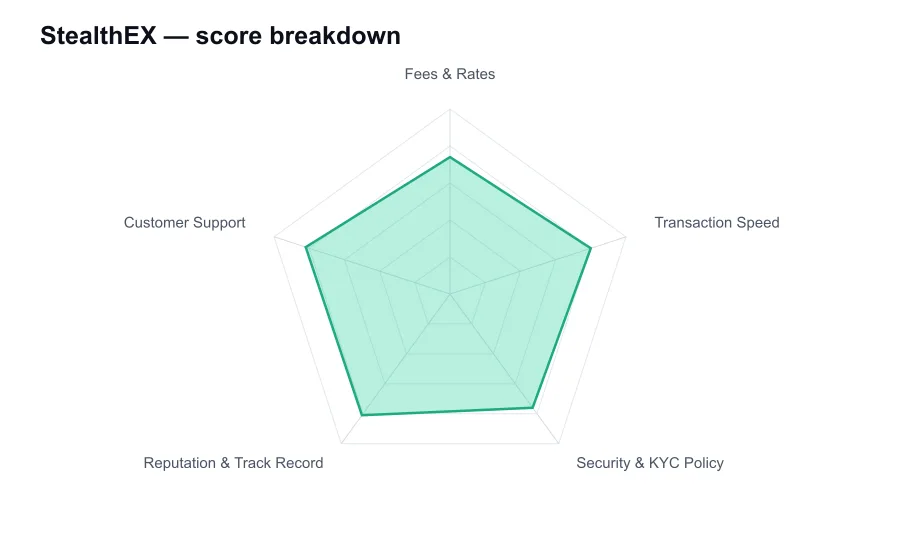
StealthEX is one of the more recognizable names in the non-custodial instant-swap category. Since launching in 2018, it has built a broad catalogue of supported coins and tokens and positioned itself as a practical alternative to opening accounts at conventional exchanges. The service does not try to be a full trading terminal. It is for the person who already has crypto in a wallet and wants to turn it into something else without parking funds on a central platform.
That is a useful proposition, especially now that many traders hold assets across several chains. StealthEX supports a very large selection of assets and routes, including mainstream networks and a long tail of smaller tokens. Breadth is one of its genuine strengths. A user who needs to move from a common coin into an obscure asset will often find a route here when a bank-facing exchange offers neither the token nor a simple withdrawal path.
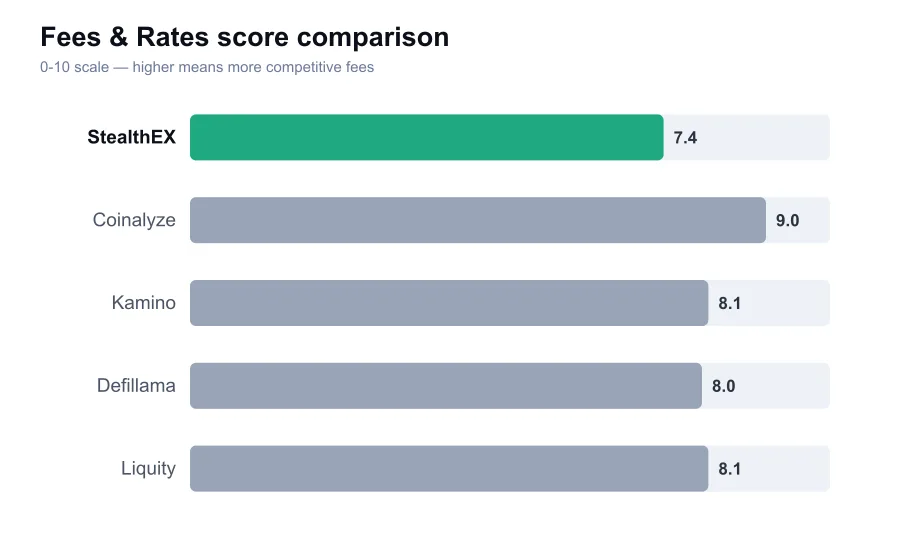
The headline fee is fairly clear by instant-exchange standards. StealthEX has historically advertised a 0.4 percent service fee on floating-rate exchanges, with the rate shown before a customer sends funds. Network fees and liquidity-provider pricing are still part of the real equation. The 0.4 percent is not the whole cost, and anyone presenting it that way is overselling the deal. The amount delivered to your wallet remains the number to compare.
On liquid routes, its pricing is often competitive with similar non-custodial services. It is not always the winner. ChangeNOW can occasionally produce a better final amount, while a spot trade on Kraken, Binance, or Coinbase Advanced will generally be cheaper for users who already have an account and can handle withdrawals. StealthEX charges for convenience, routing, and not demanding an account. That is an honest trade if you value those things, but it is still a trade.
The fixed-rate option deserves particular attention. Floating quotes are usually preferable in calm markets because they can offer better pricing, but the amount received can change while the transaction is being processed. A fixed-rate transaction gives greater certainty about the output, subject to the provider's stated conditions and sending the required amount within the allotted time. For volatile pairs, that predictability can be worth a higher quote. For a quiet USDC to ETH swap, it often is not.
Execution is usually quick after the incoming transfer is confirmed. For assets with fast blocks and healthy liquidity, a normal order may move through in minutes. Bitcoin, Ethereum during congestion, and tokens requiring several confirmations naturally slow the experience. That is not a StealthEX-specific failure. The better question is whether the service detects the payment promptly, progresses the order visibly, and broadcasts the payout without unnecessary manual intervention. In routine use, it generally does.
Still, the word instant gives newcomers the wrong expectation. A Bitcoin transaction with a low network fee cannot be made fast by an exchange widget. Nor can a service settle a chain outage or a wallet maintenance event on demand. If the coins are needed for a time-sensitive purchase, do not begin the swap at the last minute. Use a network with realistic confirmation times, leave a buffer, and inspect the destination chain before committing funds.
StealthEX's non-custodial label is meaningful but needs plain English. It does not maintain a user trading balance or ask customers to deposit funds in advance. Each order is a one-time exchange, with the output sent to the wallet address supplied by the customer. During processing, however, the provider and its liquidity partners necessarily control the deposited assets. Non-custodial in this context means reduced ongoing custody, not a cryptographic guarantee that you remain in control throughout the conversion.
The platform is also not a promise of permanent anonymity. StealthEX states that it does not normally require registration or routine KYC, but it has an AML policy and can request verification when a transaction is flagged. That is standard for serious providers in this field. It can still be an unpleasant surprise for a user who assumed no sign-up meant no compliance checks under any circumstances. It does not. Avoid sending funds connected to questionable sources and do not use an instant swap to solve a compliance problem.
Security practice from the customer side matters enormously. Verify the receiving address character by character, use the correct network, and treat token contract lookalikes with suspicion. If you are swapping to an exchange deposit address, confirm its memo, tag, and network requirements first. StealthEX cannot retrieve assets sent to a wrong address or restore a completed on-chain transfer. A small test swap is not paranoid. It is cheap insurance, particularly with an unfamiliar chain.
Its track record is stronger than that of a newly launched anonymous swap site, though it should not be equated with the regulated history of a top-tier centralized exchange. StealthEX has been operating for years, has visible partnerships and a substantial web footprint, and is widely discussed in crypto comparison circles. That gives it more credibility than a blank-slate provider. It does not erase the normal complaints seen across the sector, most commonly about delayed orders, rate movement, or transactions placed into review.
A fair reading of user feedback separates an isolated rough transaction from a pattern. Most completed swaps never generate a public post, while a delayed transaction understandably does. StealthEX has a longer enough history that there is meaningful evidence of regular usage, and its public support presence is better developed than many small competitors. I would still avoid treating any external review score as a guarantee, because crypto review platforms can be noisy and disputes are often technically complicated.
Customer support is available around the clock through live chat and email channels, which is one reason StealthEX has remained competitive. For routine order questions, fast access to a human matters more than polished marketing. The team can look up an order using its ID and hashes, explain confirmation status, and identify a missing memo or a compliance hold. The quality of a difficult case naturally depends on how quickly a liquidity partner responds, but the support infrastructure is more mature than average for this niche.
StealthEX is not the cheapest route for someone who trades every week, and it should never be used as a substitute for careful wallet hygiene. It is, however, among the more credible choices for an account-light swap involving many possible assets. I would be comfortable using it for a modest conversion after comparing the final quote, particularly where token availability matters. For large sums, recurring trading, or fiat access, a regulated exchange remains the more sensible base.