Morpho is not an instant exchange and should not be judged as one. It is a decentralized lending protocol, primarily associated with Ethereum and EVM based markets, that lets users supply assets, borrow against collateral, and build lending vaults. Its place in the market is closer to Aave, Compound, Spark, and Euler than to a swap service. The important distinction is that a Morpho user is taking smart contract and market risk, not simply requesting a one time currency conversion.
The protocol developed from an earlier model that optimized peer to peer matching around existing lending pools. Morpho's newer architecture, Morpho Blue, is a more permissionless lending primitive. Markets are defined by a loan asset, collateral asset, oracle, interest rate model, and liquidation loan to value parameter. That flexibility is powerful. It also transfers much more responsibility to users, curators, and integrators than a tightly governed money market does.
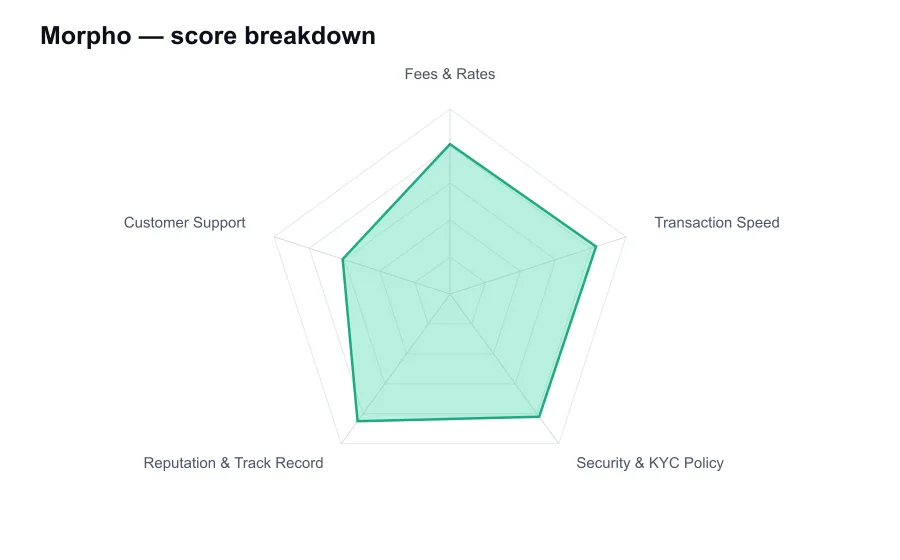
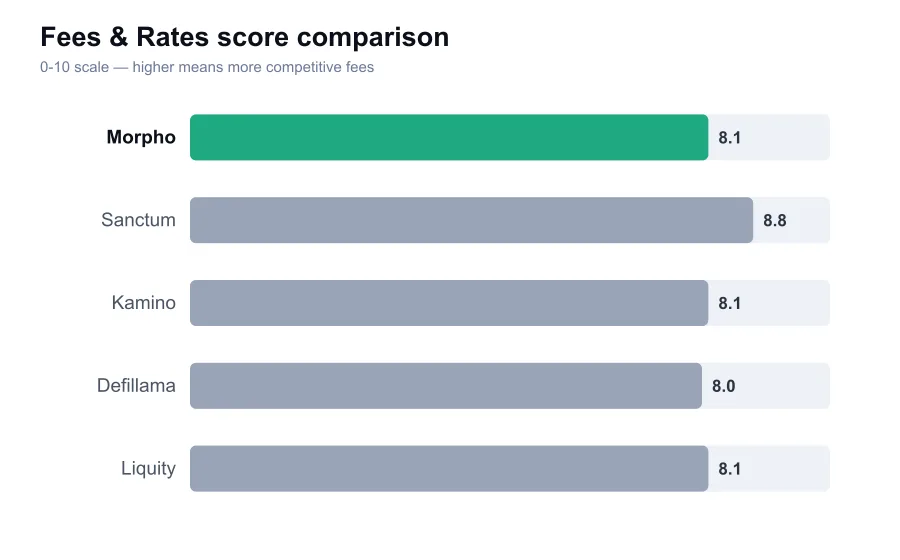
There is no typical retail exchange fee in the familiar sense. Morpho Blue itself is designed with a very lean protocol layer, and borrowing costs are determined by the market's interest rate model rather than a standard trading commission. Vault curators may charge fees, and users still pay network gas. The practical price of using Morpho is therefore a mix of variable borrow APR, vault fee, Ethereum transaction costs, and the opportunity cost of the collateral posted.
That structure can be cheaper and more transparent than an opaque instant swap spread, but only if the user reads the parameters. Do not look only at a displayed supply APY. Ask what asset is borrowed, what collateral backs it, which oracle is used, who curates the vault, whether the yield includes incentives, and whether the rate can change sharply as utilization rises. A high APY without this context is advertising, not analysis.
Morpho's vault model is its most approachable entry point. A depositor can allocate capital to a vault managed by a curator that selects markets within defined rules. This lowers the burden of selecting individual loans, but it does not make the position risk free. The curator's judgment becomes part of the investment decision. A vault can be diversified, conservative, and carefully monitored, or it can pursue higher yield by accepting more concentrated or novel risk.
Borrowers receive something closer to a professional DeFi money market experience. They can use supported collateral to borrow another asset without selling the collateral outright. This is useful for liquidity management, leverage, hedging, or maintaining exposure. It is also one of the fastest ways for an inexperienced user to get liquidated. If collateral value falls and the position crosses its liquidation threshold, bots can close it without sympathy and without a customer service appeal.
Speed is excellent at the protocol level because actions settle according to the underlying blockchain. On Ethereum, that generally means a transaction can be confirmed in minutes, with timing dependent on gas conditions. There is no bank settlement queue or human operator approving an ordinary supply or repayment. But blockchain speed is not the whole story. A transaction can fail, sit pending, or become expensive during congestion, and a liquidation can happen faster than a user reacts.
The protocol's security design deserves more respect than the casual DeFi user often gives it. Morpho has attracted serious technical attention, audits, bug bounty efforts, and a public ecosystem of builders and risk managers. Its contracts are open source and its architecture is widely examined. Those are substantial positives. They do not turn code into a guarantee. Smart contract vulnerabilities, oracle failures, governance decisions, integration bugs, and economic attacks remain possible.
Security also depends heavily on what sits around the core contracts. A user may interact through the official interface, a third party front end, a wallet extension, a vault curator, an oracle provider, or a bridge. Each additional dependency is another attack surface. Fake websites and malicious approvals are more mundane dangers than a protocol exploit, yet they are responsible for many real losses. Bookmark the official interface and inspect token approvals regularly.
Morpho does not impose conventional KYC at the protocol level. Anyone with a compatible wallet can generally interact with permissionless markets, subject to interface access and jurisdictional restrictions that may apply at the front end level. That permissionless quality is central to DeFi, but it also means no one verifies that a user understands liquidation mechanics. There is no help desk that can reverse an onchain borrow because the borrower misread the health factor.
Its reputation is strong within DeFi, though it is not a household name outside crypto native circles. Morpho has earned credibility through technical development, substantial usage, integrations, and the seriousness of its lending design. I would place it well above anonymous yield farms and lightly documented lending apps. It still does not have the consumer protections, deposit insurance, or regulatory accountability of a bank. Those are not minor caveats, they are the terms of the product.
Customer support is inherently limited by the protocol model. Documentation, community channels, governance forums, vault curator materials, and integration support can be helpful. None of them can retrieve funds from a completed transaction or prevent a valid liquidation. Users who expect a live agent to fix a wallet mistake will find Morpho frustrating. Users comfortable reading transaction data and risk parameters will find the self service model appropriate.
For conservative users, the sensible path is to begin as a supplier in a well understood vault with a small amount, after researching the curator and underlying markets. Borrowing should come later, if at all. Avoid using volatile collateral to borrow a stablecoin near the maximum allowed loan to value. A large market move can erase the apparent advantage of a modest borrowing rate in a few blocks.
Morpho is one of the more credible pieces of modern DeFi lending infrastructure, and its modularity is a real strength rather than a gimmick. But flexibility magnifies the cost of weak judgment. It rewards users who can evaluate market configuration and curator quality, while punishing people who chase yield labels or borrow too aggressively. That is not a defect. It is a reason to be selective.
My final view is positive, with a firm warning label. Morpho offers sophisticated, transparent onchain lending tools and has a stronger technical reputation than most DeFi protocols competing for deposits. The fee model can be attractive, and settlement is efficient. Yet it is not simple savings, and a high score for protocol quality should never be confused with a low risk score for every vault or position built on top of it.