Sanctum is not a conventional crypto exchange, and judging it as though it were one misses what makes it interesting. It is a Solana focused liquid staking infrastructure project that lets users move between SOL, liquid staking tokens, and integrated DeFi applications. Its core pitch is straightforward: staking SOL should not mean choosing between earning validator yield and retaining usable liquidity. In a market crowded with generic swap widgets, Sanctum has a much more focused identity.
The project emerged from the former Solana staking operation known as Socean and has become a major part of Solana's liquid staking ecosystem. Sanctum's Infinity pool is designed to make different liquid staking tokens more interchangeable. That matters because Solana has several respected LSTs, including jitoSOL, mSOL, bSOL, LINFRA and others, each tied to different validator sets, fee structures, and community incentives. Sanctum tries to remove the friction of moving among them.
For someone holding native SOL, the practical route is usually to stake through a supported LST provider, then use Sanctum's liquidity infrastructure or partner interfaces to exchange that LST. This is not the same experience as opening an account at Coinbase or Kraken, depositing dollars, and trading a familiar order book. There is no bank rail, no standard spot exchange dashboard, and no customer account in the traditional sense. It is DeFi, with all the control and responsibility that implies.
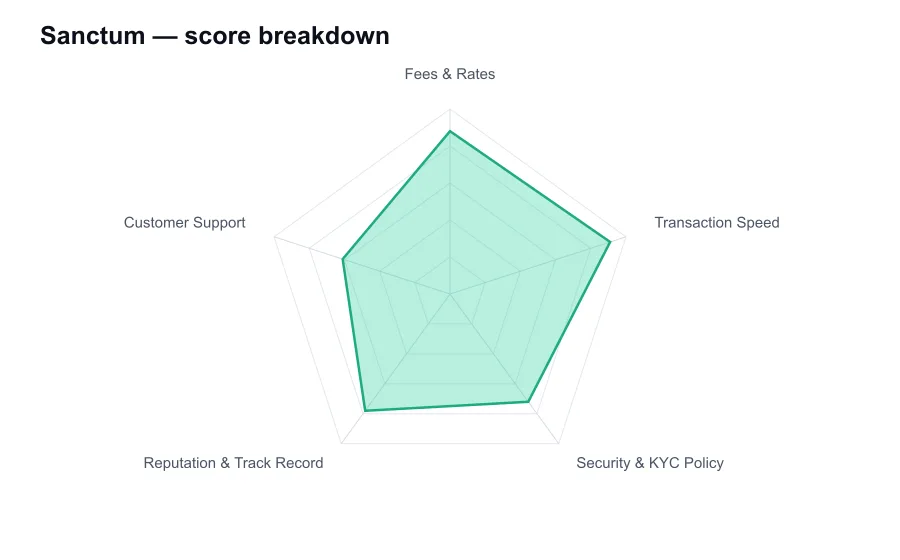
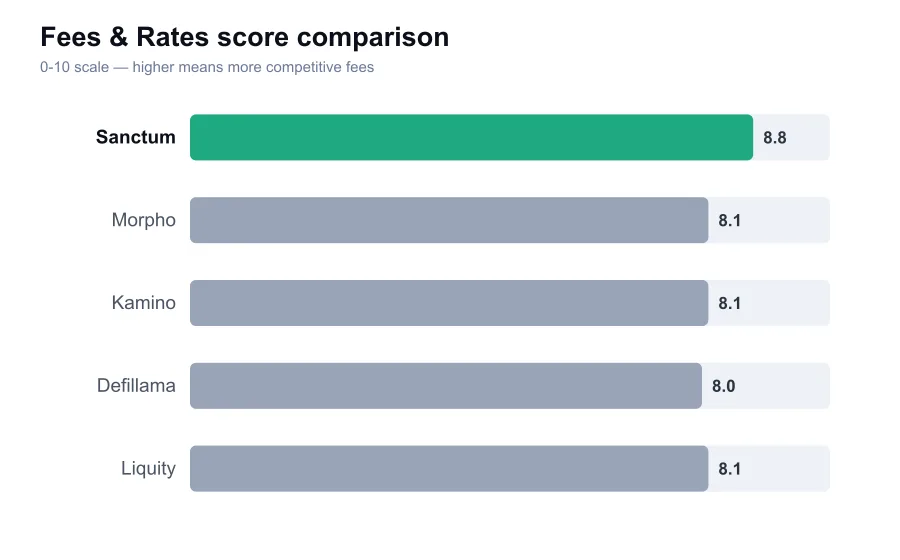
Fees are one of Sanctum's stronger points, although the word free needs careful handling in this corner of crypto. Swaps involving Infinity-supported liquid staking tokens can often be completed with very low or zero explicit swap fees. The user still pays Solana network fees, though these are normally tiny, and the economics of an LST are never entirely fee-free. Each underlying liquid staking provider can charge a management fee, an unstaking fee, or capture part of validator rewards in its own way.
That distinction is important. A user comparing a Sanctum route with a simple SOL to USDC swap should not look only for a visible percentage on the screen. The quoted exchange rate, pool depth, and value of the specific LST all matter. A token may trade at a small premium or discount to its underlying SOL claim. During calm conditions that difference is often narrow. During a volatile market, or when liquidity gets thin, it can become the real cost.
The Infinity pool is clever because it makes liquidity less fragmented than it would be if every LST pair needed its own pool. In practice, that can make swapping between Solana staking positions considerably smoother than routing through several decentralized exchanges. It also supports a broader thesis: validator diversity is healthier if users can choose smaller or specialist staking providers without sacrificing liquidity. That is a meaningful contribution, not just a cosmetic product feature.
Speed is excellent as long as the Solana network is behaving. Most actions settle on-chain in seconds, and the user gets a transaction signature rather than waiting for a centralized service to approve a withdrawal. Compared with the hours, and occasionally days, associated with exchange withdrawal queues, Sanctum feels immediate. The caveat is that Solana transaction failures, RPC issues, wallet popups, and congestion can turn an ostensibly simple swap into a mildly technical task.
Native unstaking is a different proposition. If users want to redeem a liquid staking token through the underlying stake program rather than sell it through liquidity, they may face Solana's epoch timing. An epoch is roughly two to three days, though timing varies. Sanctum's liquid routes can avoid that wait if pool liquidity is available, but immediate liquidity is not a guarantee that the price will always be perfect. Fast exits are a market service, not magic.
Security is where a reviewer needs to be more demanding. Sanctum is noncustodial in the sense that users transact from their own Solana wallet. It does not hold a retail login balance in the way an exchange does. There is no routine identity check for using an on-chain swap, and that privacy is appealing to experienced DeFi users. But no KYC also means no account recovery desk, no card-payment dispute process, and no protection from signing the wrong transaction.
Users should inspect the destination address, token mint, and wallet approval every time. Solana's speed is a benefit until it makes an irreversible mistake happen quickly. Fake token mints and lookalike websites remain practical risks across the Solana ecosystem. Start from Sanctum's official links, use a reputable wallet such as Phantom or Solflare, and do a small test transaction if the amount matters. Those are not optional rituals for a newcomer.
The protocol's security story also depends on smart contracts, integrated LST providers, validators, and the surrounding Solana network. That is a wider attack surface than simply holding SOL in a hardware wallet. Audits and public technical work are useful signals, but they do not eliminate contract risk, oracle assumptions, liquidity stress, or governance mistakes. Anyone presenting liquid staking as equivalent to risk-free staking is selling a comforting fiction.
Sanctum has earned real recognition inside Solana, particularly after its 2024 CLOUD token launch and the expansion of its partner LST network. Its reputation is much stronger among active Solana users than among mainstream retail traders, which is understandable. It has a credible product and a recognizable team history, but it has not been tested across multiple long crypto cycles in the way older exchanges such as Kraken have. The project is established enough to take seriously, not old enough to treat as institutional bedrock.
Support is the least polished part of the experience. Sanctum maintains documentation, social channels, and community support routes, but users should not expect an exchange-style phone line or a concierge who can reverse a transaction. Help is generally best for wallet connection questions, route explanations, and known interface issues. It is much less useful after a user has signed a valid but unwanted on-chain transaction, because the protocol cannot simply pull funds back.
The right user for Sanctum is someone already comfortable on Solana who wants liquid staking exposure, wants to move between LSTs efficiently, or cares about supporting validator diversity. It is a poor first crypto purchase and an even worse place to send money you cannot afford to misroute. The low direct trading friction is genuinely attractive, and the product solves a real liquidity problem. Still, low fees should not distract from the fact that every layer of DeFi adds a layer of operational risk.
My view is positive, with a firm condition: use Sanctum as specialized Solana infrastructure, not as a substitute for a regulated exchange or a savings account. Its speed and LST liquidity design are among the more useful pieces of the Solana DeFi stack. The noncustodial model is a strength for self-directed users and a trap for people who expect human rescue. If you understand liquid staking and can verify what your wallet is doing, Sanctum is one of the more compelling tools in its niche.