Pegasusswap appears to position itself as a lightweight crypto exchange or swap service rather than a full-service financial platform. That distinction matters. A visitor looking for margin, regulated brokerage infrastructure, deep order books, or a long operating history should not assume those things exist simply because a site can convert one token into another. The practical question is whether it can execute a small swap safely and predictably.
My main concern with Pegasusswap is the thin public record. It does not have the volume of independent reporting, regulatory visibility, long-running user discussion, or institutional footprint associated with established operators such as Kraken, Coinbase, Bitstamp, or even better-known instant exchangers. That does not automatically make it fraudulent. It does mean it deserves a much higher burden of proof before a customer sends it meaningful funds.
Small swap brands often market themselves through simplicity. Pick two assets, enter an address, send crypto, and receive the converted currency. That can be useful for a one-off conversion, particularly for people who do not want to fund a custodial exchange account. Yet simplicity on the screen tells us little about liquidity sources, legal entity details, security controls, or who resolves a transaction if the quoted pair becomes unavailable.
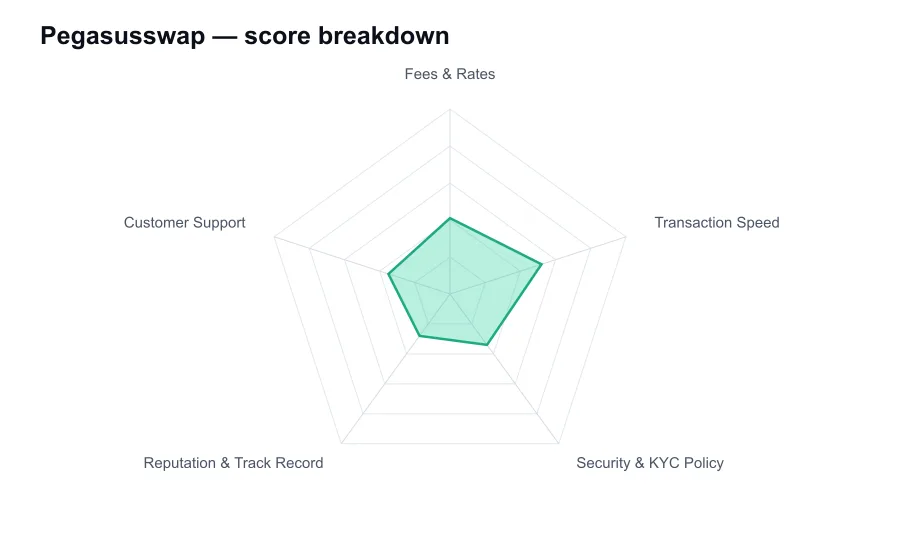
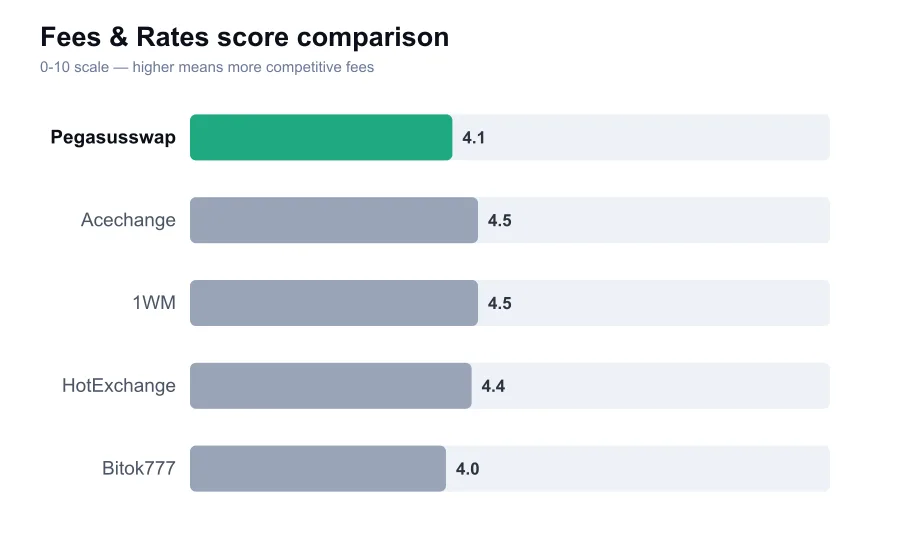
Fee transparency is where Pegasusswap needs to do better. With a conventional exchange, a maker and taker schedule gives customers a baseline. With an instant-swap service, the fee may be folded into the displayed exchange rate, network fee, and partner liquidity spread. That model is not inherently unfair, but customers need a clear before-and-after quote. If a platform cannot show the rate, the network charge, and the output amount in a comprehensible way, assume the conversion is expensive until proven otherwise.
I would not call Pegasusswap a destination for price-sensitive trading. Without demonstrably deep liquidity or a transparent fee table, there is no reason to expect it to beat major exchanges on a large BTC, ETH, USDT, or USDC order. Test a small transaction first and compare the expected output with a live quote from a reputable venue. A difference of a few dollars may be acceptable for convenience. A wide unexplained gap is not.
Speed claims should be treated carefully as well. Any swap involving on-chain deposits depends first on blockchain confirmations, then on the provider's liquidity and risk checks, then on the payout network. A quick service can complete a liquid transaction in minutes. Bitcoin deposits, congested Ethereum transfers, unusual token routes, and manual reviews can take much longer. No website can honestly guarantee the speed of a public blockchain.
A platform without an established public support record is difficult to judge until something goes wrong. That is the problem. Fast swaps are easy to praise because nobody needs support when the funds arrive. The test is a missing memo, an underpaid network fee, a delayed payout, or an address mistake. In those cases, customers need a traceable ticket, a responsive human, and clear transaction identifiers rather than a generic promise that support is available.
Security has two parts here. First is technical security: encrypted connections, account protection where accounts exist, proper wallet handling, and safe operational processes. Second is counterparty security: who is taking custody during the swap, where the business is registered, and whether there is an accountable legal entity. Pegasusswap's limited independently verifiable footprint makes the second part particularly hard to assess.
A no-account or low-friction flow can feel private, but it should not be confused with a guarantee of no compliance checks. Many instant exchangers reserve the right to request identity documents or source-of-funds information when risk systems trigger. If that happens after funds have been sent, a supposedly quick swap can become an uncomfortable verification process. Read the terms before depositing, not after a transaction is flagged.
I would also avoid treating a swap service as a wallet. Send in the exact amount needed for the exchange and receive to a wallet you control. Do not leave a balance on the platform, do not use it to park stablecoins, and do not make its address your regular receiving address. These are sensible habits on any exchange, but they become non-negotiable where public accountability is limited.
Reputation is the decisive weak point. Plenty of legitimate small providers begin with little public coverage, but trust is earned through years of visible operation, transparent leadership or company data, external reviews that can be examined critically, and consistent handling of complaints. Pegasusswap does not currently offer enough independently established evidence to stand beside mature providers. A polished interface is not a substitute for that record.
The absence of a widely documented hack or scandal is not the same as a strong safety record. It may simply mean the business has not handled enough public volume to generate scrutiny. Readers should be particularly skeptical of testimonials displayed only on a provider's own pages. Real customer feedback is messy, and a credible company should be willing to show its policies clearly enough that users do not have to infer basic protections.
For a tiny test swap, Pegasusswap may be workable if the live quote is transparent, the destination address is checked carefully, and the user accepts the counterparty risk. I would not use it for a first large purchase, a treasury conversion, or any transaction whose delay would create financial trouble. Those jobs belong with an exchange that has clearer compliance, a documented fee schedule, and a support team with a verifiable public history.
This is not a platform I can recommend enthusiastically on the available evidence. Its possible virtue is a simple, low-friction conversion path. Its problem is that the things sophisticated users need to know before trusting an intermediary, pricing, liquidity, legal accountability, and dispute handling, are not established to the same standard as larger competitors. In crypto, uncertainty is itself a cost.
My take is blunt: Pegasusswap has to prove more before it deserves serious balances. If you decide to try it, use a small amount, save every transaction ID and screenshot, and avoid obscure assets. Users who need reliability should pay a little more for an established exchange or a transparent non-custodial protocol. The market offers too many better-documented alternatives to make blind trust sensible.