1Mile belongs to the long tail of online exchange brands where the advertised service can be easy to understand while the business behind it is hard to evaluate. It is presented as an exchange option rather than a globally recognizable trading venue with deep markets, major licensing disclosures, and years of public reporting. That distinction should frame any decision to use it. A convenient conversion page is not proof of institutional strength.
The service may be encountered through exchange-rate listings, referral pages, or search results by people looking for a specific cash, bank, or crypto route. That is a normal acquisition model for smaller exchangers. It also means a user should independently verify the exact domain, current operating details, and order terms before sending funds. Brand names in this part of the market are often similar, and clone sites are a persistent problem.
I could not establish the kind of broad, independently verifiable operating record that would justify placing 1Mile alongside major exchanges. That does not automatically mean the service is dishonest. It means the burden of caution is higher. A platform with limited public documentation should be assessed as a counterparty for a single transaction, not as a trusted financial institution or a place to store digital assets.
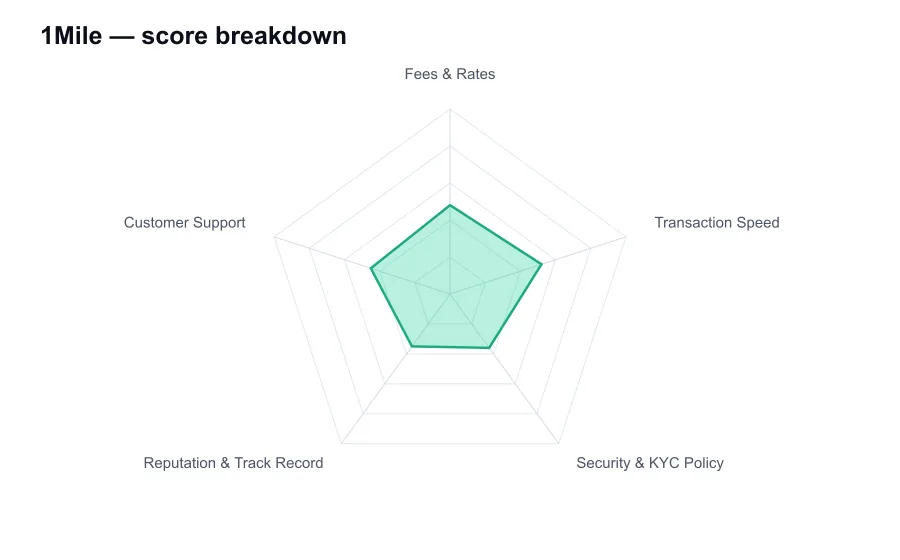
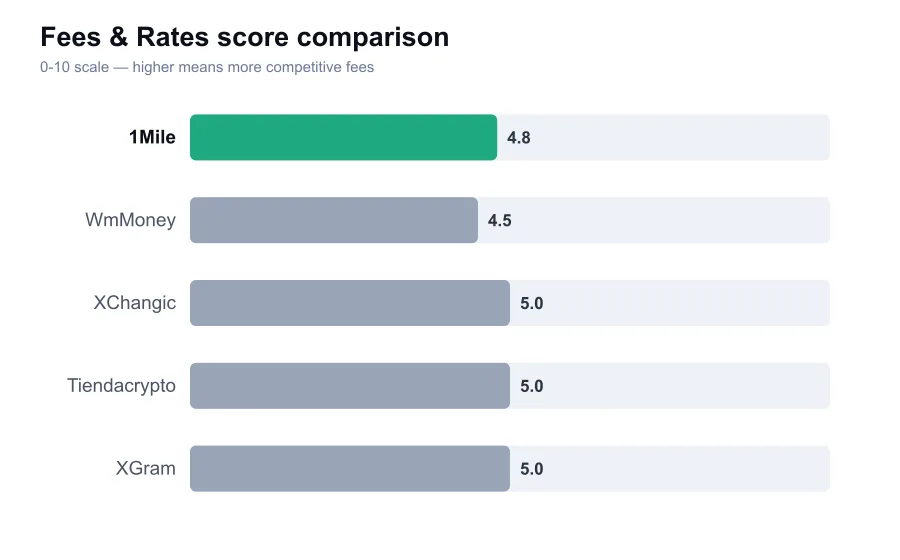
Fees are likely expressed through the exchange rate rather than a transparent maker and taker schedule. This is typical for manual and semi-automatic exchangers, but it complicates fair comparison. The only price that matters is the exact amount promised to the recipient address or payment account after every network cost, processor charge, and service margin. A page that highlights a favorable nominal rate can still produce a weak final payout.
Before opening an order, compare the received amount against more than one alternative and take a screenshot of the quote. Check the minimum and maximum limits as well. Some services offer an attractive rate for a narrow amount range, then apply a less favorable calculation when an incoming payment is short, late, or split into separate transfers. That is not unique to 1Mile, but it is a real operational hazard in this market segment.
Transaction speed is similarly dependent on the route, not merely on the word instant. A stablecoin transfer on a fast chain may be processed quickly after confirmation. Bitcoin, bank payments, card payments, and cash-like settlement methods create more variables. If the service needs an operator to check a payment, source a payout, or verify a beneficiary detail, the clock is no longer governed only by blockchain confirmation time.
A sensible customer treats the stated completion time as a target, not a guarantee. Do not schedule a same-day debt payment, margin top-up, or exchange withdrawal around a small exchanger's fastest advertised figure. Leave room for bank delays, blockchain congestion, and compliance review. If speed matters more than price, a large liquid exchange with direct withdrawals is usually the safer choice even if its published quote looks less exciting.
KYC claims deserve particularly close attention. Some exchange services do not require account registration for routine orders, yet keep contractual authority to request identity documents, a selfie, payment proof, or source-of-funds evidence. That is often described as anti-money-laundering compliance. The practical consequence is that an order can be paused after deposit if the operator's risk controls object to the payment or the wallet history.
This is not a good environment for customers who need certainty about privacy rules. Read the terms before transferring, especially provisions about frozen orders, refunds, and disputed payment details. If an identity request would be unacceptable, do not assume that skipping a registration form solves the issue. If a refund is needed, it may also depend on the service's review process and the payment rail used.
The security picture is hard to score generously without published technical detail, a well documented legal entity, or a substantial independent history. There may be ordinary safeguards behind the scenes, but a user cannot sensibly give credit for safeguards they cannot verify. Use a fresh receiving address where appropriate, secure your email and messaging accounts, and do not share seed phrases or remote-device access with anyone claiming to be support.
Public reviews are useful only if read with skepticism. A handful of positive comments tells you that some orders may have worked. It does not establish how the operator handles a difficult case, a high-value transaction, or an account flagged by a payment processor. Look for dated, detailed reports describing the same direction you plan to use. Vague five-star statements and copy-pasted praise should carry very little weight.
Support is likely order-centered, which is reasonable for a small exchange but limiting under pressure. Have the order ID, transaction hash, sending address, payment receipt, and timestamp ready before you contact anyone. A clear, factual message will get further than a stream of chat messages. Save the entire conversation. If the service cannot identify a transparent escalation process, that is another reason to keep the transaction size small.
For anyone determined to try 1Mile, a test transaction is not optional. Send the smallest practical amount, confirm that the exact payment direction works, then judge the net rate and elapsed time after completion. Do not treat one successful test as a reason to send a life-changing amount. Counterparty reliability can vary with liquidity, staffing, network conditions, and the specific payment method used.
My assessment is cautious rather than dismissive. 1Mile may be functional for a modest, carefully checked conversion, especially if it offers a route unavailable elsewhere. It has not earned the confidence needed for large balances, urgent transfers, or users who require strong consumer protections. The attraction is convenience. The cost of that convenience is a level of counterparty uncertainty that better known exchanges work much harder to reduce.