Goexme presents itself as a lightweight instant crypto exchange rather than a full trading venue. That distinction matters. It appears aimed at people who want to swap one asset for another without opening an account, learning an order book, or leaving coins parked with a centralized exchange. It occupies a crowded part of the market, alongside services such as ChangeNOW, SimpleSwap, and StealthEX, but it has nowhere near their public visibility.
The attraction is obvious enough. A visitor can select a pair, provide a receiving address, send funds, and wait for delivery. For an occasional conversion, that is less intimidating than signing up for Binance or Kraken. The problem is that convenience only has real value if the provider is transparent about the rate, liquidity source, operator, and support process. Goexme gives prospective customers less public material to work with than I would want before sending a meaningful amount.
Its advertised flow is generally non-custodial in the narrow sense that users send funds for a swap rather than maintain a long-term account balance. That reduces the risk of leaving a portfolio on a platform for months. It does not eliminate counterparty risk. During the exchange, the service controls the incoming funds and the customer depends on it to complete settlement. A non-custodial label should never be mistaken for a guarantee.
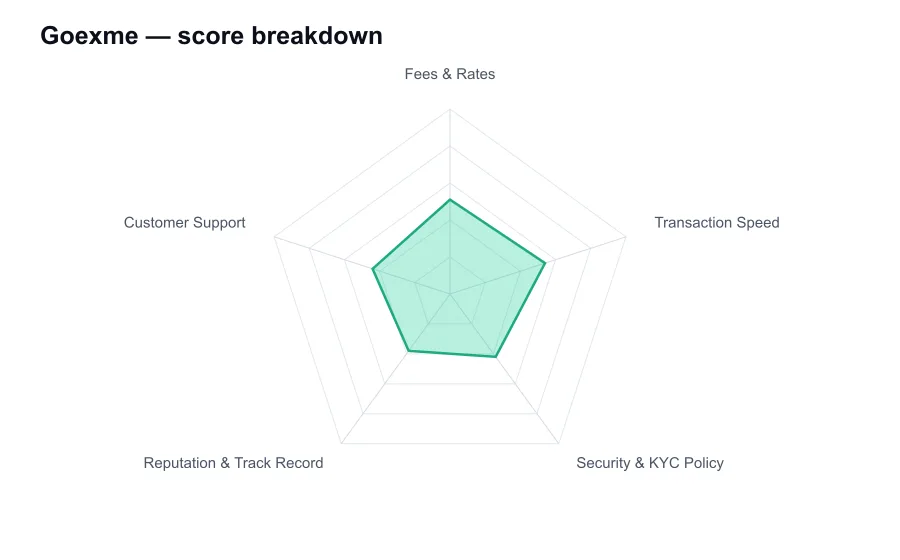
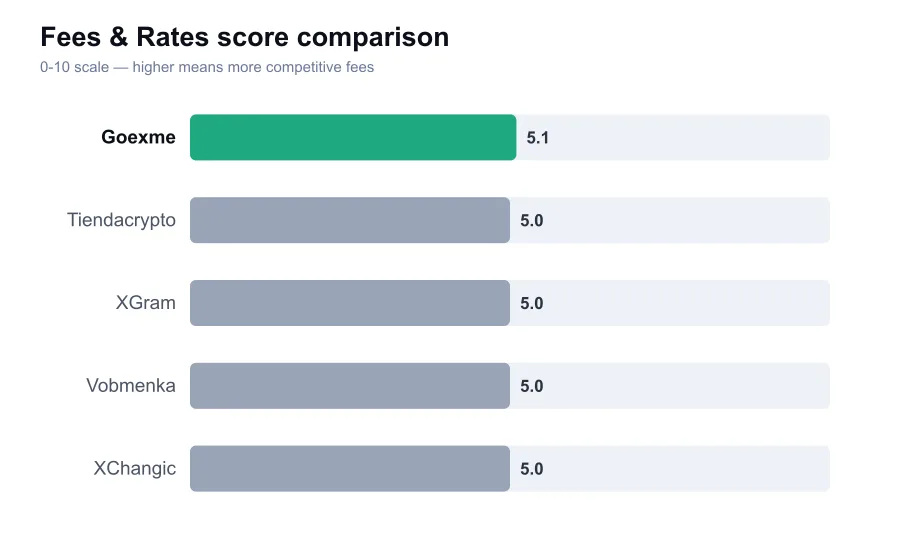
Fees are the difficult part to assess. Goexme does not have the kind of detailed, easily auditable fee schedule that serious exchange users expect. In instant-swap services, the quoted rate commonly includes a provider spread, network costs, and sometimes a liquidity-provider margin. That can be perfectly legitimate, but a customer should be able to distinguish those elements. Here, the practical test is comparing the final amount quoted against several alternatives immediately before sending.
That comparison is particularly important for Bitcoin, Ethereum, and stablecoin swaps. Network fees can be substantial in busy periods, but they do not explain every weak quote. A spread that looks trivial on a small test can become expensive on a four-figure transaction. Goexme may work acceptably for modest convenience swaps, yet it is not a platform I would choose for price-sensitive conversions or repeat trading without independently checking each quote.
Fixed-rate and floating-rate swaps also deserve attention. A floating quote can change between deposit and completion, especially on volatile pairs or thinly traded tokens. A fixed quote can offer more certainty, but only if the deposit arrives within the stated time and the service actually honors the terms. Customers should photograph or save the quote details, transaction ID, receiving address, and stated minimum before sending. That is basic self-protection, not paranoia.
Speed will depend far more on the assets involved than on the website's clean exchange form. A swap involving Litecoin or a fast stablecoin network may settle in minutes after the deposit confirms. Bitcoin and Ethereum transactions can take longer, and an exchange that needs to source a less liquid asset can add further delay. There is little independently documented evidence that Goexme consistently beats established instant-swap competitors on completion times.
The real concern is exception handling. Smooth swaps are easy for almost every provider. The revealing cases are deposits sent without a memo, under-minimum transfers, delayed confirmations, compliance reviews, or an output wallet that cannot receive a token. Goexme has a limited public track record of resolved edge cases. That does not prove poor service, but it means a user has less reason to assume a prompt recovery process if something goes wrong.
Its privacy proposition should also be read carefully. A service may permit a swap without routine account registration and still request identification for risk or anti-money-laundering checks. Most instant exchanges reserve that right. Anyone who needs predictable privacy should not assume that no initial sign-up means no KYC under any circumstances. Sending funds before understanding that policy creates the possibility of a transaction being paused at exactly the wrong time.
On security, the absence of a large, well-documented corporate footprint is a weakness. I look for clear ownership information, jurisdiction, security disclosures, external audits where relevant, transparent terms, and a history that can be checked beyond the provider's own site. Goexme does not inspire the same confidence as a regulated fiat exchange or a long-running swap service with substantial public feedback. That calls for caution rather than accusation.
Reputation is similarly thin. There is not a broad body of reliable third-party reporting, substantial community discussion, or years of verifiable operating history that would let me rank it with well-known names. A handful of positive comments or referral listings are not enough. Crypto users should be suspicious of rating pages that have no transaction evidence, no negative reviews, and no meaningful detail about support outcomes.
Support appears to be primarily online ticket or contact-based, which is standard for this type of service, but it is not the same as having a mature support operation. There is no convincing public case for assuming 24-hour human help, phone escalation, or rapid intervention during a stalled trade. Before using Goexme, I would test the contact channel with a simple question and judge the quality of the response.
For a first transaction, keep the amount small enough that a delay would be annoying rather than financially disruptive. Verify the destination chain, because similarly named tokens and unsupported network selections are common causes of loss. Do not use a rushed swap to meet an exchange deposit deadline, pay a merchant, or move funds during a volatile market. Those are situations where certainty matters more than a simple interface.
My view is blunt. Goexme may be usable for a small, straightforward conversion, but it has not earned the trust required for large transfers, urgent settlements, or users who need audited pricing and accountable support. The lack of deep public evidence is the central issue, not the design of the swap form. Established alternatives may charge a little more on some pairs, but they give customers more information with which to judge the risk.