Vobmenka is a regional online exchanger built around direct currency conversion rather than market trading. Its natural customer is not someone building a portfolio through limit orders. It is the person who needs to move value between crypto, electronic money, cards, or local banking channels with as little ceremony as possible. That can be genuinely useful, but the service should be approached as an exchange desk with counterparty risk, not as a bank substitute.
The interface model is familiar to anyone who has used an exchanger monitor. Choose the send and receive instruments, inspect the rate and reserve, enter details, then create an order. This is simpler than an exchange account, but it puts extra importance on the fine print. The rate, reserve, minimum amount, network selected for a stablecoin, and receiving details all need checking before you transfer funds.
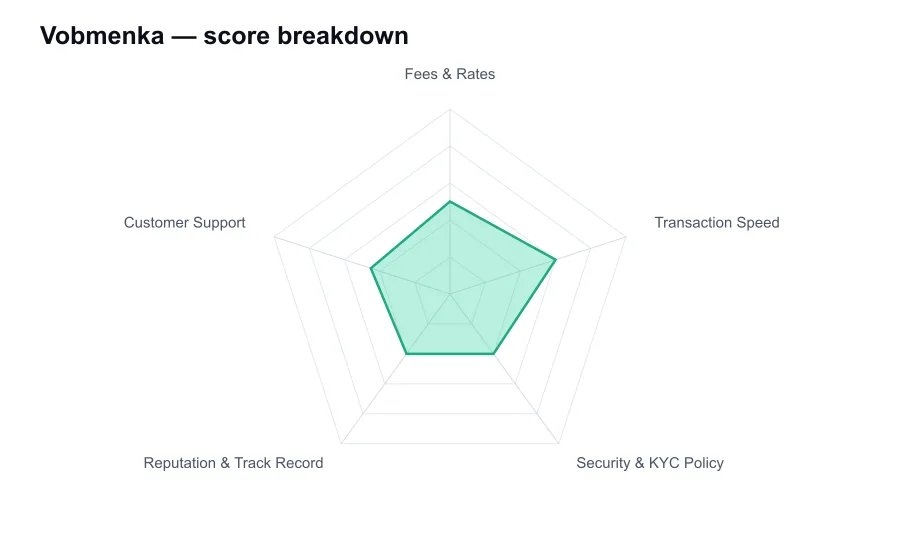
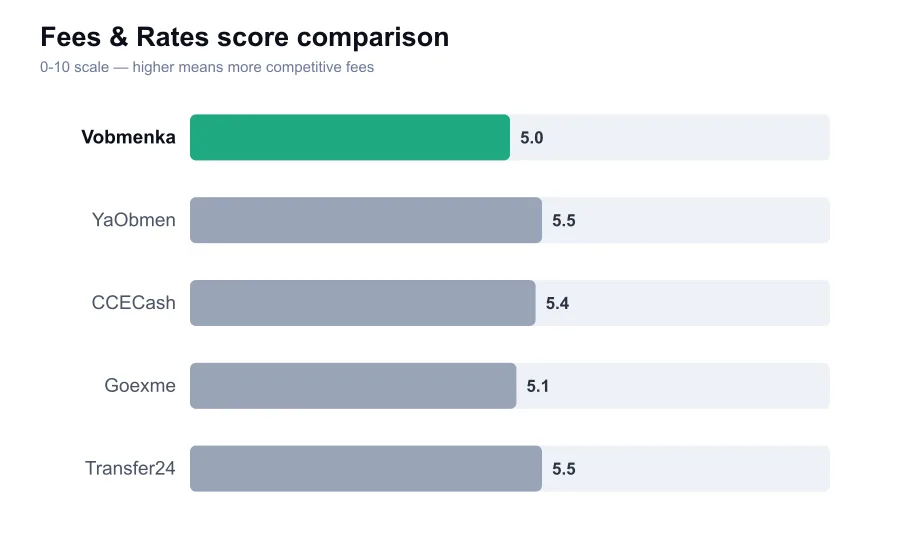
Vobmenka's pricing is likely to be most competitive in its busiest directions, where it has enough turnover and reserve to quote tightly. That does not mean it is automatically cheap. Exchange desks often embed their compensation in the displayed rate, sometimes alongside payment-provider charges or blockchain withdrawal costs. A customer who sees no line marked commission can still pay a meaningful all-in spread.
That pricing approach is not inherently deceptive. In fact, a final quote can be easier to understand than a complicated maker and taker table. The problem is that users sometimes compare only the headline rate and ignore what actually lands in their wallet or bank account. For a small conversion, convenience may justify the difference. For larger amounts, it is worth checking Vobmenka against several monitored competitors and a liquid exchange withdrawal route.
Execution speed depends heavily on the direction. A crypto transfer has to clear the relevant network. A card transaction can be delayed by the issuer. Electronic payment transfers may be near immediate if both sides are automated. Vobmenka can be a fast option for normal, supported routes, but no exchanger can guarantee instant completion once external banks, payment systems, or blockchain mempools enter the picture.
This matters most with USDT. Sending on the wrong network, such as choosing TRC20 when the order specifies ERC20, can turn a routine exchange into a recovery request that may not be possible. Network fees and confirmation times also differ sharply. The service may be quick, but it cannot correct a sender's routing error without a complicated manual process, if it can correct it at all.
The security picture is typical of a small exchange desk. The user does not need to maintain a large custodial balance, which is better than leaving funds unnecessarily on a poorly protected platform. Yet the order itself involves trust. You send first and rely on the operator, its reserves, its payment partners, and its internal controls. That is a different risk profile from a self-custody wallet or a highly regulated financial institution.
A no-friction onboarding experience should not be mistaken for a permanent no-KYC promise. Risk monitoring can lead an exchanger to request a passport, payment proof, wallet source information, or a video check. The policy may be especially relevant for large transfers, suspicious payment patterns, or sanctioned-risk exposure. If you cannot or will not provide documents, do not send funds until you have verified the current terms and limits.
Vobmenka's reputation is likely to be judged chiefly through exchanger-monitoring sites, regional review channels, and repeated user experience rather than extensive mainstream press coverage. That source material can be helpful, but it has limits. A large number of brief positive reviews tells you that some orders completed. It does not establish how a provider handles difficult cases, compliance holds, fraud claims, or a payment processor problem.
I would look for practical signs before trusting it with material money. Check whether the domain, support contacts, terms, and reserve information are consistent. Search for recent complaints rather than only old praise. Read how the service responds to criticism. Then make a small order in the exact direction you plan to use. This is a more useful due-diligence routine than relying on an attractive monitor badge.
Customer support is a decisive issue for this kind of provider because the transaction cannot be undone once crypto is broadcast. Vobmenka may offer online contact routes suitable for order-status questions, but a buyer should not assume instant, high-level support at every hour. Clear order documentation, payment receipts, and transaction IDs make it much easier for an agent to locate a problem and resolve it.
The service is not a compelling choice for an active trader. There are no deep order books, sophisticated charting tools, margin products, or strong reasons to route repeated spot trades through an exchanger spread. For that, a liquid platform such as WhiteBIT, Binance, or Kraken will normally provide clearer execution and more control. Vobmenka is about finishing a conversion, not optimizing a trading strategy.
It may fit users who need a supported payment combination that is inconvenient on major exchanges. It can also work for someone converting a modest crypto amount to a local payout method and willing to compare quotes carefully. The sensible transaction size is the amount you can verify and monitor comfortably. A service with limited public institutional disclosure should not be the first destination for a substantial, irreversible transfer.
My take is that Vobmenka belongs in the practical but cautious category. It may save time for the right local conversion and has the familiar simplicity people seek from an online exchanger. It does not have the market depth, regulatory visibility, or documented security posture that would justify blind trust. Use the service only after checking the live quote, payment details, and current verification rules, then keep the transaction purposefully small.