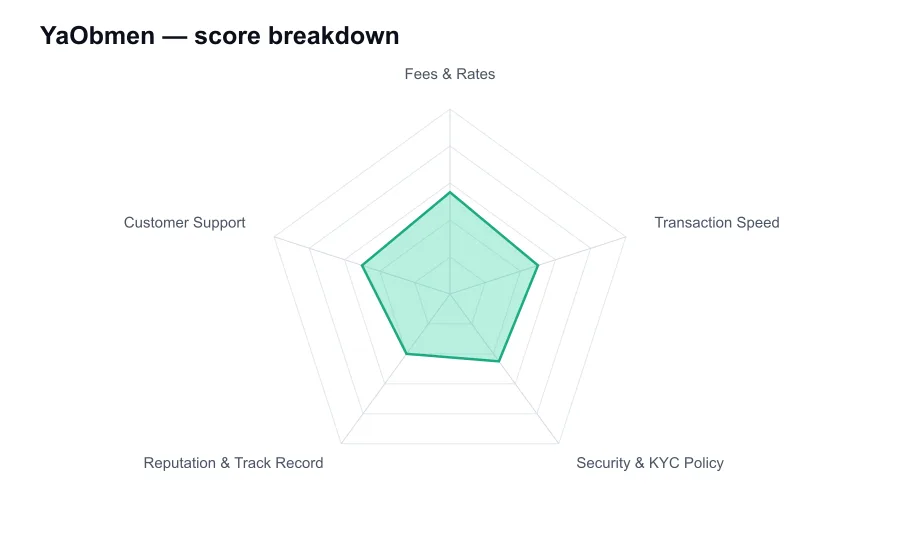
YaObmen is positioned as a direct online exchanger for users moving between cryptocurrencies and payment methods, rather than as a broad trading platform. The name is familiar in the style of regional exchange services, but familiarity of format should not be mistaken for the scale of a major financial institution. It is the kind of service that may solve a specific conversion problem neatly, yet demands more care from the customer than a heavily regulated global exchange.
That is not a criticism of the direct exchange model itself. Many people do not need margin markets, complex charts, or an account with dozens of assets. They need one conversion and a clear destination. YaObmen can be attractive if it supports the precise pair, card, wallet, or banking direction that a user needs. The sensible way to assess it is not by its layout, but by the final quote, current reputation signals, and quality of communication.
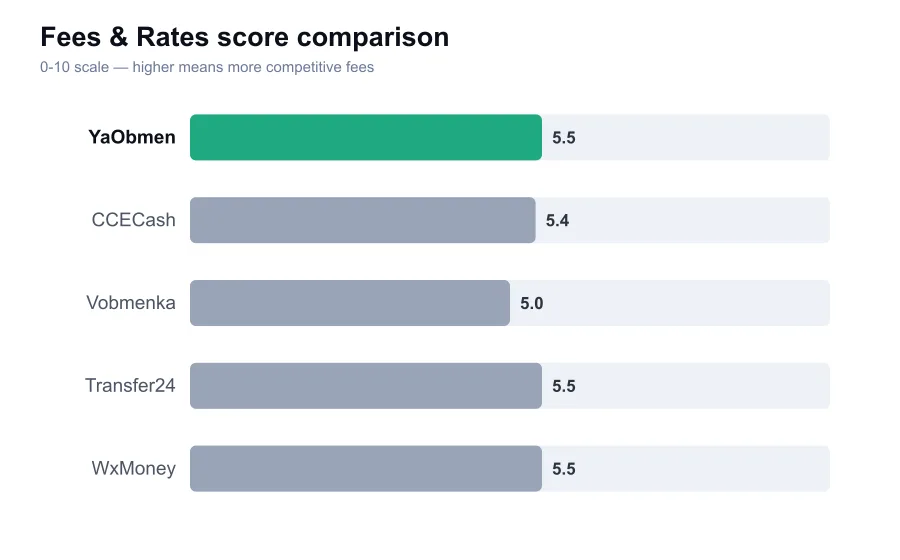
Fees at services like YaObmen are often blended into the exchange rate. This is why a clean looking promise of low commission tells only part of the story. Compare the exact amount you will receive against several alternatives at the same moment. Include withdrawal fees, blockchain fees, payment system charges, and the possibility that a floating rate changes before the exchanger releases the payout. The final number is the only number that pays your bill.
On common stablecoin directions, a modest spread may be a fair price for convenience. On less liquid coins and fiat routes, the provider has more room to build in a margin. That does not automatically mean the deal is poor, because manual handling and payment risk cost money. It does mean a user should not reward a service simply for hiding its fee inside a favorable sounding quote. Transparent arithmetic is better than marketing language.
Minimum and maximum order amounts deserve attention as well. A small order can suffer disproportionately from network costs, while a large request may exceed available reserve or require manual confirmation. Never assume a displayed calculator result means immediate capacity for a substantial payout. If the amount matters, contact support first and ask whether the direction and size can be completed under the advertised terms. Keep the answer for your records.
Speed will vary more than a website's generic processing promise suggests. A crypto deposit needs confirmations, and the number required can differ by asset. After that, YaObmen has to make the outgoing payment. On chain payouts are generally dependent on network conditions, while bank cards, transfers, and electronic wallets introduce their own queues and fraud checks. A transaction can be operationally complete at the exchanger but not yet visible to the recipient.
The fastest path is usually a correctly formatted, ordinary sized crypto order on a well supported network. Complications arise from underpayment, overpayment, a payment sent from another person's account, an omitted destination tag, or mismatched personal details. These are not exotic edge cases. They are routine reasons for manual review across this industry. If timing is critical, use a platform with a documented service level and a support channel you have already tested.
Security should be considered in terms of custody risk. During an order, YaObmen controls the funds it has received and the customer relies on it to send the payout. HTTPS and a password protected administrative panel are expected basics, not evidence of robust cold storage, independent audits, or segregated client assets. The public information available to an ordinary customer does not provide the same assurance offered by large exchanges that publish extensive security and compliance material.
For that reason, sending a large amount in one first transaction would be careless. Start with the smallest practical test that still verifies the exact route and payout method. Confirm that the amount received matches the order, then decide whether the convenience is worth using again. This process costs a little time and perhaps a little spread, but it is cheaper than discovering a support problem after placing a major order.
YaObmen's KYC approach should be understood as risk based, not as a binary label. Some orders may be created with little friction, yet financial crime checks, suspicious transaction screening, payment provider rules, or transaction size can generate a request for identification. A user should not interpret a minimal form as a promise that no documents will ever be required. Read the current policy and make sure your payment account is in your own name.
The difficult part of reviewing YaObmen is reputation. There may be user comments and exchange monitor references to inspect, but public volume and depth should be weighed honestly. An extensive, long running body of independently verifiable experience gives a customer more confidence than a modest collection of positive remarks. Look for recent reports about delayed orders and see whether the operator resolves them clearly. Silence or vague replies are more revealing than an isolated complaint.
A careful user also checks the exact domain and published order instructions at the moment of payment. Exchange brands are frequent targets for impersonation, especially through social channels and paid listings. Do not send funds to an address supplied in a direct message or accept an unexpected change to payment details. Open the order yourself from a trusted bookmark, then compare every character of the crypto address and every bank detail.
Support is the practical safety net. Before funding an order, ask about one detail that could affect your transaction, such as a network, a maximum, or rate recalculation. The answer should be direct and should not pressure you to send first. During a dispute, you will need the order ID, transaction hash, screenshots, and proof of payment. Keep communication in a written channel where the history can be preserved.
YaObmen may be useful for a small conversion if it offers the best live payout and shows solid current feedback from credible external sources. I would not elevate it above that role. It lacks the publicly demonstrated scale and transparency needed to make it a default choice for major funds or professional use. The correct posture is practical but guarded: test first, document everything, and choose a more established venue whenever the consequences of delay are serious.