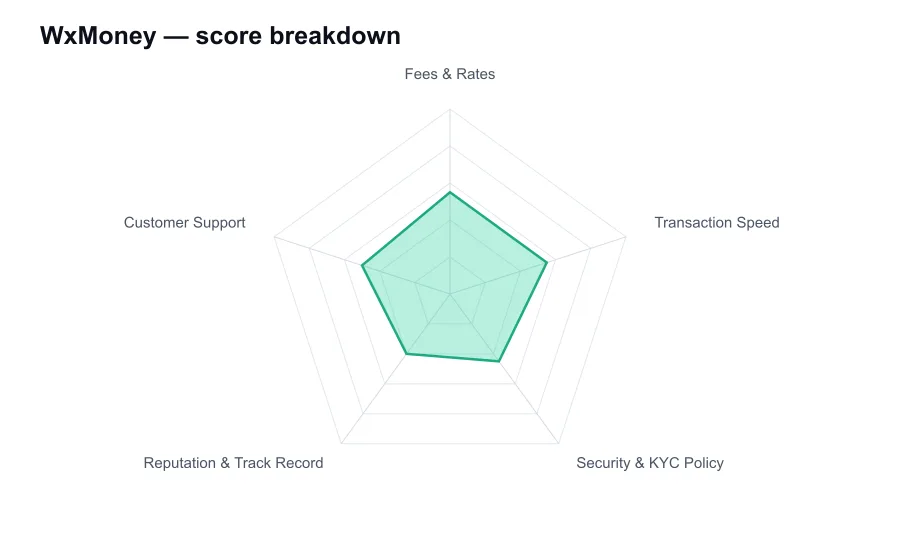
WxMoney appears to sit in the crowded Russian language instant exchange market, aimed at people who want to swap crypto, electronic money, or bank based payment methods without opening a full trading account. It is not a household name in the way BestChange regulars may recognize larger long running exchangers. That positioning matters. A small exchange can be quick and convenient, but the customer accepts more counterparty risk than they would at an established regulated platform.
The first thing a prospective user should understand is that WxMoney is an exchanger, not a conventional spot exchange with a public order book. You select a direction, enter payment details, send funds, and wait for an operator or automated process to complete the payout. That can be a perfectly sensible model for a one off conversion. It is a poor fit for active traders looking for charting, limit orders, deep liquidity, or a transparent matching engine.
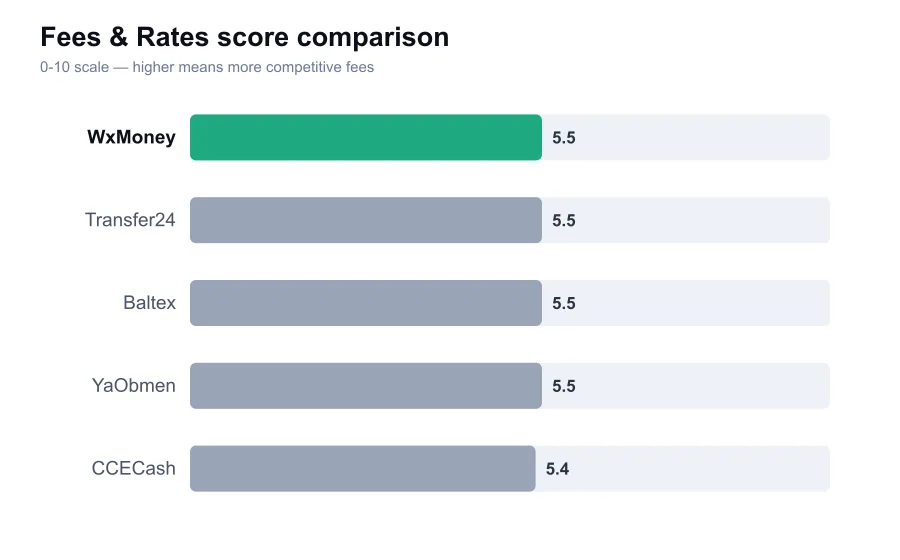
Its rates should be read as an all in quote rather than judged by a headline commission. Like many exchangers in this segment, the displayed amount normally embeds a spread between the market rate and the rate offered to the customer. Network costs, payment processor risk, reserve levels, and manual handling can all be reflected in that number. A seemingly fee free swap can still be expensive if the execution rate is weak.
That does not make WxMoney unusually bad. It does mean that a user should compare the final receive amount with at least two alternatives immediately before paying. The gap can be minor on liquid routes such as USDT to a common card transfer, then become meaningful on smaller coins, less common banks, or directions involving electronic wallets. The exchange rate is the fee that matters here, and it changes faster than any static fee table.
Small transfers are where the economics can look least appealing. A blockchain withdrawal fee or a fixed operational charge takes a larger percentage from a modest transaction, while card and wallet payouts may carry their own cost inside the quote. For a larger exchange, comparing the received amount across several services is not optional. A rate that is only one or two percent worse than a rival becomes real money on a sizeable order.
Speed is one of the reasons users consider services like this in the first place. A straightforward crypto transaction can be processed after the required network confirmations, and many bank or wallet directions are intended to be handled within the same day. That is the optimistic case, not a guaranteed service level. The speed of the blockchain, the destination payment rail, reserve availability, and whether a transfer triggers review all matter.
I would not send money to WxMoney with a deadline measured in minutes. Bitcoin and Ethereum congestion can delay the point at which an exchanger considers a deposit final, while card and bank payments may be checked manually. A transaction can also be paused because the amount sent differs from the order, the memo is missing, or the customer uses a third party payment account. Fast exchange interfaces often hide these practical bottlenecks.
The security question is where a lesser known exchanger deserves tougher scrutiny. The service holds the customer's funds during the swap, so the user is relying on its wallets, operational controls, and staff integrity. Publicly visible claims about SSL, protected forms, or automated processing are basic hygiene, not proof of strong custody. There is limited independent evidence available to put WxMoney in the same trust category as a major exchange with audited reserves and a long public operating history.
KYC should also be treated realistically. Many exchangers market straightforward exchanges and may not request identity documents for every order. That is not a promise of permanent anonymity. Suspicious activity controls, payment provider requirements, sanctions screening, or a compliance flag can lead to document requests and a paused transaction. Anyone who cannot tolerate that possibility should not send a large amount, regardless of what an initial form seems to imply.
Privacy minded customers should avoid supplying more data than the chosen payment direction actually requires, but they should not mistake minimal registration for zero data collection. Bank transfers and card payments already create records outside the exchanger. Crypto addresses can be screened. A responsible user keeps screenshots of the order, transaction ID, payment receipt, and any correspondence, especially if the destination is a bank card or account held by another party.
WxMoney's reputation is difficult to assess with the confidence that comes from years of broad, independently documented user feedback. A few favorable comments, monitoring site listings, or an attractive website do not establish how a provider behaves when an order is delayed or disputed. The important evidence is sustained public history, clear terms, responsive complaint handling, and a pattern of completed orders. The available picture is thinner than I would want for a large transfer.
That does not mean every small exchanger is unsafe. Plenty of them serve repeat local customers and process routine orders without drama. But the burden of proof stays with the provider, not the buyer. Before using WxMoney, check current monitoring site feedback, look for recent complaints rather than just aggregate ratings, confirm the domain carefully, and begin with an amount you can afford to have tied up while a dispute is resolved.
Support is likely adequate for ordinary order questions if the listed contact channels are staffed, but the true test is an exception: a delayed payout, an incorrect amount, or a compliance request. In those moments, a generic chat button is not enough. A good exchanger gives a ticket number, explains what is needed, and follows through. I would want written confirmation of any changed payment instructions rather than relying on a message that could be impersonated.
For a small, routine conversion, WxMoney may be useful if its live quote is genuinely competitive and current third party feedback is clean. I would not choose it as a primary venue for savings, recurring high value conversions, or a time critical payment. The lack of a deeply established public track record outweighs any convenience gained from a simple form. Test carefully, compare rates at checkout, and keep the first order deliberately small.