BTC2Pay presents itself less like a conventional retail exchange and more like a crypto payment and swapping service for people who want a direct transaction without opening a trading account. That positioning has appeal. It avoids the clutter of advanced exchange screens, order books, perpetual contracts, and all the distractions that come with a major platform such as Binance or OKX. The tradeoff is equally clear, BTC2Pay is a smaller operation with a much lighter public footprint than the market leaders.
The site is built around straightforward asset conversion and payment-oriented use cases. A user chooses a pair, enters a destination address, sends funds, and waits for settlement. That is familiar territory for anyone who has used a non-custodial instant exchange. It can be easier for a first-time swap than navigating a centralized exchange, particularly if the user already holds crypto in a wallet and simply needs to change one asset into another.
BTC2Pay's real advantage is convenience, not price discovery. There is no meaningful trading environment here and no reason to expect exchange-grade liquidity or sophisticated execution tools. People looking to buy and hold, move stablecoins, or make an occasional coin-to-coin conversion may find the stripped-down flow useful. Active traders should not. They need transparent books, limit orders, reliable API access, and a public execution history.
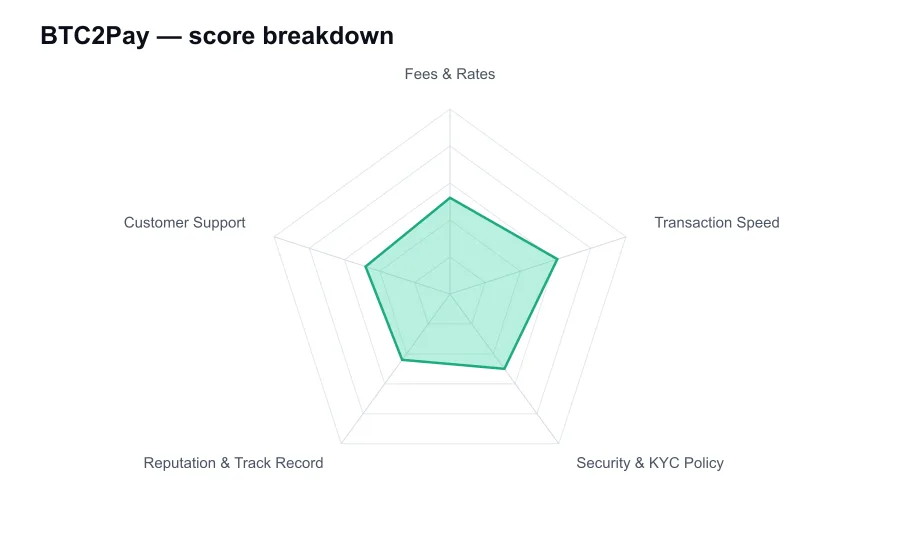
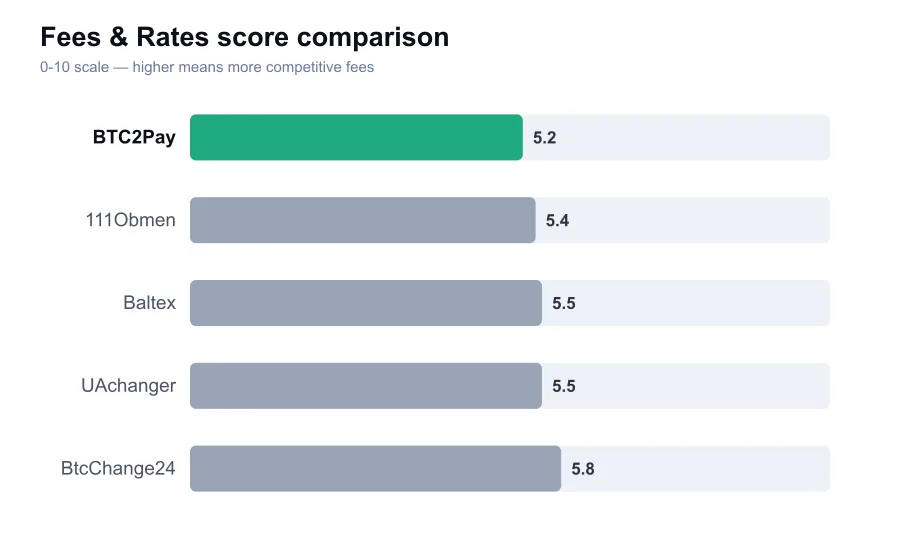
Fees are the first area where I would slow down. BTC2Pay does not have the sort of prominently documented, all-purpose fee table that users can compare line by line against Kraken, Coinbase Advanced, or a large fixed-rate swap desk. The cost is generally reflected in the quoted conversion amount, network fee assumptions, and the spread available from its liquidity sources. That does not automatically mean the service is expensive, but it makes price comparison a job the customer has to do before sending money.
A sensible test is to quote the same modest swap at BTC2Pay, ChangeNOW, SimpleSwap, and a major exchange where the pair is listed. Do it at the same moment, then compare the final amount received, not the attractive headline rate. Small swaps can look inexpensive until the network charge and spread are included. On less liquid coins, the difference can be substantial. Users should also watch whether a displayed rate is floating or fixed, because those are fundamentally different products in a fast market.
For mainstream chains, transaction speed is normally dictated by blockchain confirmations and the liquidity route rather than by the time it takes to fill in the form. A Bitcoin conversion can take materially longer than a USDT transfer on Tron or a swap involving an EVM chain with normal network conditions. BTC2Pay's process is simple enough that there should be little platform-side delay after the deposit is recognized, but no instant exchange can make a congested source chain settle instantly.
The weak spot is visibility during exceptions. With a large exchange, users can often see deposit confirmations, internal ledger movements, trade fills, and withdrawal status separately. Smaller swap services tend to provide a transaction page and an order identifier, which is useful but not nearly as diagnostic when something stalls. If a deposit is sent with too little gas, from the wrong network, or with an incorrect memo, the customer may need support intervention rather than a self-service fix.
BTC2Pay's non-custodial style is preferable to leaving a balance on an unfamiliar exchange. Funds are sent for a specific conversion and then delivered to the user's chosen wallet, rather than being parked indefinitely in a trading account. That reduces one category of risk. It does not eliminate risk, because the service still temporarily controls the deposit during processing and users remain exposed to operational mistakes, address errors, liquidity partners, and any compliance review triggered by a transaction.
The KYC question deserves plain language. A no-account or low-friction front end should never be mistaken for a guarantee that no verification will be requested. Crypto services may screen deposits for sanctions, fraud indicators, stolen-fund exposure, or other compliance signals. If a transfer is flagged, a provider can ask for identification or information about source of funds. Anyone who cannot tolerate that possibility should not use a third-party swap service at all, regardless of the marketing around privacy.
I also would not confuse limited public complaints with a long-established reputation. BTC2Pay does not have the broad independently documented history, deep regulatory disclosure, or years of public security reporting that support confidence in top-tier exchanges. That does not prove misconduct. It means the burden shifts to the user to keep transaction sizes modest, verify every address, and avoid treating the service as a vault. In crypto, an absence of evidence is not a substitute for a track record.
Customer support matters most when the normal path has failed, and this is where small providers are often hard to judge. A contact form, email channel, or messenger link can handle a basic order question. It is less reassuring than round-the-clock live support with published escalation procedures, ticket references, and a documented dispute process. Before sending a significant sum, I would test the support channel with a specific pre-sale question and see whether the reply addresses the detail rather than sending a generic script.
The service is better suited to a user who understands wallet security already. Check the destination address character by character, make sure the selected network matches at both ends, and start with a small amount if the asset or route is unfamiliar. Save the order page, transaction hash, and quoted payout. Those simple precautions make a support case far easier if the transaction needs manual attention.
BTC2Pay does not compete with regulated exchanges on transparency, nor does it need to for every use case. It competes with quick-swap services where convenience, a direct wallet-to-wallet flow, and a relatively uncomplicated interface matter more than a full trading terminal. That can be a legitimate niche. Still, it is a niche where users should be more demanding about the final quote and less trusting of promotional claims.
My view is guarded rather than hostile. BTC2Pay may work adequately for small, routine conversions by experienced self-custody users, especially where the quoted payout is competitive. I would not use it as a primary platform, store funds there, or make it my first choice for a large transaction without a successful smaller test. The lack of easily comparable fee disclosure and the limited public track record keep it well below established exchanges for serious money.