Transfer24 belongs to the crowded category of smaller crypto transfer and exchange services that promise a quick route between assets or payment methods. The name itself suggests speed and availability, but a brand name is not evidence of either. In this part of the market, customers must separate the interface from the operating business behind it. A smooth quote screen does not tell you who holds funds, how disputes are handled or whether a transaction can be traced if something goes wrong.
Unlike a major spot exchange, a service of this type may function as a broker, swap desk, payment intermediary or a combination of all three. Those models carry different risks. A non-custodial swap service might route an incoming coin deposit to a liquidity partner. A custodial broker may accept fiat or crypto first and send the final asset later. Transfer24 should make that distinction explicit before a user is asked to transfer anything.
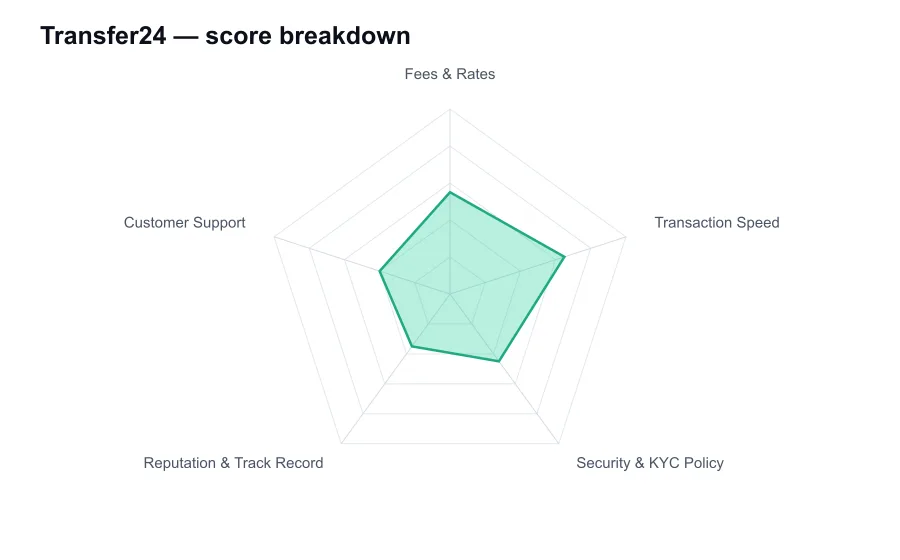
The most important finding from a critical review is that Transfer24 does not have the widely documented public footprint of established global names. I would not treat that absence as proof of bad faith, but it prevents a high reputation rating. There is a huge difference between a company that is merely new and one that is difficult to identify, difficult to contact and difficult to evaluate after a problem. Users need to establish where Transfer24 falls before committing money.
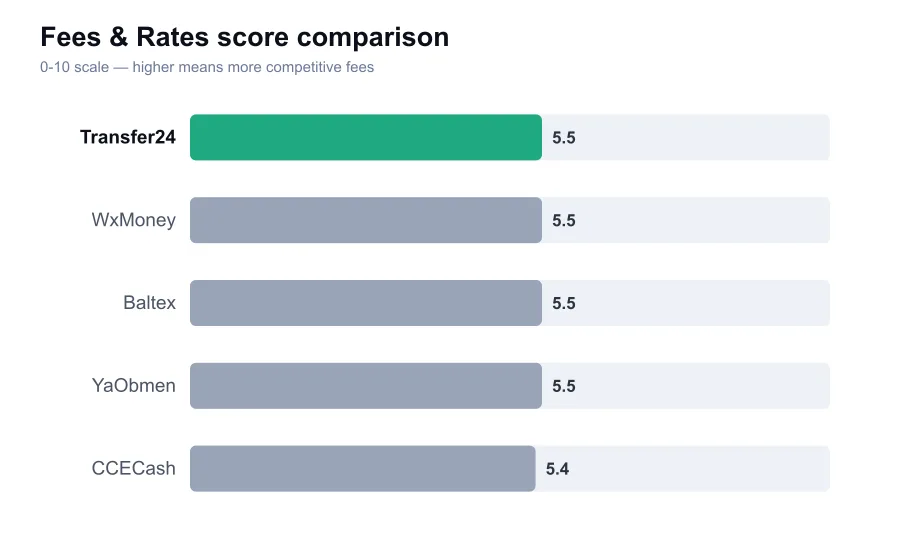
Fees are a likely pressure point. Smaller conversion services commonly make their margin through the quoted rate rather than a clearly separated trading commission. That can be convenient for a customer who only wants a final price, but it makes apples-to-apples comparisons harder. The relevant calculation is simple: how much value leaves your wallet or bank account, and how much arrives at the other end after every charge? Anything else is marketing.
If Transfer24 presents a fixed rate, read the conditions carefully. Fixed-rate swaps can protect against market movement for a short window, but they often require an exact deposit amount and can have limits on what happens if the amount is wrong or late. Floating-rate swaps may execute with less friction, yet the final amount can change while confirmations arrive. Neither method is automatically cheaper. A quote should always identify which one you are accepting.
I would compare any Transfer24 quote with a liquid exchange, a non-custodial aggregator and at least one established instant-swap service before proceeding. For major pairs, the difference can be surprisingly large. A 1 percent or 2 percent hidden spread sounds modest, but it is costly if repeated. On smaller tokens or awkward network combinations, the spread can be much larger because liquidity is genuinely thin.
Speed is impossible to judge solely from an advertised 24-hour name or support claim. It depends on blockchain confirmations, payment verification, liquidity availability and whether the transaction triggers compliance review. Crypto-only swaps can finish in minutes if they are automated and the route is liquid. Fiat-related transactions may take much longer. A provider should give an estimated time, then provide an order identifier and transaction hash once the outgoing transfer is broadcast.
A good operational sign is a status page that distinguishes between waiting for deposit, confirming, exchanging and sending. A bad sign is vague language saying that the transfer is being processed with no traceable evidence. Users should save the deposit address, amount, timestamp, order ID and source-chain hash. Those details are what support needs, and they are also necessary if you must independently trace the deposit on a block explorer.
Security is not only about whether the site has HTTPS and a padlock icon. It is about the custody path, the legal entity, account protection, how the company handles address changes, and whether it publishes meaningful security practices. Transfer24 does not offer the kind of long-standing, independently scrutinized security record that would let me recommend it for large transfers without reservation. That should inform the size of any transaction.
KYC is another point that should be clarified before a deposit. Many instant exchange services advertise simple access but reserve the right to request identification under risk controls or partner policies. That can be legitimate. The problem starts if the rule is opaque, or if the customer cannot see what documents are required, how long review normally takes and what happens to an uncompleted order. Never assume a service is permanently no-KYC because the first screen did not request documents.
The safest approach is to use a newly verified official web address, avoid sponsored impersonator links, and send a small test first. Do not accept a payment address through an unsolicited message. If a service uses a destination tag, memo or payment reference, copy it exactly. Crypto transfers are unforgiving, and a support team may be unable to recover a deposit sent on the wrong network even if the business itself is legitimate.
Support is where smaller providers can either distinguish themselves or lose trust quickly. A real support channel should answer precise questions about rate type, limits, KYC triggers and transaction tracking. It should not rush a customer into sending funds. I would give more credit if Transfer24 offers a documented ticket process and published service terms than if it relies exclusively on chat apps or social messages.
There is a place for smaller services that solve a narrow payment or conversion problem better than a huge exchange can. They can be faster to navigate and less intimidating for a one-time transaction. But that benefit is narrow. It does not justify leaving funds on platform, paying an unexplained premium or accepting a vague answer about who operates the service.
Transfer24 is best approached as a possible transaction tool, not a financial home. Start with an amount you can afford to have delayed while support investigates. Judge it by the final rate, the quality of transaction records and whether its terms remain consistent when a question becomes inconvenient. Until it establishes a fuller independent record, that is the only responsible way to use it.
My take is firmer than the promotional language common in this sector. A fast crypto transfer is only good if it is traceable, fairly priced and backed by a reachable operator. Transfer24 may be serviceable for a small, carefully checked swap, but its limited public reputation makes it unsuitable for significant balances or urgent high-value settlements. Better-known exchanges and established swap aggregators remain the safer default for most people.