CCECash belongs to the older school of online currency exchangers, where the service is built around individual exchange directions rather than an exchange account and live market screen. That style remains useful for users who need a particular payment route, but it is also a market where caution matters more than branding. The difference between a smooth order and a frustrating one can come down to reserve levels, payment instructions, and whether the route needs manual confirmation.
It should not be evaluated as though it were Coinbase, Bitstamp, or Kraken. Those companies are account-based exchanges with published market infrastructure and large compliance operations. CCECash is closer to a transaction desk. The customer arrives with one currency or payment method, accepts a quoted payout, and relies on the exchanger to complete the other side. That is a perfectly valid service model, but it carries different risks and gives the customer fewer tools if something goes wrong.
The strongest reason to use CCECash is usually route availability. A user may find that a niche e-currency, a regional bank transfer option, or a familiar digital payment method is not conveniently served by large exchanges. In that situation, a specialist exchanger can be more practical than moving funds through several platforms. The crucial question is not whether the site lists a direction. It is whether that direction has enough reserve, a realistic minimum and maximum, and terms the customer can actually meet.
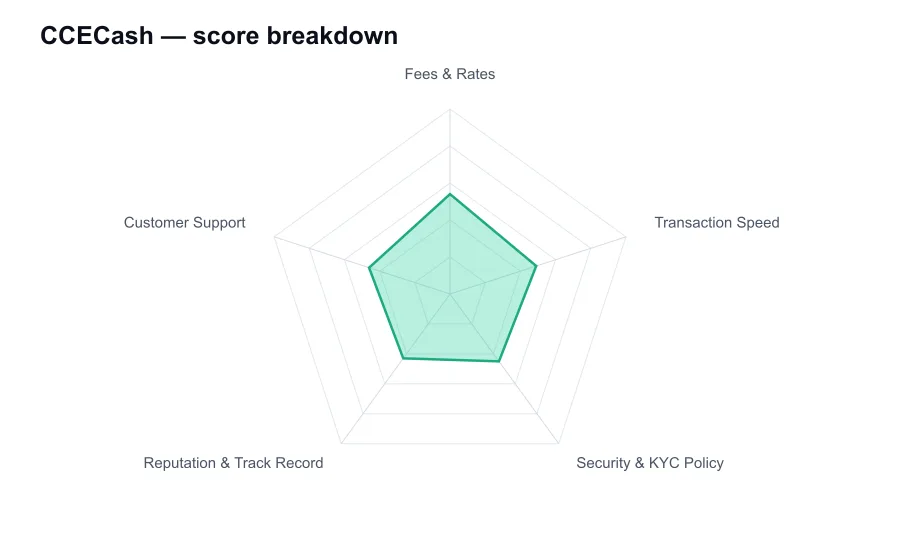
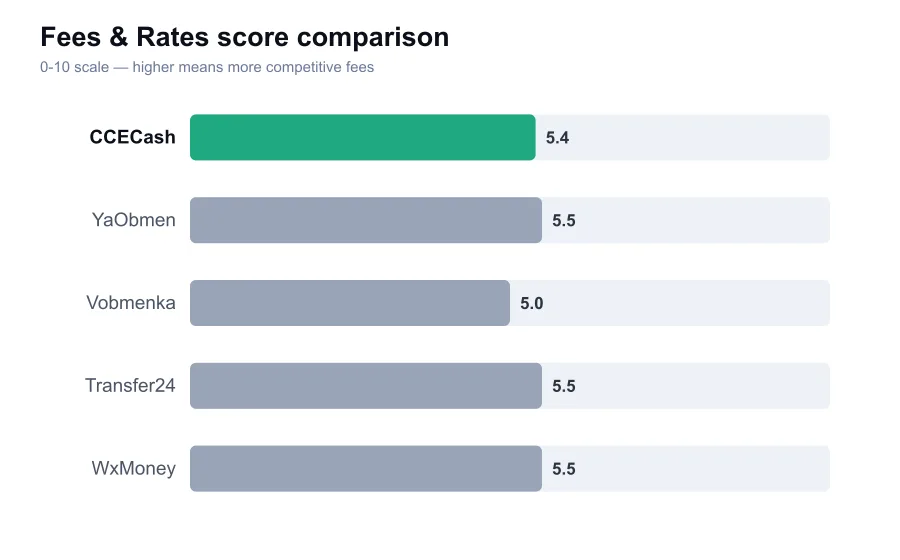
Pricing should be treated as an all-in quote. CCECash does not operate on the simple visible trading commission model that users see on exchange order books. Its effective cost is incorporated in the rate, plus any stated network or payment-system charge. This can be fair for a difficult route, but it means a customer must calculate carefully. The amount received is the only number that matters after every deduction and conversion spread has been accounted for.
I would be particularly wary of comparing a CCECash quote with the spot price of Bitcoin or USDT and deciding it looks expensive or cheap from that alone. The service may be solving a payment conversion problem, not merely selling crypto. Compare another exchanger that supports the same exact rails, then compare the time, conditions, and final amount. A slightly worse rate may be tolerable if it has clearer instructions and a better history of handling the chosen payment method. A dramatically better rate is a reason for extra scrutiny, not celebration.
Transaction speed is similarly route-specific. A crypto deposit may be recognized after required confirmations, while a bank transfer can wait on banking systems, manual review, or local business hours. Electronic payment systems can appear instant but still be held for anti-fraud checks. CCECash should therefore not be used for an emergency payment where a missed deadline would be expensive. In this segment, a promised processing window is an estimate, not the same thing as a guaranteed settlement service.
A practical user will check the receiving instructions before sending anything. Exact amounts, account names, reference notes, network choices, and wallet tags can all matter. If CCECash asks for a payment reference, use it exactly. If the service gives a time limit, do not create an order and fund it hours later after the market has moved. Many complaints around exchangers are not scams or platform failures, they are disputes created by a customer sending a mismatched amount or using the wrong network.
CCECash's security profile should be viewed through the lens of temporary custody. The service does not need to hold an ongoing trading balance to process a transaction, which is better than leaving funds sitting in an obscure account. Yet the customer still gives it control of an incoming payment until the payout is made. That means the sensible rule is simple, only send money you can afford to have delayed, and never use an unfamiliar exchanger as a storage solution.
No-account exchange services can also create false confidence around anonymity. Depending on the route, transaction size, payment provider, and risk checks, CCECash may need additional information. This can include identification, proof of payment, or information supporting the source of funds. Users should read the terms before ordering, because a verification request after a transfer has already been sent is the worst time to discover that the route is not suitable for their circumstances.
The public reputation of a small exchanger is rarely as clean or as comprehensive as customers would like. Review monitor listings and user comments may offer useful leads, but they are not equivalent to audited financial reporting or a regulator's supervision. Look for consistency across time rather than a pile of recent five-star remarks. Pay attention to whether negative reviewers describe a provider responding with order-specific evidence, because that says more than a generic reassurance from either side.
Support is where CCECash will earn or lose a customer's trust. A normal order needs very little communication. A delayed bank payment, an incorrectly sent cryptocurrency, or a disputed rate requires a real human who can identify the order and explain the next step. The service may have contact channels available, but users should not assume immediate live support comparable to a large exchange. Keep communication factual, provide the order number and transaction proof, and avoid sending sensitive documents through unofficial social accounts.
There is also a basic operational discipline that many customers skip. Confirm the domain independently, bookmark it after verifying it, and return through the bookmark rather than sponsored search results or unsolicited messages. Do not let a supposed support representative change the destination wallet outside the official order page. Crypto payment fraud often succeeds because people are rushed, and an exchanger workflow can make a last-minute change sound plausible.
CCECash can be useful if the customer has a particular route that it handles well and if the quote remains competitive after comparison. That is a narrower recommendation than an endorsement of the service for every crypto need. It is not a destination for trading, yield products, long-term custody, or large institutional movement. It is a transactional tool, and it should be used with transactional caution.
My final take is that CCECash deserves neither reflexive dismissal nor blind confidence. The exchanger model fills real gaps, especially beyond the polished world of major crypto platforms. But the lack of exchange-level transparency, the variable pace of payment routes, and the possibility of manual compliance review make it a poor fit for large or time-critical transfers. Start small, document everything, and choose it only when the exact route gives it a genuine practical advantage.