Tiendacrypto appears to operate in the smaller retail crypto-provider segment rather than the global exchange league occupied by Coinbase, Kraken or Bitstamp. That distinction matters. A small provider can still be useful, especially for local payment methods or a personal service model, but it should be judged by a stricter standard of transparency. With little widely available independent information, I would approach it as a local counterparty, not as a major exchange with decades of public scrutiny.
The first question a potential customer should ask is very basic: what exactly is being bought or sold, and who is taking custody at each step? Some services branded around crypto sales act more like brokers or OTC desks than exchanges. That can be perfectly legitimate, but it changes the risk. A broker may quote a final price and settle manually, whereas an exchange normally exposes market depth, trading fees, withdrawal rules and account controls more clearly.
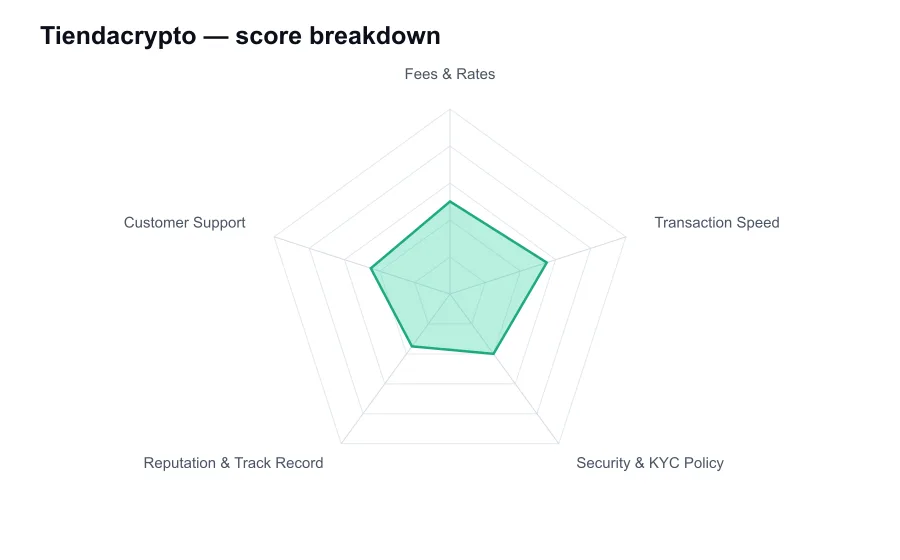
Tiendacrypto's public footprint does not provide the level of documentation I would want before treating it as a primary platform. A serious provider should plainly identify its legal operator, jurisdiction, customer terms, fee schedule, supported payment rails, complaint process and custody arrangements. If any of those details are absent, difficult to find, or only supplied in private messages, that is a weakness rather than a charming small-business trait.
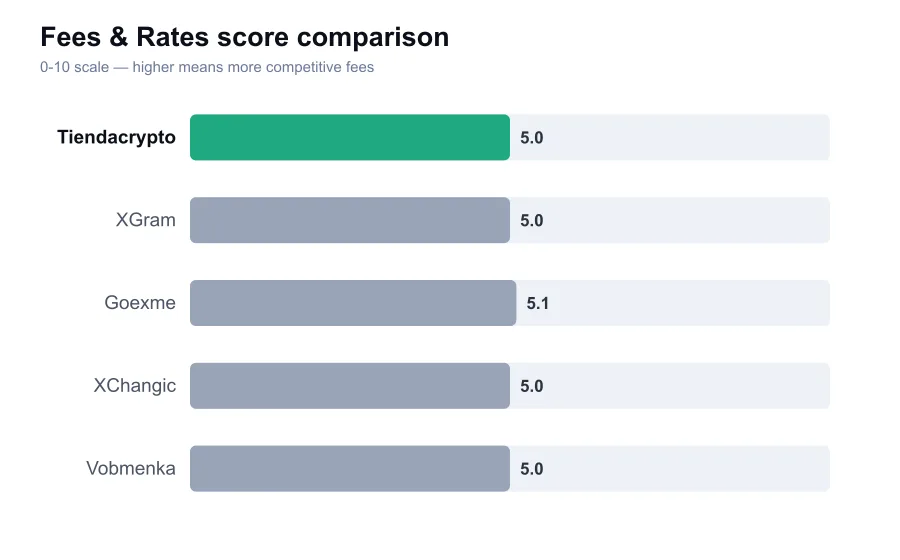
Fees are particularly difficult to score generously where a provider does not publish a comprehensive rate card. The relevant cost may not be labeled a fee at all. It can be embedded in the buy quote, the sell quote, the payment-provider charge or the withdrawal amount. A customer comparing only the displayed bitcoin price can easily miss a large spread. That is why I would ask for the exact amount of crypto to be delivered, or the exact fiat payout, before sending money.
For a local cash or bank-transfer broker, a spread is not automatically unreasonable. Human handling, payment risk and lower volume cost money. But the spread has to be visible enough to judge. If Tiendacrypto offers a quote materially worse than a liquid exchange after accounting for local transfer costs, convenience is not a sufficient defense. A one-off emergency purchase is one thing. Repeatedly paying an opaque premium is another.
Speed depends largely on its operating model and the payment method selected. Card payments can be fast from the buyer's point of view, but manual review or fraud controls may delay delivery. Bank transfers can be quick during local business hours and slow outside them. Crypto withdrawals should be trackable with a transaction ID once sent. A provider that says a transfer is complete but cannot supply a hash has not provided the evidence a customer needs.
I would not expect the automation or round-the-clock execution of a large exchange. That is not necessarily a deal breaker for a customer who wants help with a straightforward purchase. It does mean that promises about instant service should be read carefully. Instant payment confirmation and actual on-chain delivery are different events. Bitcoin, Ethereum and stablecoin transfers also have their own confirmation times after a withdrawal has been broadcast.
Security is the area where thin public disclosure becomes most uncomfortable. Customers need to know whether crypto is delivered immediately to a personal wallet, held by the provider, or retained with a third-party custodian. Immediate self-custody delivery limits platform exposure, but it also places responsibility squarely on the buyer. Held balances require stronger evidence of access controls, segregation, reserves and withdrawal procedures.
KYC may be required depending on country, payment method and transaction size. A legitimate provider should state this before it accepts a payment, not introduce an identity-document demand after the customer is already committed. The same goes for source-of-funds checks. Compliance checks can be necessary, but surprise verification creates exactly the disputes that damage a small provider's reputation.
Reputation is not just a star rating or a few social-media posts. It comes from a long, independently visible record of fulfilled orders, clear responses to problems and a business identity that can be verified. Tiendacrypto does not have the broad, well-documented international track record that would justify a high reputation score. That does not prove misconduct. It simply means the burden of verification stays with the customer.
Before using it, I would check corporate registration where applicable, confirm the domain and social accounts from each other, read recent comments rather than only promotional testimonials, and make a very small first purchase. Verify that the coins arrive in a wallet you control. Then test a withdrawal or sale process before committing meaningful capital. This is sensible with any lesser-known provider, but it is essential where public information is limited.
Customer support may be one of Tiendacrypto's potential advantages if it offers real local communication rather than an anonymous ticket queue. Smaller firms can be excellent at answering a specific payment question. They can also be inconsistent if a single operator is unavailable. The useful test is whether support provides precise answers about costs, settlement times and verification before it has your money.
I would be wary of communicating solely through messaging apps, especially if a representative pushes urgency, asks for a crypto transfer to a personal address, or refuses to put terms in writing. Genuine support can use WhatsApp or Telegram, but those channels are heavily abused by impersonators. Use contact details linked from the provider's own verified site and preserve receipts, chat records and transaction hashes.
Tiendacrypto may make sense for a modest, locally convenient transaction after careful checking. It does not currently offer enough public evidence for me to recommend it as a long-term custody venue or a place to hold a large balance. The potential value is personal service. The price of that convenience is a higher due-diligence burden than users face at established exchanges.
My final view is cautious rather than dismissive. Small crypto businesses can serve customers that large platforms ignore, but trust has to be earned through transparent pricing, identifiable operations and repeatable delivery. Until those elements are easy to verify independently, Tiendacrypto belongs in the small-test-transaction category. Keep custody in your own wallet and do not confuse a responsive salesperson with institutional-grade protection.