Alfacash is one of the older names in the instant crypto exchange category. It began as a service for straightforward cryptocurrency conversions and has remained focused on swaps rather than trying to become a Binance style trading universe. That focus gives it a certain practical charm. You select an asset, enter a destination address, pay from your wallet, and wait for the converted coins. It is a familiar model, but Alfacash has been around long enough to be judged by more than its marketing.
The service's longevity is its strongest credential. Alfacash has operated since the mid 2010s, through several ugly market cycles, chain splits, fee spikes and periodic regulatory pressure. Survival does not prove perfection, and it certainly doesn't make every order painless, but it counts for a lot in an industry full of short lived exchange front ends. It has a more identifiable history than obscure swap sites that appear, collect search traffic, and vanish.
Alfacash is primarily an exchange service, not a custodial venue for active traders. There is no reason to treat it like a place to park a portfolio, and the best way to use it is to arrive with funds, complete a conversion, and receive the payout in your own wallet. Its interface is more functional than glamorous. That's not a criticism. For a service handling irreversible transfers, obvious fields and a readable order flow are more useful than a screen full of promotional widgets.
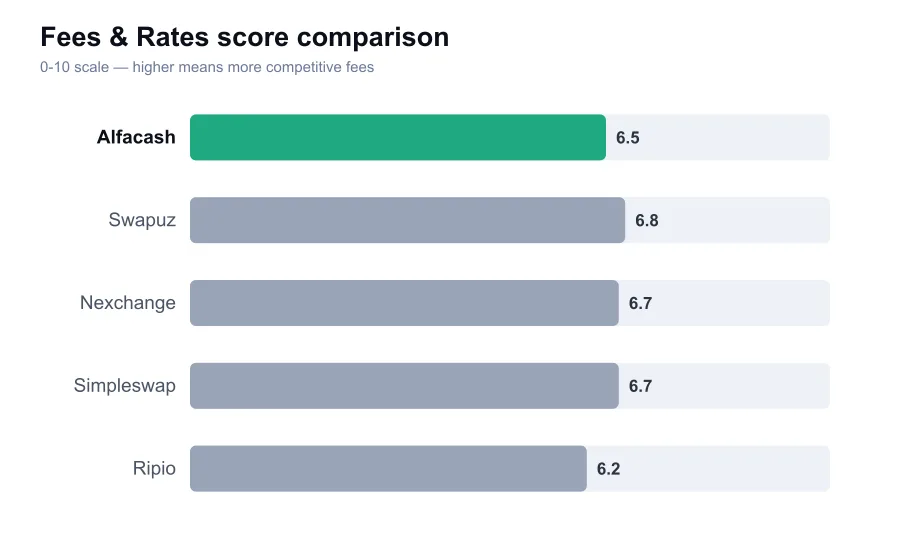
Fees require a little care. Alfacash generally presents a final quote rather than inviting users to calculate maker and taker charges from an order book. Its costs can include a market spread, processing costs and the blockchain network fee for the payout. The service has historically described exchange fees in the vicinity of 0.8% for some swap operations, though the actual cost varies by pair, payment method and market conditions. Treat the quote, not an old percentage, as the price that matters.
That is not bargain basement pricing. A liquid BTC to ETH swap on Kraken, Coinbase Advanced or Binance can be cheaper if you already have verified access, use a limit order and are comfortable withdrawing yourself. Alfacash earns its fee by reducing that friction. You don't need to navigate an order book, maintain a trading balance or deal with a separate withdrawal step. For a small cross chain conversion, the premium can be reasonable. For a $10,000 exchange, it deserves serious comparison shopping.
The service has also offered purchases and sales through external payment partners in some jurisdictions. These are usually more expensive than crypto to crypto swaps. Card payments in particular carry issuer, fraud and processing costs that can make a headline exchange rate look less attractive by checkout. Read the final amount carefully and do not confuse a partner's payment fee with Alfacash's core exchange margin. Fiat availability can also change based on your country and the provider currently connected to the transaction.
Speed is decent for the category, provided the network isn't misbehaving. Once an inbound transaction has the required confirmations, a standard liquid pair can often be processed in minutes. Bitcoin is naturally slower than fast chains because confirmation time is part of the security model. A claimed instant exchange cannot make a Bitcoin deposit final instantly. It can only start its own part of the process after it considers the deposit sufficiently confirmed.
Alfacash is generally better suited to ordinary conversions than exotic low liquidity tokens. If you are swapping common assets such as BTC, ETH, LTC, USDT or stablecoins on supported networks, the route is more likely to be smooth. A thinly traded asset, a token on the wrong network, or a surge in blockchain fees can complicate an order quickly. Users should double check network labels, especially for USDT and USDC, because sending an asset over the wrong chain can turn a routine purchase into a support ticket.
Privacy is another area where the advertising shorthand can confuse people. Alfacash can permit users to initiate many cryptocurrency swaps without a conventional account registration. That is not the same as an unconditional promise of anonymity. The company states that it follows anti money laundering practices and may request verification when transaction risk, payment method, jurisdiction or compliance checks require it. This is normal for an exchange service operating in the current environment, even if privacy minded users dislike it.
That policy is more honest than pretending compliance never exists, but users should understand the practical implication before they send money. If a transaction is flagged, the exchange may pause it and ask for documents or additional information. You may be uncomfortable with that, but you cannot safely assume a swap is outside financial controls just because the first page asks only for an address. Keep records of the source of funds and avoid sending third party payments into an order you cannot explain.
Alfacash's security model is sensible for a noncustodial style exchanger, because the customer normally controls both the sending and receiving wallets. The company still temporarily handles the conversion, so operational security and partner risk remain relevant. There is no public reason to regard it as equivalent to self custody or decentralized on chain trading. The safest habit is simple, use a wallet you control, verify every address, do a test transaction with a new network, and don't leave anything behind after settlement.
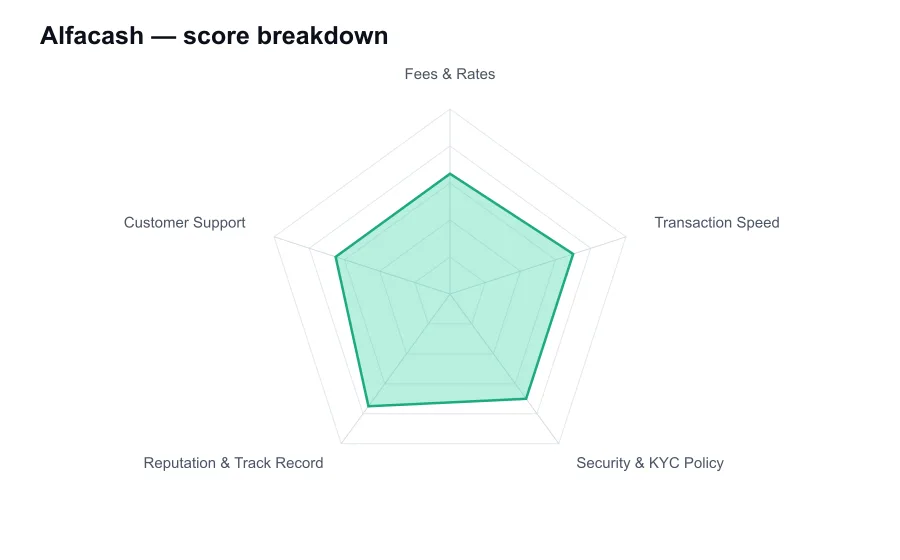
Customer support has a mixed but recognizable profile. Alfacash provides help resources and ticket based contact, and its years in business mean there is a substantial trail of user discussion to assess. Many routine orders attract no comment because they simply work. Complaints tend to involve verification, delayed confirmations, partner payment disputes or users entering incorrect details. That pattern is common across the industry, though it is still frustrating if you are the person waiting for funds during a volatile market.
I would not expect concierge support or an immediate phone line for a modest swap. What I do expect is a traceable order number, clear status information and a support agent who can explain where funds are in the process. Alfacash is more credible on this front than newer anonymous brands, but it remains a lean exchange service. If instant access to a live representative is essential, a large regulated platform with premium support may be a better fit.
Alfacash makes the most sense for users who value a long running, straightforward exchange tool and are willing to pay more than professional spot market rates for convenience. It is less compelling for active traders, card buyers chasing the cheapest route, or people determined never to face a potential KYC request. Its age and basic competence matter, but they don't erase the usual instant exchange trade offs.
My take is positive with reservations. Alfacash is a credible veteran in a field crowded with less proven operators, and that counts heavily in its favor. Its fees can be fair for a quick wallet to wallet conversion, but they are not cheap enough to ignore on larger trades. Use it for the job it was designed for, a clean, occasional exchange, and compare rates before confirming. It is a service I would consider, rather than one I would use automatically.