Nexchange is an instant cryptocurrency exchange and API provider rather than a conventional trading platform. Its retail interface is built for direct swaps, while its infrastructure has also been used by wallets, brokers, and other services that need exchange functionality without operating their own liquidity stack. That API orientation is the most interesting part of the business. It explains why Nexchange can feel more like financial plumbing than a consumer brand built around a trading community.
For a retail user, the basic process is familiar. Select a send asset and a receive asset, enter an address, accept a quote, send the deposit, and wait for settlement. There is no need to place a limit order, fund a fiat account, or keep coins on the service after the conversion. That is convenient for one off transactions. It is not a replacement for an exchange where you need charting, recurring purchases, margin controls, or a detailed portfolio ledger.
Nexchange's fee model is quote driven. Instead of a highly visible maker and taker fee table, the service presents a rate that reflects the market price plus network costs, liquidity sourcing, and its service margin. That is normal for instant exchange products and especially normal for an API business where the final economics may vary by partner and route. It is less transparent than paying a stated percentage on an order book.
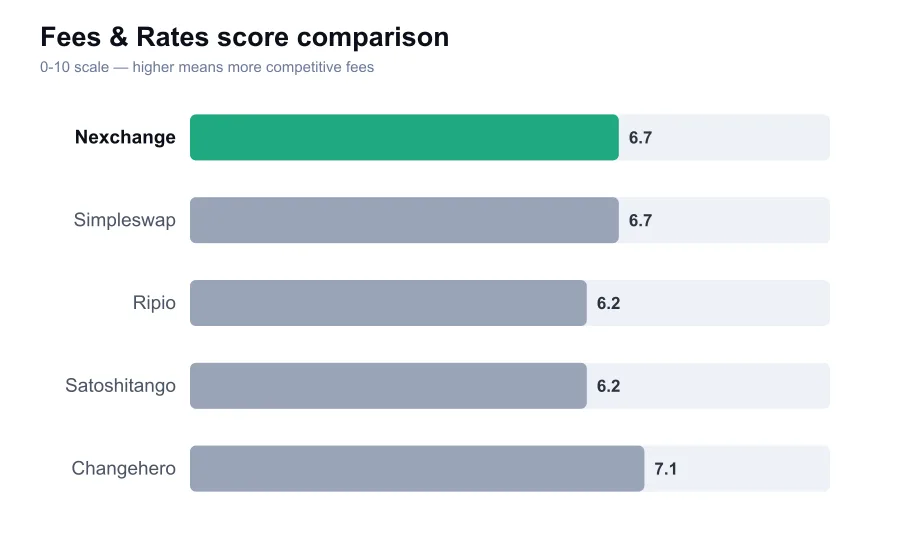
The correct way to judge the price is by comparing the expected output. Check the same asset pair, amount, and network at Nexchange, ChangeNOW, SimpleSwap, and a major centralized exchange where available. Include withdrawal fees in the centralized exchange comparison, otherwise the calculation is misleading. Nexchange can be competitive on a convenient route, but I would not assume its quote is cheapest simply because the interface says there are no hidden fees.
Rate type matters. A floating rate order generally tracks the market after the deposit is received, which can produce a different result from the initial estimate. A fixed rate can provide certainty for a short window, but certainty costs money and depends on accurate, timely funding. Users should also look for minimum amounts. Small transactions can be disproportionately affected by blockchain fees, while unusually large ones may be subject to liquidity limits or compliance checks.
Transaction speed is good for the category, but instant is a marketing word rather than a technical guarantee. Nexchange must detect the deposit, wait for enough confirmations, execute or source the conversion, and send the payout. A fast chain and liquid pair may settle quickly. Bitcoin deposits, congested Ethereum transactions, exchanges requiring many confirmations, or thin assets can substantially extend the wait. The estimated time shown during an order is a guide, not a contractual deadline.
Its API heritage is valuable because a service handling programmatic orders must expose status information, pair data, pricing, and transaction monitoring in a way integrations can use. That does not automatically make the consumer experience superior, but it is a positive signal of operational focus. Developers should still test every endpoint, callback, and network mapping in a sandbox or with small amounts before putting a payment flow into production.
Security is helped by the absence of a persistent retail balance. Nexchange is normally used to complete a conversion, not to hold customer deposits indefinitely. That narrows the risk compared with leaving a large portfolio on a custodial exchange. It does not eliminate counterparty risk during an active order. The provider temporarily controls funds in transit, and an error in the receiving address or token network remains the customer's loss unless recovery is technically possible.
The company also operates in a sector where compliance procedures cannot be ignored. Users may see a low friction process and assume KYC will never apply. That is a mistake. Instant exchange operators often reserve the right to conduct transaction monitoring and request additional information where activity triggers risk controls. A routine swap may complete without identity documents, but a flagged transaction can become a different experience. Anyone needing predictable compliance handling should ask in advance or use a regulated account based exchange.
Nexchange has been around long enough to be more than an anonymous overnight swap page, and its API role gives it a clearer business identity than many retail only competitors. Still, its public name recognition is modest compared with Coinbase, Kraken, Binance, or even the largest instant exchange brands. That means users should place more weight on their own due diligence, current service status, and the exact terms of a transaction than on broad consumer reputation.
The support model is functional but not luxurious. Order related support depends on identifiers, transaction hashes, exact amounts, and addresses. Provide those details immediately if a swap is delayed. Expecting a support agent to infer the problem from a vague message usually slows matters down. For API clients, the quality of technical documentation and response to integration issues is arguably more important than the retail contact experience, because an error can affect many end users at once.
I like Nexchange best where its infrastructure strengths are relevant. A wallet operator or developer who needs programmatic swaps, status callbacks, and broad pair access may find it far more compelling than a casual retail user does. The retail customer gets a competent conversion tool, but not necessarily an emotional reason to choose it over every other instant exchange. Price and route quality should decide that choice.
There are practical habits that make Nexchange safer to use. Confirm the network, especially for USDT and USDC. Do not send from a platform that might attach a memo or restrict the destination. Preserve the order URL and transaction data. Avoid sending more than quoted or less than the minimum. And do not use a swap to solve a time critical payment unless you have allowed room for confirmation delays.
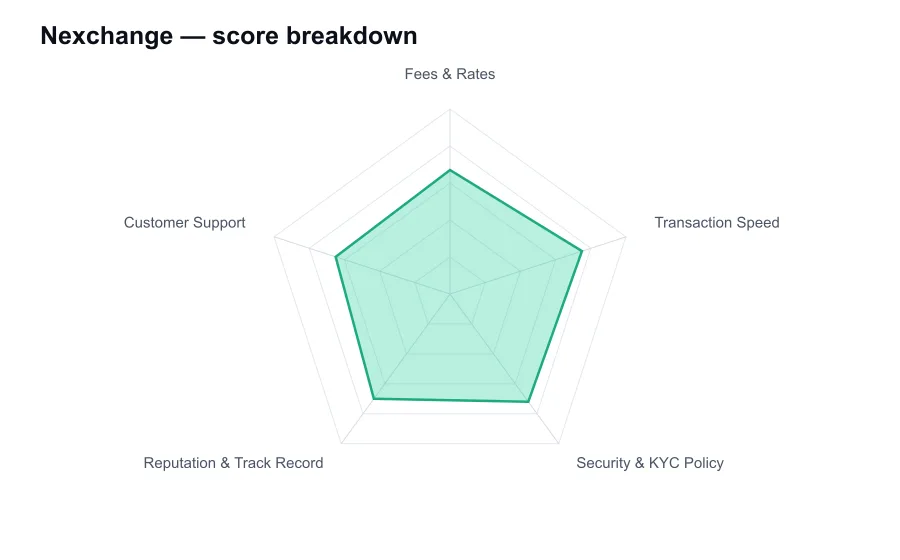
Nexchange is credible infrastructure in a market full of interchangeable looking conversion widgets. Its API capability, noncustodial transaction model, and straightforward retail flow are real strengths. The weak spots are familiar: quote based pricing can be difficult to benchmark, no KYC does not mean no review, and customer service cannot neutralize blockchain finality. It is better judged as a practical execution layer than as a full service exchange.
My final assessment is favorable for users who understand that distinction. Nexchange can be a sensible choice for routine crypto to crypto conversions and especially for businesses integrating swap capability. It is not the cheapest option by definition, and it should not be trusted with an untested large transfer merely because the interface is simple. Compare the final quote, test the route, and use it for what it does well.