Allswap presents itself as an instant cryptocurrency conversion option, a type of service that has become extremely easy to launch and extremely hard to evaluate. Its basic purpose is straightforward, route a user's deposited crypto through available liquidity and deliver another asset to a nominated wallet. The concept is useful, especially for people who don't want a standing account at a centralized exchange. The problem is that Allswap has not established the public credibility, operational detail or broad independent coverage that a financial service should have before it handles meaningful sums.
That doesn't mean every transaction will fail. Many small swap services complete routine orders because the underlying task is not technologically exotic. They connect to liquidity sources, monitor incoming deposits and send an outbound transaction. But a review should focus on more than the happy path. A platform earns confidence by explaining who operates it, what its policies are, how it handles lost funds and what users can reasonably expect if something goes wrong. Allswap leaves too many of those questions unresolved.
Its market position is therefore very different from recognized instant exchange brands. ChangeNOW, StealthEX, SimpleSwap and Alfacash each have their own shortcomings, including rate spreads and sporadic support complaints, but they also have larger public footprints and longer trails of customer experience. Allswap appears far less documented. That places the burden on the user to do more due diligence, not less, before sending an irreversible deposit.
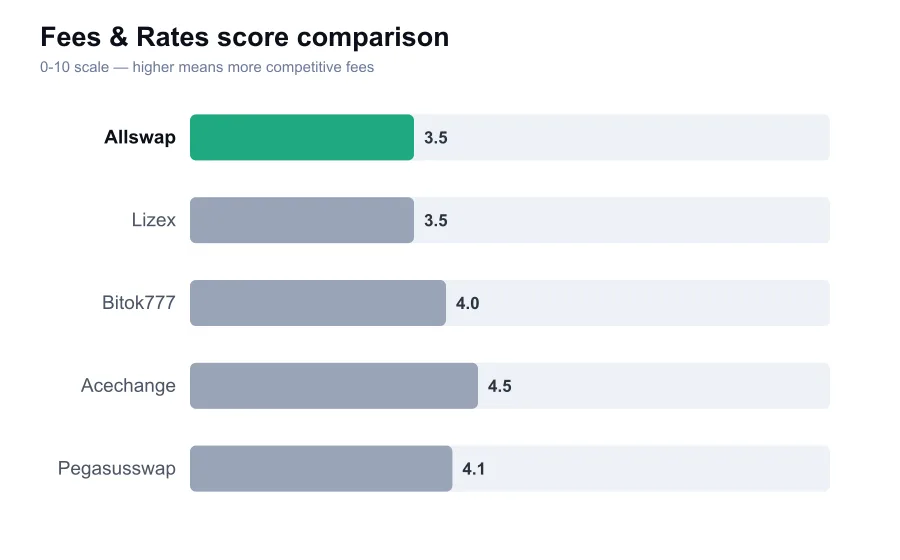
The core pricing concern is transparency. Instant swap providers often advertise a rate without spelling out a neat trading commission because their revenue is embedded in the conversion quote. That can be acceptable if the displayed payout remains competitive and the service distinguishes a fixed quote from an estimated floating one. With Allswap, reliable public information about standard spreads, partner fees and how rate changes are managed is limited. A customer cannot confidently budget a transaction from a vague promise of competitive pricing.
Never assume that a low quoted fee means a low cost. A service can charge no separate platform fee yet still quote a poor conversion rate. The practical test is simple, compare the exact amount of destination currency you will receive, including network charges, against two reputable alternatives at the same moment. If Allswap's result is materially lower, there is little reason to accept its weaker reputation. If it is better, ask why, and consider whether a small apparent saving compensates for a greater counterparty risk.
Speed is similarly difficult to score highly without a convincing record. The exchange process is affected by the inbound chain, confirmation thresholds, liquidity availability and the outbound chain. A fast chain can deliver a payout in minutes, while a BTC deposit may require a noticeably longer wait. Those are normal technical realities. What is not normal is leaving customers without a clear order tracker, documented processing stages or prompt explanations when the expected window passes.
Allswap may perform adequately during quiet markets and with highly liquid pairs. That is the easiest test any exchange can pass. Stress conditions tell a more useful story. During sharp price movement, an aggregator can face repricing, exhausted liquidity or a partner interruption. If the provider cannot offer a transparent fixed rate process or a well explained refund path, the user carries nearly all the uncertainty. That is a poor bargain for anyone swapping money they cannot afford to have delayed.
The absence of a traditional signup requirement, if offered for a particular transaction, should not be confused with a blanket privacy guarantee. Crypto exchange services can screen addresses and transactions, and they may require identification where their policies or partners demand it. The question isn't whether this is theoretically possible, it is whether users can find a clear policy describing the triggers, the documents requested and the treatment of held funds. Allswap's limited public documentation makes that assessment difficult.
Security is also about accountability. A noncustodial style service is safer than leaving an investment balance in an exchange account only in the narrow sense that funds are meant to pass through for one conversion. Before and during the swap, the provider still controls the route and the payout. Users need a real operator, clear terms, a support path and a defensible dispute process. A polished landing page cannot substitute for those basics.
For any Allswap order, I would take cautious operational steps. Start with an amount small enough to lose without distress. Use a fresh, self controlled destination address. Check the asset ticker and the chain, because USDT on Tron is not interchangeable with USDT on Ethereum or another network. Screenshot the offer, save the order reference and retain both transaction hashes. Do not send funds from an exchange account if a refund might have to return to a different address or if the sending platform's compliance team could complicate the trail.
The support question is particularly important for a provider with a small public profile. An email contact might resolve a routine issue, but it doesn't tell us whether there are trained agents available during an urgent incident. A delayed payment can become stressful very quickly when prices move. Strong support means more than a polite reply. It means the agent can identify the transaction status, coordinate with a liquidity partner and give a realistic time frame rather than generic reassurance.
Allswap has not provided enough visible evidence for me to treat its support as proven. Nor is there a robust independent review history that would let a prospective customer separate isolated complaints from recurring failures. This is not a minor research inconvenience. In an irreversible payment system, a lack of verifiable feedback should directly reduce the amount you are willing to risk.
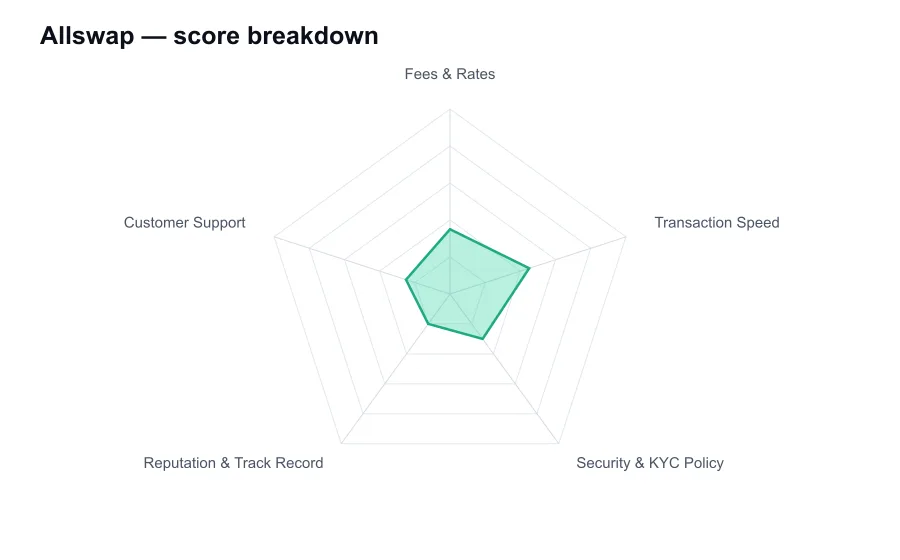
There is a broader reason to be wary of thinly documented swap brands. Crypto's open infrastructure makes it easy to imitate the look of trusted services, while the actual customer protections vary enormously. A user can inspect a wallet address and still know almost nothing about the company receiving the funds. That is why reputation carries a quarter of the score here. Allswap simply does not have enough of it in public view.
Allswap might be considered by an expert user who has independently verified the live service, found a genuinely superior quote and is making a small experimental conversion. It is not a provider I would recommend to a newcomer, a merchant accepting customer money, or someone moving a substantial share of their portfolio. Convenience is plentiful in this market. Proven recourse is not.
My final view is skeptical. Allswap's stated function is ordinary, but its limited transparency and weak public track record make it a difficult service to endorse. There are established alternatives that offer nearly identical workflows and more evidence that they can handle the complications behind a simple swap button. Until Allswap offers clearer ownership, pricing, policies and demonstrated support, it belongs in the test only category. The responsible default is to choose a better documented exchange.