Lizex is a difficult provider to review generously because the public information needed to establish confidence is thin. The name appears in crypto exchange discussions and listing pages, but it does not carry the recognizable operating history of Kraken, Coinbase, Bitstamp, Binance, or even the better-known instant-swap brands. In an industry where impersonation sites, short-lived platforms, and unlicensed operators are common, limited verifiable information is not a minor inconvenience. It is the central issue.
I would begin with identity rather than features. Before depositing funds with an exchange, a user should be able to establish who runs it, where the company is incorporated, what legal entity is responsible, how it can be contacted, and which regulatory obligations it accepts. With Lizex, those basics are not presented with the clarity expected from a serious financial service. A polished website, token list, or promotional social account does not fill that gap.
That does not automatically prove that Lizex is fraudulent. It does mean the burden of proof remains on the provider, not on the depositor. Crypto users often reverse this logic because they see a tempting rate or a newly listed token and assume the platform is legitimate until something goes wrong. A critical reviewer should take the opposite approach. If a service cannot demonstrate credible ownership, security practices, and a sustained record of withdrawals, it should receive only the smallest possible test transaction, if any.
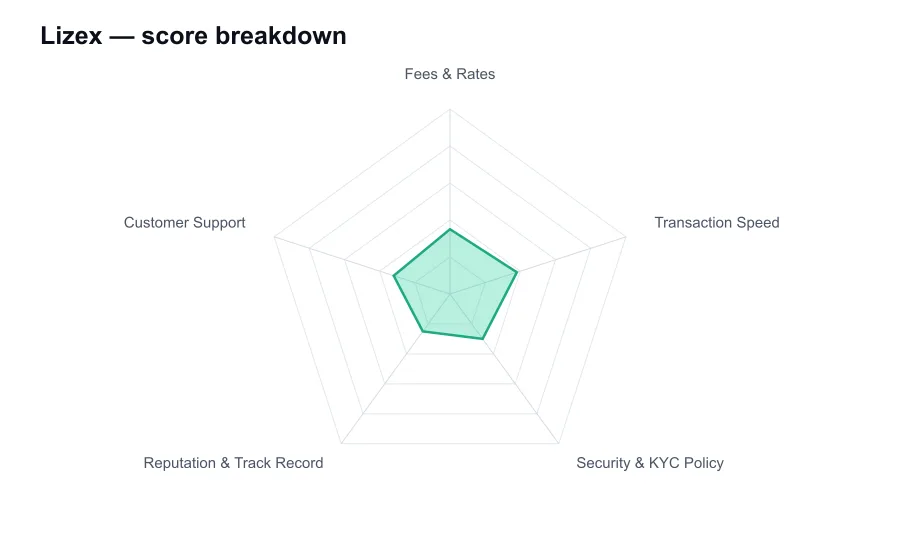
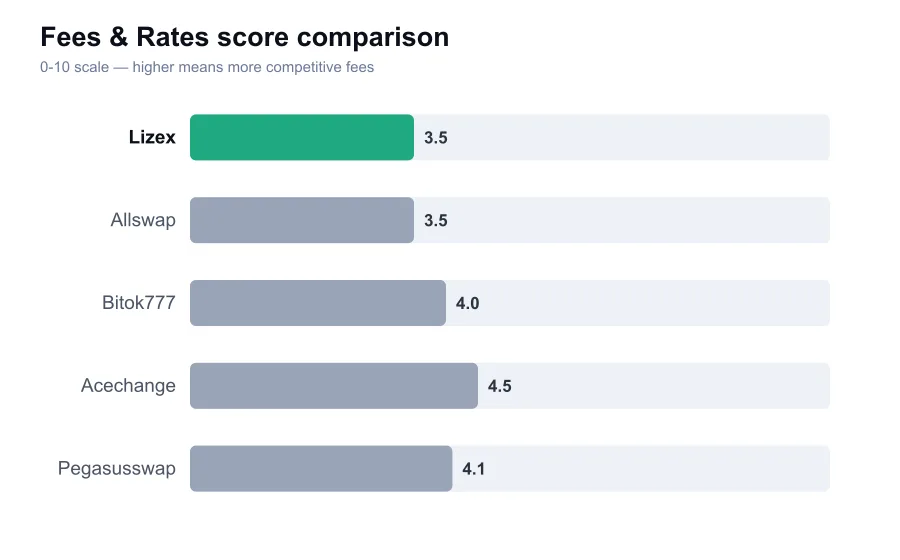
Fee transparency is similarly weak from a due-diligence perspective. Reputable exchanges publish a maker and taker schedule, withdrawal fees, deposit conditions, stablecoin conversion rules, and the circumstances in which fees may change. Instant-swap services at least show a quote before the user commits. A provider with unclear fee documentation leaves customers unable to separate its trading charge from spread, liquidity costs, or a potentially punitive withdrawal fee.
This makes a numerical fee score inherently conservative. Low advertised trading fees do not make a platform inexpensive if the order book is thin, the spread is wide, or withdrawal costs erase any savings. The only meaningful way to assess Lizex pricing would be to compare a live executable quote, the final credited balance, and the final withdrawal amount. Without that evidence, claims of low fees are marketing, not analysis.
Speed is another category where a website can make promises that the operation behind it cannot meet. A matching engine may display an instant fill, yet users still need deposits credited and withdrawals processed. The withdrawal step is where undercapitalized or badly managed exchanges reveal themselves. A provider with a limited public history has not earned the assumption that it can handle traffic spikes, wallet maintenance, chain congestion, or a wave of redemption requests.
For any unfamiliar venue, test speed means more than seeing an order complete on screen. Deposit a very small amount, execute a simple trade, and withdraw it to a self-custody wallet. Check whether the withdrawal is broadcast on the expected network, whether the transaction ID is real, and whether the received amount matches the stated fee. Do not treat internal balances as proof that assets exist. Internal balances are database entries until the coins leave the platform.
Security claims deserve the same scrutiny. Two-factor authentication, encryption, cold storage, and anti-phishing settings are useful features, but they are not evidence of solvency or safe operational controls by themselves. A trustworthy exchange can explain whether it segregates customer funds, uses multisignature controls, maintains reserves, commissions security testing, and has a responsible disclosure process. Lizex does not have a widely established public security record that lets an outsider independently assess those questions with confidence.
KYC policy is also a concern when documentation is vague. Some users see minimal KYC as a positive, but ambiguity is different from privacy. A credible platform states what identification it requires, which countries it serves, how it handles sanctions screening, what can trigger a review, and what happens to customer data. An exchange that is unclear before a deposit may become much clearer only when a customer tries to withdraw, which is exactly the wrong moment to discover an undisclosed verification requirement.
The lack of a strong, independently documented reputation is Lizex's largest weakness. Reputation in crypto is not a logo age or a handful of enthusiastic comments. It is years of functioning through bull markets, crashes, hacks, chain outages, regulatory changes, and user complaints. It is visible leadership, credible third-party coverage, responsive communication, and evidence that customers can withdraw assets without arbitrary friction. I cannot place Lizex in that category on the information available.
Search results and social proof should be handled carefully here. Review platforms can be gamed, affiliate blogs may earn from referrals, and promotional messages often repeat claims without investigating them. Negative reports also require context, because users sometimes blame a platform for a wrong network selection or an incomplete KYC process. But where independent coverage is scarce, the sensible response is not to assume the best. It is to limit exposure until stronger evidence appears.
Customer support is hard to score positively without a demonstrated support record. A contact form or chat widget is the minimum, not a strength. Users should look for a published support address, clear response expectations, an active status page, coherent help documentation, and a transparent escalation process. If a platform cannot answer basic pre-deposit questions about fees, entity details, withdrawal limits, or supported networks, there is no reason to believe it will handle a missing transaction responsibly.
The comparison with established alternatives is unforgiving. Kraken has a long public record, licenses in several jurisdictions, detailed fee schedules, and recognizable support channels. Coinbase offers extensive disclosures and a public-company reporting trail. Even non-custodial services such as LetsExchange can be assessed through years of public usage, terms, and transaction-specific quoting. Lizex has not earned equivalent confidence through visibility or verifiable track record.
There are users for whom a new or obscure platform can be worth exploring, usually researchers, token hunters, or technically capable people testing a specific unavailable market. Those users should still protect themselves: use a new wallet, enable unique security credentials, avoid uploading unnecessary documents, never leave balances on the site, and begin with an amount they can afford to lose. A platform's claimed security features do not justify skipping these precautions.
My view is blunt. Lizex may be a functioning service, but the available public profile does not provide enough evidence to recommend it for meaningful funds. The potential upside of an obscure exchange, perhaps a niche listing or promotional fee, is rarely large enough to offset counterparty uncertainty. Crypto already carries market and custody risk. Adding an opaque venue on top of that is usually unnecessary. Until Lizex provides stronger, independently verifiable transparency, established exchanges and proven self-custody routes are the better choice.