EasyBit is a non-custodial instant crypto exchange service aimed at people who want to swap one asset for another without opening a conventional trading account. It occupies the same broad territory as ChangeNOW, SimpleSwap, StealthEX, and other instant-exchange providers. The appeal is obvious: choose the pair, enter a receiving address, send the deposit, and receive the output without learning an order book or depositing funds into a long-term custodial balance.
That simplicity is useful, but it needs a clear-eyed reading. EasyBit is not a DEX where a wallet signs an atomic swap, and it is not a spot exchange where you control an open order. It acts as an intermediary arranging the conversion through liquidity partners and its own operational systems. For a period, the service takes custody of the deposited coins while it completes the order. That makes provider reliability more important than it is with a purely on-chain swap.
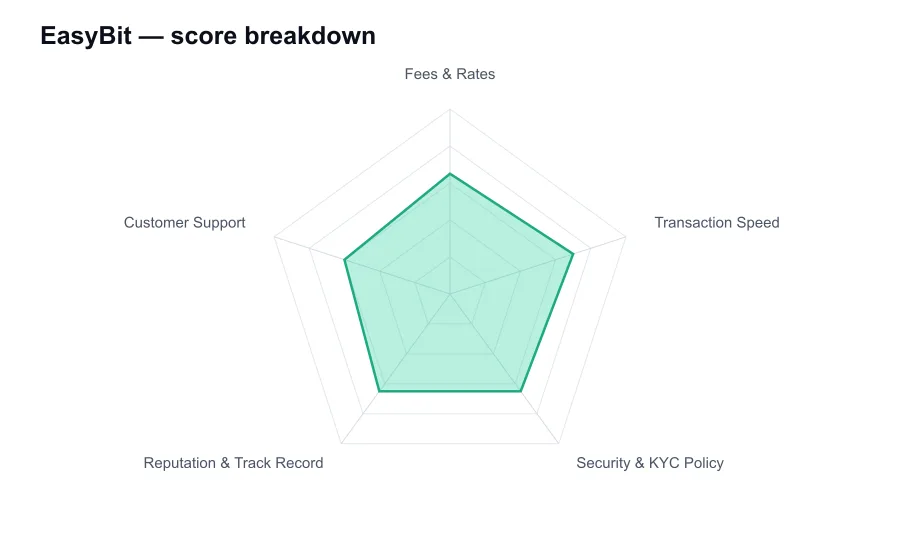
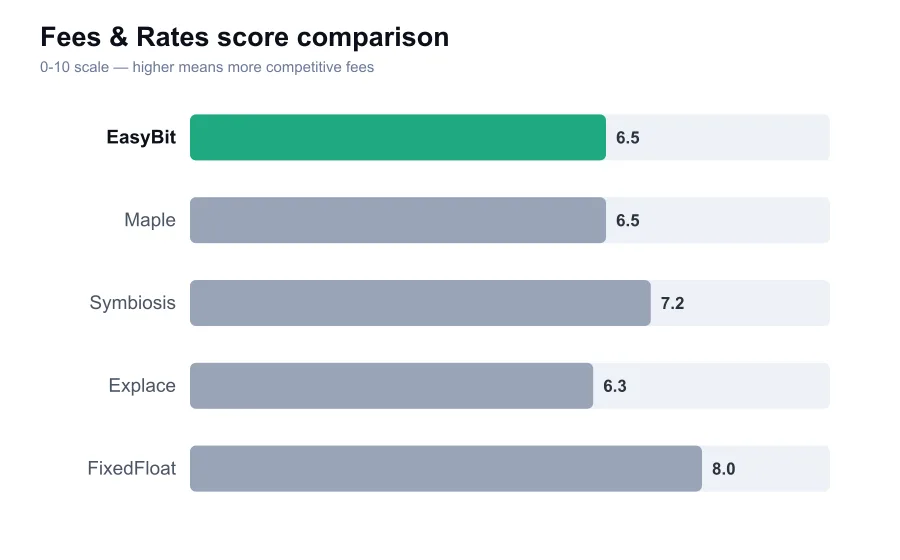
The fee picture is less clean than a fixed maker-taker schedule. EasyBit offers floating-rate and fixed-rate exchanges, and the difference matters. A floating quote can move with the market between deposit and execution, while a fixed quote attempts to lock an output for a defined time and deposit amount. The service's compensation is often reflected in the quoted exchange rate rather than presented as one easy percentage that applies to every pair.
This is normal for instant exchangers, but it makes comparison essential. Before sending, compare EasyBit's final output with ChangeNOW, FixedFloat where available, a major exchange's spot market, and an on-chain aggregator if the assets are on the same network. A convenient no-account swap may cost noticeably more than placing a limit order on Kraken or Binance. For a small urgent conversion, that premium can be reasonable. For a large trade, it can become expensive very quickly.
Network fees are another source of confusion. The quoted output may include withdrawal or network costs, but the user still needs to pay the deposit transaction fee from their own wallet. Fixed-rate quotes can also fail to deliver the expected economics if the deposit arrives late, arrives short, or is sent on the wrong network. Read the order instructions, especially for assets with memos, tags, or multiple chain versions. A mistake with USDT network selection is not a minor typo.
EasyBit is usually fast for ordinary, liquid pairs. A completed exchange can take minutes once the incoming transaction has the required confirmations and the provider can source the output. Bitcoin and some older networks naturally take longer because confirmation policy matters. A popular asset on a fast chain may arrive rapidly. A thin token, a large transaction, or a busy network can take far longer than the cheerful estimate displayed at order creation.
The critical limitation is that speed is conditional. Instant exchange does not mean guaranteed instant settlement. Deposits may be reviewed for risk, liquidity can change, blockchain congestion can delay confirmations, and partner availability can affect the final payout. This is not unique to EasyBit, but users should not make time-sensitive payments on the assumption that a swap will finish in two minutes. If the deadline is absolute, use a venue where you already hold the destination asset.
EasyBit markets a privacy-friendly, registration-light experience, and standard exchanges can often be completed without opening an account or completing routine KYC. That convenience should not be oversold as a promise of anonymity. Like many instant providers, EasyBit can request identification or additional information where compliance systems flag a transaction. A service may also delay, return, or require further checks for an order it considers risky.
This policy is the main security tradeoff. There is less personal data collection during a straightforward transaction than at a full centralised exchange, and users do not leave funds sitting in an EasyBit wallet. Yet the order flow is still custodial for its duration. If a transaction is paused, the user depends on the company to communicate clearly and resolve it fairly. The absence of a normal account does not eliminate compliance controls, it merely moves them into exceptional cases.
From a technical safety perspective, the usual habits matter more than marketing claims. Use the real EasyBit domain, save the order ID, verify the receiving address character by character, and send a test amount for an unfamiliar asset or network. Never accept support contact through unsolicited direct messages. A legitimate exchange cannot recover coins sent to a scammer's address, and a no-KYC service cannot magically reverse a confirmed blockchain transfer.
EasyBit has an established presence in the instant-exchange market, but it does not have the public scale, licensing footprint, or long institutional record of the largest centralised exchanges. That is not automatically disqualifying. It does mean users should be more conservative with trade size. The relevant question is not whether a site has positive review snippets, but how it handles delayed orders, incorrect deposits, compliance reviews, and disputed rate expectations under pressure.
Customer support is more important here than it is for Curve or DefiLlama, because a pending order may need human intervention. EasyBit provides support channels and order-based assistance, which is appropriate for its model. Reports from this sector are always mixed, as they are for competitors, especially where AML reviews occur. The sensible expectation is email or chat assistance tied to a transaction ID, not the immediate phone-based escalation a bank customer might expect.
The product is best for someone who already understands wallets and simply wants an uncomplicated conversion. It works well for moving between mainstream assets, consolidating a portfolio, or receiving a coin that a particular wallet supports better. It is less appealing for repeated trading, professional execution, or very large orders. Those users benefit from transparent books, deeper liquidity, and a venue where they can control price with limit orders.
EasyBit succeeds by removing friction, and for modest swaps that may be exactly what a user wants. The cost of that friction reduction is less pricing transparency than a spot exchange and less control than a DEX. I would use it for a straightforward, non-urgent conversion after checking competing quotes, not as a primary trading home or a place to route a life-changing sum. The service is convenient, but convenience should be priced and risk-managed rather than trusted blindly.