Maple is not a conventional spot exchange, and treating it like one misses the point. It is an onchain credit marketplace built around lending pools, institutional borrowers, and, more recently, the Syrup product for users seeking access to yield generated by secured digital-asset lending. Its closest comparisons are onchain credit protocols such as Goldfinch and Clearpool, not Binance or Coinbase. The appeal is credit infrastructure with visible smart contracts, not low-cost token speculation.
That distinction should shape expectations from the first click. Maple users generally deposit stablecoins into pools or vault-style products and receive a tokenized claim on their position. The return is generated by lending activity and protocol arrangements, not by a savings account backed by a bank deposit guarantee. Yields can change, withdrawals can depend on liquidity conditions, and a smart contract position carries risks that a traditional exchange balance does not.
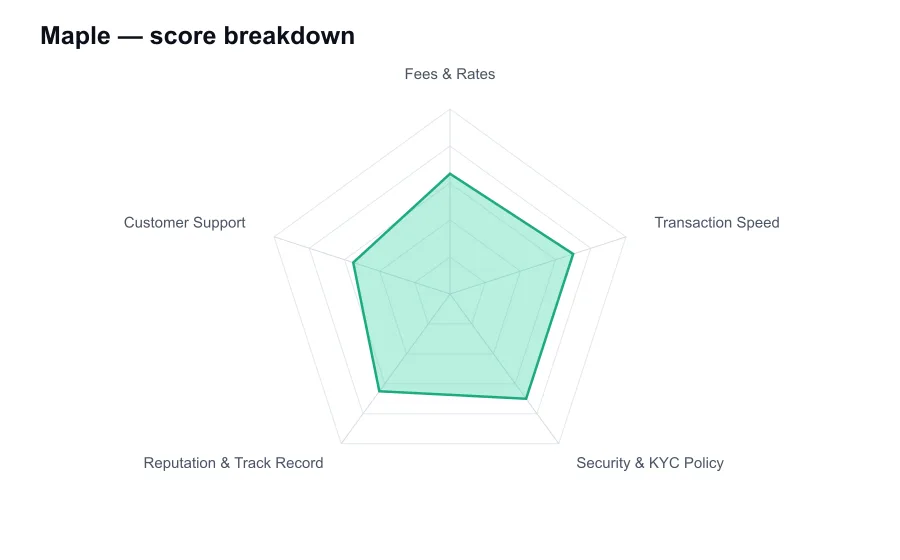
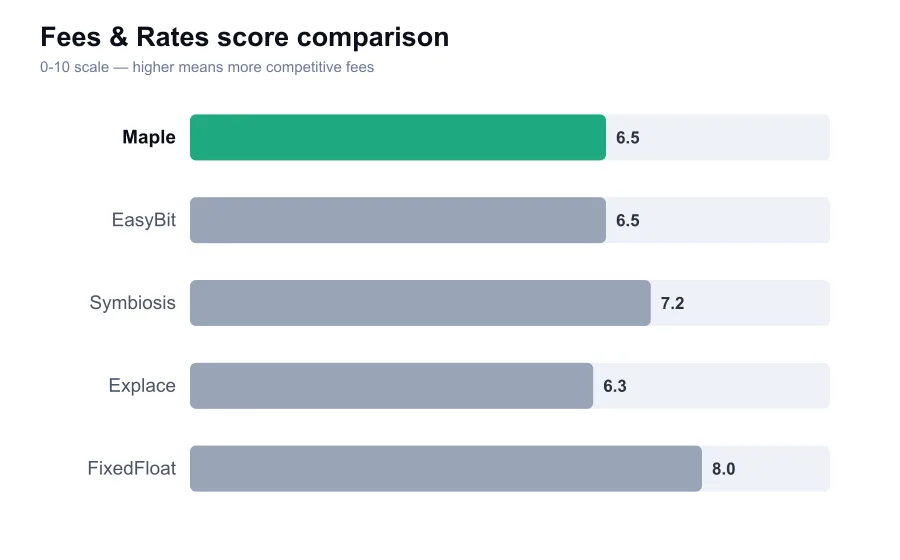
Maple's fee structure is more complicated than a simple maker and taker schedule because products have distinct economics. Lending pools may involve management fees, performance fees, borrower interest, and protocol-level charges, while the user sees a net annualized yield that can move as utilization changes. The important number is not the promotional APY alone. Users should read the pool or product documentation to see whether a quoted return is before or after fees and whether the rate is variable.
This isn't a platform for someone trying to buy a small amount of bitcoin cheaply. A centralized exchange with published spot fees is usually clearer for that job. Maple makes more sense for an investor who already holds USDC or another supported asset and understands that yield is compensation for credit, liquidity, and smart contract risk. Compared with opaque offshore lending desks, the onchain visibility is a meaningful advantage, but it does not turn the yield into a risk-free rate.
Speed is one of Maple's better qualities, within the limits of the underlying chain and the particular product. Deposits, token transfers, and redemptions are processed through smart contracts, so the transaction itself can settle after normal blockchain confirmation. On Ethereum that may mean paying meaningful gas during congestion. On supported lower-cost networks, the interaction is usually quicker and cheaper, although bridge use introduces its own delay and security considerations.
The point at which users get caught out is redemption liquidity. A wallet transaction can execute quickly while a full exit still takes time if capital is deployed or a pool has withdrawal rules. That is a feature of lending, not necessarily a failure of the interface. Maple has provided instant withdrawal mechanisms in certain products subject to available liquidity, but no investor should assume instant access is guaranteed merely because the asset is represented by a token in a wallet.
Security is more substantial here than at many anonymous DeFi yield projects. Maple has operated publicly for years, uses audited smart contracts, and publishes documentation around its architecture and products. Public code, transaction history, and named protocol contributors create a level of scrutiny that a black-box lender simply doesn't have. Still, audits reduce risk, they do not eliminate vulnerabilities, economic attacks, oracle issues, governance mistakes, or losses from bad credit decisions.
Maple's history makes credit risk especially real rather than theoretical. During the 2022 market stress, loan defaults involving counterparties including Orthogonal Trading exposed weaknesses in undercollateralized institutional crypto lending. The episode hurt lenders and damaged confidence, even though it also demonstrated why transparent reporting and clearer collateral structures matter. Maple subsequently shifted its product direction toward more secured lending and stronger risk controls. That was a necessary correction, not a reason to pretend the earlier failure never happened.
KYC depends on the product and user role. Institutional borrowers and delegates face much more extensive onboarding and compliance scrutiny. Access to retail-facing DeFi products can be wallet based, but geography, sanctions screening, frontend terms, and partner requirements can still limit availability. Do not confuse using a wallet with being exempt from every compliance rule. Maple is designed to operate in an increasingly regulated credit environment, not as an anonymous cash substitute.
The reputation score is respectable but not spotless. Maple is one of the better-known names in institutional DeFi credit and has attracted significant ecosystem attention, partnerships, and scrutiny. Its public response to the failures of the last crypto credit cycle has been more credible than the silence or collapse seen at several centralized lenders. Yet an investor evaluating the protocol today should still price in the fact that the brand has a difficult credit-loss chapter in its record.
Support has the usual DeFi strengths and weaknesses. Documentation, community channels, and transaction transparency can answer many technical questions faster than a generic call center. For a self-directed user who knows how to inspect a transaction and read product terms, that is workable. For somebody who expects a human agent to reverse an incorrect wallet transfer or reimburse a signing mistake, it is a poor fit. Smart contract interactions are generally irreversible.
Maple also demands more homework than a simple staking product. Check the chain, asset, pool terms, current utilization, redemption mechanics, and actual source of yield before approving a wallet transaction. Be wary of copycat sites and fake token approvals. Use the official domain, limit token allowances where practical, and consider a small test transaction before committing a larger stablecoin position.
I like Maple more than the average high-yield DeFi pitch because it addresses a real credit-market function and exposes more of the machinery than most competitors. The protocol has matured through a difficult period rather than simply disappearing. But a clean interface and an attractive yield should not distract from the central proposition, which is lending capital into a crypto credit system. That requires risk tolerance and patience.
My take is that Maple is a credible specialist protocol, not a universal crypto account. It can suit sophisticated stablecoin holders who want onchain credit exposure and are able to judge liquidity and counterparty risk. It is not where I would send emergency savings, money needed next week, or funds belonging to an investor who cannot explain how a redemption queue works. The product is real, the risks are real, and both deserve equal attention.