Explace is a smaller instant crypto exchange service built around simple wallet to wallet conversions. It is not a full exchange with spot books, bank transfers, advanced charts, or account based custody. Its appeal is much narrower. You arrive with one cryptocurrency, choose another, provide a destination address, and let the service arrange the swap. That model can be convenient, but it also means trust and price discovery deserve more attention than the tidy interface suggests.
The service feels designed for users who find centralized exchanges cumbersome. There is no long onboarding process for a standard order, and the exchange form is direct enough that a newcomer can follow it. Explace does not make customers learn order books or maker and taker terminology. That simplicity is valuable, although it comes at the cost of visibility. Users do not see the underlying venue, liquidity source, or exact spread being taken.
Asset selection is reasonably broad for an instant exchanger, covering familiar networks and numerous altcoins. Availability should not be confused with depth. A Bitcoin to USDT conversion usually has a liquid path. A low volume token into another low volume token may be a chain of conversions behind the scenes, with a noticeably weaker rate. The most prudent way to use Explace is to stick to established assets unless the quote has been checked carefully.
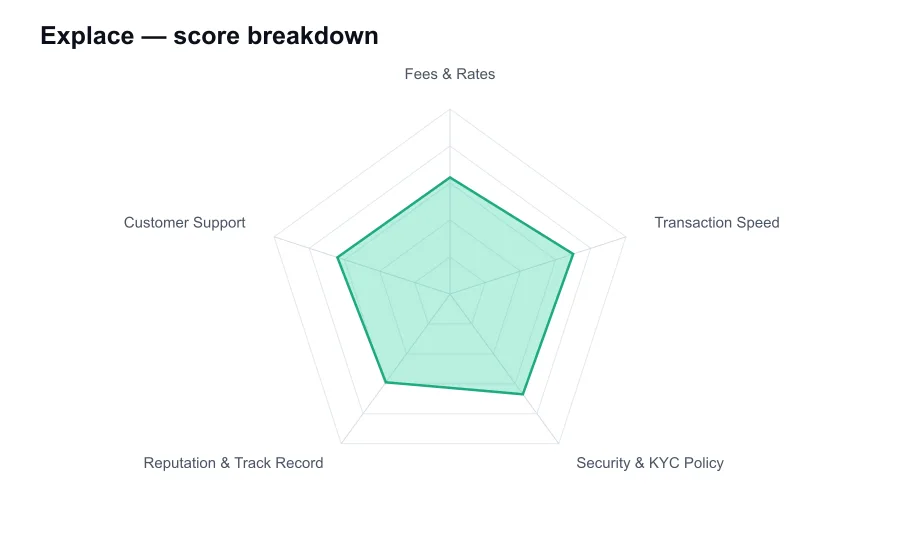
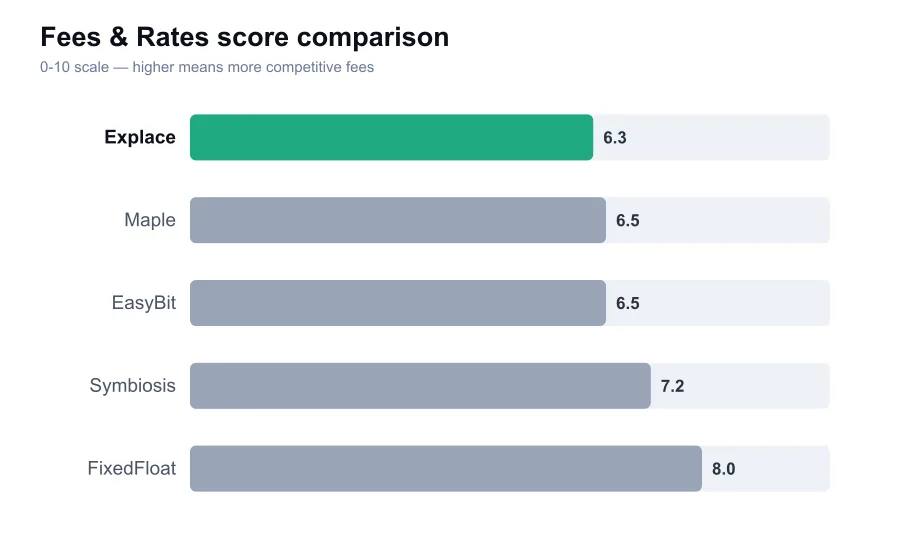
Fees are the weak point, not because Explace is necessarily expensive on every route, but because the all in price is hard to audit. The service generally presents a quoted receive amount rather than separating an exchange fee, provider spread, and network charge into a crisp invoice. This is normal among instant swap sites, but it is less transparent than using a real exchange order book or an on chain aggregator with visible routing.
For a small convenience swap, that opacity may be acceptable. If you are converting fifty dollars of crypto, a few dollars of spread can be a fair trade for skipping account creation. For a four figure conversion, it is lazy not to compare. Put the same input amount into Explace, Exolix, ChangeNOW, and a reputable exchange withdrawal calculation. The resulting amounts can differ enough to cover several on chain transaction fees.
Explace offers rate choices on supported routes, and users should not click through them mechanically. A floating rate may show a more attractive estimated result, but the actual payout can change while the deposit receives confirmations. A fixed rate provides more certainty for a limited payment period. It is usually the better choice for a time sensitive purchase, although the certainty is often reflected in a slightly less favorable initial quote.
Transaction speed is mainly governed by the asset you send and the route Explace uses. Swaps involving fast networks can complete shortly after the inbound deposit is recognized. Bitcoin, Ethereum during congestion, and tokens needing multiple confirmations naturally take longer. The service can process an order quickly, but it cannot settle Bitcoin faster than Bitcoin. Anyone promising a fixed minute count for every swap is selling an illusion.
There is a second kind of delay that deserves more emphasis. Instant exchange providers can pause an order for a wrong memo, an underpayment, a wallet screening alert, or an unavailable liquidity partner. These cases are not everyday events, but they are exactly why a casual user should start with a modest test. A service can look instantaneous until an exception occurs, then the quality of its operations becomes much more important than its landing page.
Explace's noncustodial framing is useful but should be understood precisely. It does not ask users to maintain a standing balance in a hosted account. You retain control of funds before sending and after receiving. During the swap itself, however, Explace and its counterparties handle the deposited asset. That is a lower custody burden than storing a portfolio on an exchange, not a cryptographic guarantee that eliminates all counterparty risk.
Routine KYC is not normally the center of the Explace experience. Still, the absence of an account form is not a promise that a transaction will never be reviewed. Like practically every service connected to external liquidity and payment infrastructure, it can apply AML controls and request information where it considers a transfer risky. Users concerned with privacy should read the policy before sending, not after a hold has already happened.
The bigger reputational limitation is scale. Explace has a much lighter public footprint than older names such as Godex, Changelly, or ChangeNOW. That does not establish wrongdoing, and smaller companies can provide excellent service. It does mean there is less independent history from which to judge how the business handles prolonged disputes, major security incidents, or a difficult compliance claim. I would not make it my first choice for a very large, urgent transaction.
A smaller footprint can have an upside. Explace's product does not feel overloaded with promotional clutter, and it has avoided the false grandeur some crypto brands use to disguise a basic routing service. The site is geared toward getting an order created. Yet polish is not a substitute for public accountability. Users should save the order ID, quoted amount, deposit address, transaction hash, and correspondence until the received asset is safely confirmed.
Support is available digitally rather than through a full scale support operation. That is adequate for simple questions, particularly if you contact the team before starting an unusual transaction. It is less reassuring for someone who expects immediate, high touch recovery assistance after sending to the wrong network. Email and chat support can resolve operational issues, but they cannot reverse an irreversible blockchain transfer or guarantee a rapid review by a liquidity partner.
My view of Explace is measured. It is useful for a modest, uncomplicated crypto swap, particularly for users who prefer not to create a trading account. It has not built enough of a public track record to justify blind trust on a major transfer, and its quote based fee structure needs active comparison. Treat it as a convenience service, make a test swap, and keep your own records. That is sensible behavior with Explace and, frankly, with every instant exchanger.