MoneroBridge is a small privacy focused instant exchange service built around one obvious audience, people who want to move into or out of Monero without opening a conventional trading account. It sits closer to ChangeNOW, SimpleSwap, and fixed rate swap desks than to Binance or Kraken. The appeal is straightforward: choose a pair, send the deposit, receive coins at a supplied address. There is no order book to learn and, under normal conditions, no account to create.
That simplicity matters particularly for Monero users. Centralized exchanges have steadily narrowed their XMR offerings because privacy coin compliance is awkward in many jurisdictions. A service that lets someone exchange BTC, ETH, LTC, USDT, or another supported asset for XMR without uploading identity documents fills a genuine gap. Still, the narrow focus also explains its limits. This is not a broad trading venue, a fiat ramp, or a place to store assets.
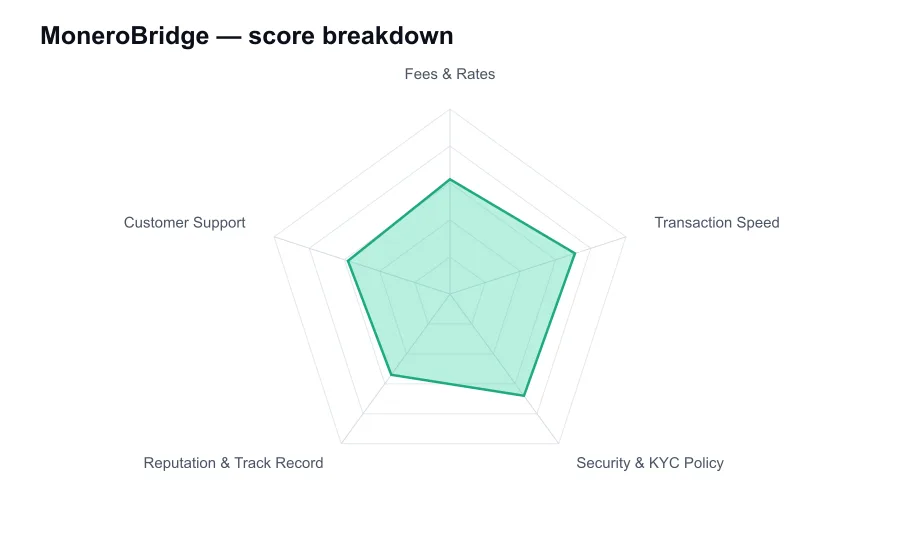
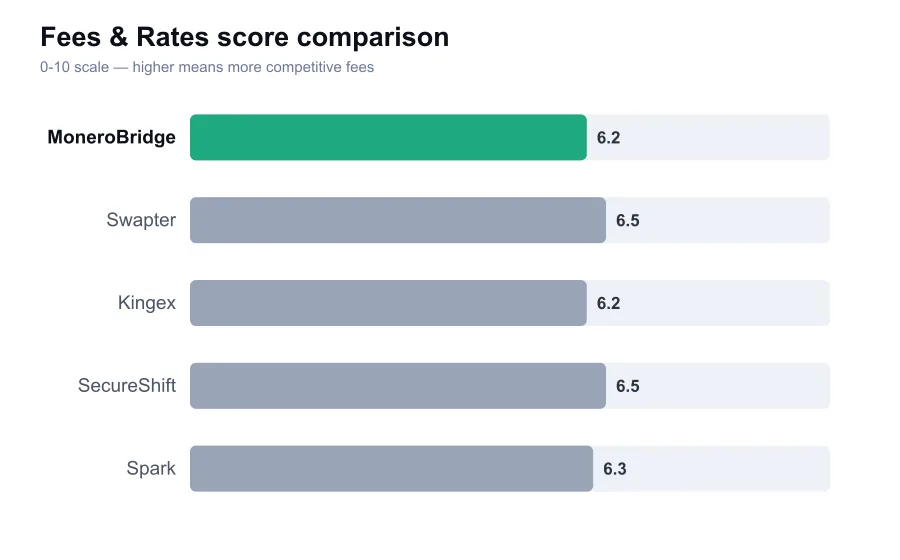
The fee presentation is one of the first areas where buyers should slow down. MoneroBridge does not work like an exchange with a plainly published maker and taker schedule. The spread, network cost, liquidity cost, and service margin are generally folded into the quote. That is common for instant exchangers, but it makes the headline rate less meaningful than the final receive amount. Compare the exact output against at least one competitor before sending funds.
For small swaps, the convenience premium can be reasonable. A person converting a modest amount of LTC to XMR may care more about a clean, no account workflow than saving a fraction of a percent. On larger swaps, that logic deteriorates quickly. A seemingly minor difference in the quoted XMR amount can amount to a meaningful cost. MoneroBridge is not the service I would select blindly for a five figure conversion.
Fixed rate quotes deserve special attention. A fixed quote can protect the customer from a sharp market move during confirmation, but it may have a higher included margin and a limited deposit window. Floating quotes can be cheaper in calm conditions but expose the recipient amount to market movement and changes in network fees. Users should read the selected rate mode rather than assuming that a displayed estimate is guaranteed.
Speed is normally governed by two things MoneroBridge cannot fully control, the source chain's confirmation requirement and the availability of the asset it needs to deliver. Fast chains can complete in minutes. Bitcoin deposits, Ethereum during congestion, and some token routes can take considerably longer. Monero itself has block times of roughly two minutes, and wallet visibility may lag until the relevant confirmations are recognized.
The service provides an order page and status tracking, which is essential for a noncustodial swap model. Keep the order ID, deposit address, payout address, transaction hash, and screenshots of the quoted terms. If something goes wrong, those details turn an uncertain support request into a solvable one. They are also your only practical audit trail because there is no full customer dashboard with years of account history.
The no registration approach is a privacy advantage, not an absolute guarantee that no compliance review can happen. Most instant exchange providers reserve the right to pause suspicious orders, request information, or return funds after screening. MoneroBridge should be assessed with that reality in mind. No KYC by default is materially different from a contractual promise that every transaction will remain anonymous and unreviewed.
From a security standpoint, the positive is that customers do not leave a standing balance on the platform. You send funds for an individual conversion and provide a destination wallet you control. That reduces the familiar exchange risk of an account takeover or a long term custodial collapse. It does not remove execution risk. Once crypto is sent to a swap address, reversing a mistake is usually impossible.
Use a wallet address copied directly from your own wallet, verify its first and last characters, and avoid swapping from an address controlled by an exchange that may reject privacy coin activity. For a first order, a small test is sensible. This is not paranoia. It is basic operational discipline for a relatively low profile service handling irreversible transfers, especially if you are crossing between chains or using a token with multiple network versions.
MoneroBridge has a thinner public track record than the established large instant exchange brands. That does not prove it is unreliable, but it limits the confidence one can draw from independent reporting, long running community discussion, and public incident history. A privacy oriented user may accept that tradeoff, yet it should affect order size. Reputation is earned over years of visible, consistent execution, not through a polished landing page.
Customer support appears to be centered on the site's order process and direct contact channels rather than phone support or a sophisticated ticket portal. That is acceptable for a simple service, but it can feel sparse during a delayed order. The quality of support only really becomes visible when a deposit is underpaid, a memo is missing, or blockchain screening flags a transfer. Those are precisely the moments where small operators are tested hardest.
I would not treat MoneroBridge as a wallet, a bank, or a substitute for a regulated exchange. Treat it as a transaction tool. Check the quoted output, inspect the network selected for every token, send the correct amount before a quote expires, and move received XMR into your own wallet. Those habits address more real risk than any marketing language about privacy or convenience.
My view is that MoneroBridge is useful because it addresses a difficult access problem for Monero, not because it has built an unassailable reputation. Its no account flow is attractive, and its swap process is easier than navigating an order book, but opaque all in pricing and limited public history keep it below the top tier. It fits careful, technically literate users making modest conversions. For very large transfers, regulated fiat activity, or users who need rapid human escalation, I would choose a more established venue.