Kingex is a small, non-custodial instant-exchange service built for people who want to swap one coin for another without opening a full trading account. It sits closer to ChangeNOW, SimpleSwap, and StealthEX than to Binance or Kraken. There is no order book to study, no advanced charting terminal, and no real reason to use it for active trading. Its appeal is convenience: choose an asset pair, send coins, and receive the output asset to a wallet you control.
That simple model has real advantages. New users can avoid the familiar exchange routine of registration, email verification, two-factor setup, deposit confirmation, trade execution, and withdrawal. Kingex cuts out much of that friction. For a straightforward BTC to ETH or USDT to SOL conversion, the checkout is easier to understand than a conventional exchange interface. The question is whether that convenience is being sold at a reasonable price.
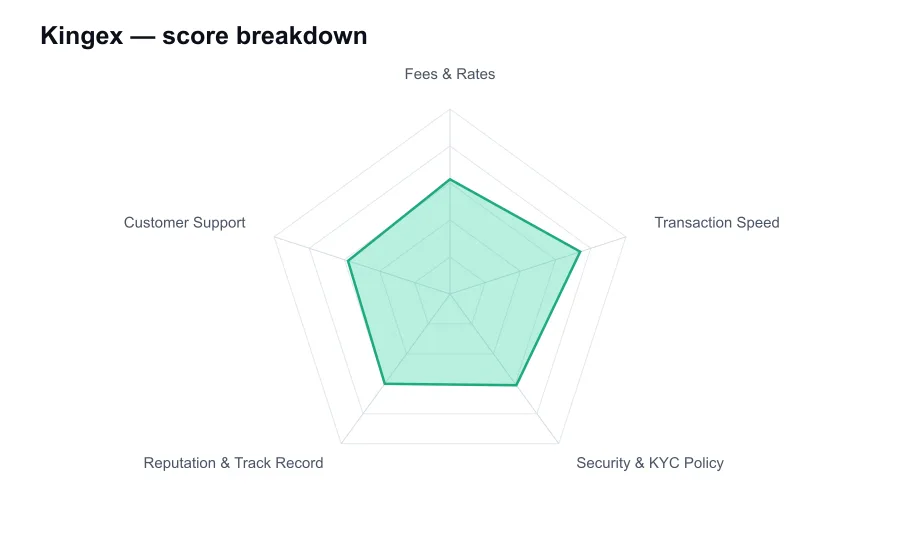
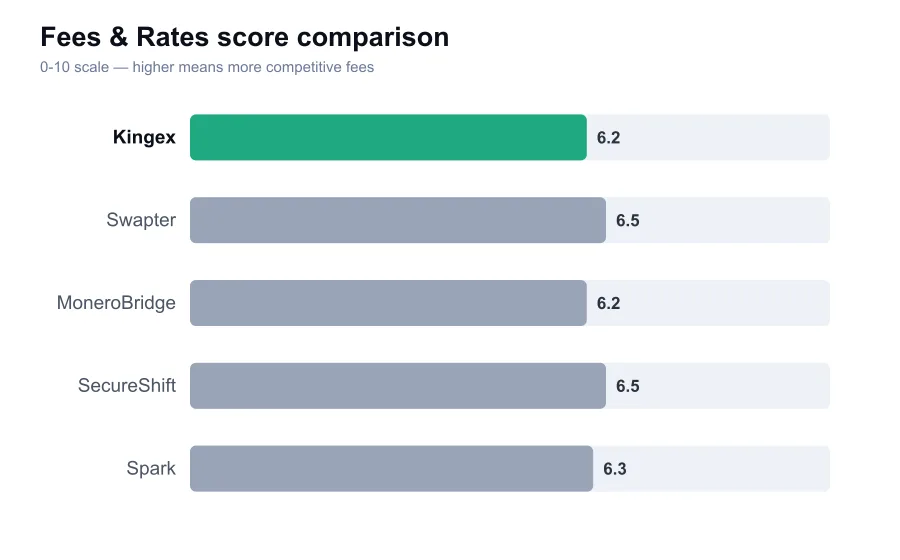
Kingex does not present a clean, universal percentage service fee in the way Coinbase Advanced or Kraken Pro does. The rate shown in the quote is the practical fee the customer pays, and it can include liquidity-provider spread, network costs, and Kingex's own margin. That is normal for instant exchanges, but it makes true comparison harder. A customer looking only at the headline exchange rate can mistake a wide spread for market movement.
In my spot checks of services in this category, Kingex's pricing has usually looked acceptable for smaller, ordinary swaps, but it has rarely been the obvious bargain. Major pairs can be competitive, particularly when liquidity is deep and network fees are calm. Less liquid tokens, cross-chain stablecoin conversions, and urgent fixed-rate swaps can become noticeably expensive. If saving every fraction of a percent matters, an order-book exchange or a DEX aggregator will usually offer more visibility and often better execution.
The fixed-rate option is useful, provided the user understands what it is buying. A floating quote can improve or worsen between the moment a customer opens the page and the time the incoming transaction gets confirmed. A fixed quote reduces that uncertainty, which is valuable during volatile markets. But the protection is not free. Fixed routes generally carry a wider embedded margin, and customers should compare the received amount before assuming that certainty is a bargain.
Speed is one of Kingex's better qualities, although no instant-exchange brand controls the blockchains involved. Once the deposit receives enough confirmations, common routes can complete in roughly five to twenty minutes. Fast networks such as Litecoin, Tron, Solana, or Polygon can make the process feel nearly immediate. Bitcoin deposits, Ethereum congestion, wallet-side delays, and compliance reviews can turn the same experience into an hour or more.
That distinction matters because the service's marketing language can encourage unrealistic expectations. Kingex may process an order promptly, but it cannot force a slow Bitcoin block or repair an incorrectly chosen network. A user sending USDT must verify whether the destination and deposit routes use Ethereum, Tron, BNB Smart Chain, or another supported network. This is not a small detail. Sending on the wrong network can turn a convenient swap into a recovery request with no guaranteed outcome.
Kingex's non-custodial framing is meaningful but should not be romanticized. It does not operate like a wallet where the user holds private keys throughout a trade. The customer sends funds to an address controlled for order processing, then Kingex or its liquidity partners send the output asset onward. That is a shorter custody window than keeping funds on a centralized exchange, but it is still a trust event. Users should swap, then withdraw to their own wallet, not treat the service as storage.
The service generally allows many transactions without account creation and without routine KYC. That is attractive to privacy-minded users, and it makes small swaps less invasive than on regulated exchanges. Yet no-KYC does not mean no compliance policy. Kingex reserves the right to pause an order and request identity information under anti-money-laundering procedures, especially where automated screening identifies a risk signal. Anyone who cannot or will not provide documents should not send funds assuming a review can never happen.
This is the central trade-off with Kingex. Its light onboarding is genuinely convenient, but its compliance escalation process is not as transparent or predictable as a fully regulated exchange's published account rules. If an order is flagged, a customer may face a support exchange and a request for source-of-funds information after the coins have already been sent. That is unpleasant, even if the screening itself is understandable. Large transfers and coins with questionable transaction histories are poor candidates for this kind of service.
Kingex has been operating for several years, which puts it ahead of anonymous swap pages that appear for a season and disappear after complaints build up. It has an established web presence and a recognizable product rather than the look of a hastily assembled clone site. Still, it does not have the public corporate depth, regulatory footprint, audited financial reporting, or battle-tested institutional reputation of Kraken, Coinbase, or Bitstamp. That limits the amount of blind trust it has earned.
Public review sites show the familiar instant-exchange pattern: plenty of users report quick, painless swaps, while the negative stories tend to involve delayed orders, rate differences, or compliance holds. Neither kind of review should be read in isolation. A five-star comment after a routine low-value swap proves little, while a complaint about a frozen transaction needs context that outsiders rarely have. The consistent lesson is more practical: use small test transactions before committing meaningful value.
Customer support is available through the site's contact channels and live-chat style assistance, and basic questions often get answered quickly. That is enough for routine order tracking. It is less reassuring when a transaction is stalled, a network has been selected incorrectly, or a compliance request appears. Kingex does not have the support infrastructure, phone access, or formal escalation visibility that a large regulated platform can provide. Users should save transaction IDs, screenshots, and the exact quoted amount before opening a ticket.
The interface itself is clean and sensibly restrained. It doesn't drown a one-time buyer in charts or promotional clutter. Supported-asset availability is broad enough for common swaps, but availability should never be assumed from a token's popularity alone. Networks and routes change, and a coin may be listed while a particular pair or chain is temporarily unavailable. Check the final route, minimum, and expected receipt amount every time.
Kingex makes sense for a modest, uncomplicated swap from a self-custody wallet, especially for someone who values speed and minimal signup over exchange-grade pricing. It is not where I would place a large purchase, move institutional capital, or trade frequently. The spread is the price of convenience, and the AML hold risk is the price of loose initial onboarding. Used carefully, it is a credible utility service. Used casually with a large sum, it asks for more trust than its public profile really justifies.