SecureShift is an instant crypto exchange aggregator, not a venue with its own conventional order book or a full-service custodial broker. Its job is to take a request such as BTC to USDT or ETH to XMR, find an available third-party liquidity route, and present a conversion quote. That puts it in the same broad category as services such as ChangeNOW, SimpleSwap, StealthEX, and Swapzone, although the exact liquidity partners and terms can differ.
The attraction is obvious. Users can exchange assets from a personal wallet without creating a standard trading account, depositing funds into a custodial balance, or learning how to use a spot exchange. For a one-off conversion, the workflow is familiar: choose a pair, enter a receiving address, send funds to a generated deposit address, then wait for the exchanged asset to arrive. It is simple enough to feel almost too simple.
That simplicity is also why users need to understand what SecureShift is and is not. It does not control blockchain confirmation speed, it is not necessarily the final counterparty to every trade, and it cannot guarantee that an initially displayed rate will survive a sharp market move. The service sits between the user and a network of liquidity sources. Its execution quality therefore depends on both its own systems and its partners' inventory, compliance rules, and operational reliability.
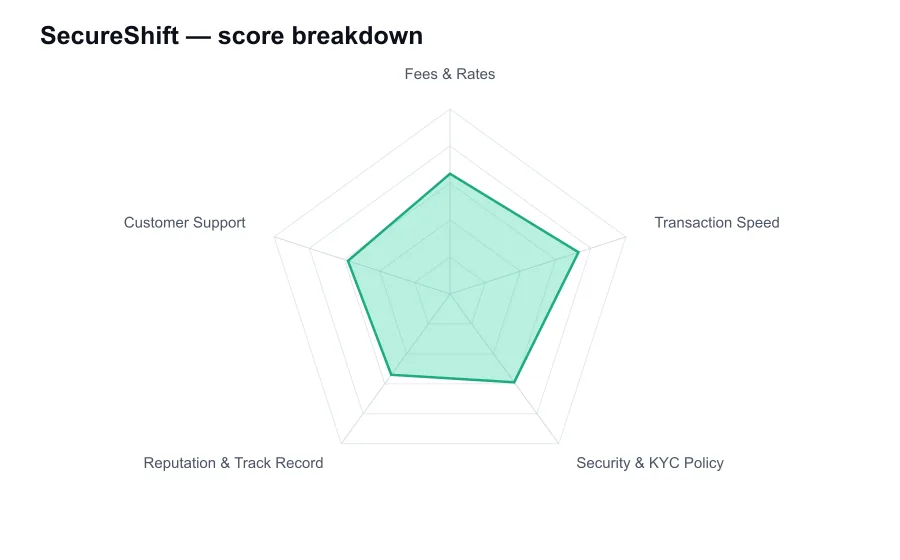
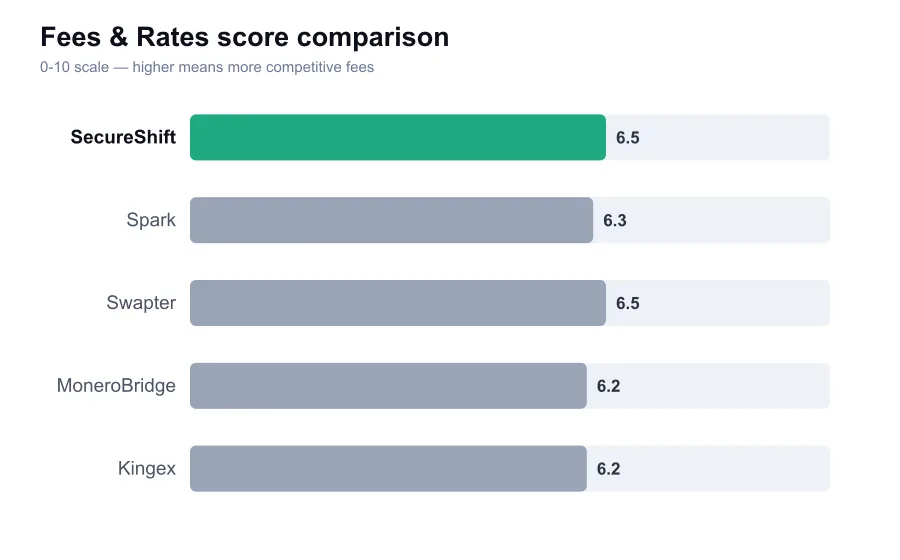
Fee transparency is the critical issue with instant exchanges. SecureShift can show a rate that includes its margin, a partner fee, network costs, and market spread rather than presenting a clean maker and taker fee schedule. That is standard for this model, but it means the only number that really matters is the estimated amount you will receive. Compare it with at least one rival quote before sending funds, especially for a trade above a few hundred dollars.
Fixed-rate and floating-rate options, where available for a particular pair, should be treated differently. A fixed quote usually aims to protect the user against market movement during a stated time window, but it can carry a higher built-in cost and may have strict deposit timing requirements. A floating quote may be cheaper at the moment it appears, yet the final amount can change before the incoming transaction receives enough confirmations. Neither option is universally better. It depends on volatility and urgency.
SecureShift can be cost-effective for a modest swap of liquid assets when its routing is competitive. It is much less convincing for frequent trading. The spread hidden in an all-in quote can easily exceed the costs of using Kraken, Coinbase Advanced, Binance, or a decentralized exchange directly. Instant swap providers sell convenience and reduced setup time. They generally do not sell professional-grade price discovery.
Speed is decent but variable. Once the deposit transaction has received the required confirmations and a liquidity provider accepts the order, many common swaps complete within minutes. Fast networks can make the process feel near-instant. Bitcoin, privacy coins, congested Ethereum transactions, and any trade flagged for manual review can take much longer. The relevant timer starts when the deposit is confirmed, not when you first click exchange.
The most frustrating failures in this category happen when users send the wrong asset, use an unsupported network, or deposit less than a platform's minimum. These errors are especially painful because a no-account service has fewer recovery tools. SecureShift provides an order identifier and status page, which users should save immediately. Do not close the page, delete the transaction ID, or assume a wallet's sent notification proves the service has credited the deposit.
SecureShift presents itself as noncustodial or registration-light, and that is partly true in the ordinary flow. It does not require a permanent exchange account to request a swap, and users can receive funds directly to their own wallet. Still, calling any instant exchange fully anonymous or immune to compliance review would be misleading. Like comparable providers, it may request identification if transaction monitoring flags an order or if a liquidity partner needs additional information.
That conditional KYC model is better described as no routine KYC than no KYC. For a privacy-conscious user, the distinction is substantial. Most straightforward transactions may proceed without uploading documents, but there is no promise that every transaction will. If a swap is held for review, the customer may be asked to verify identity or source of funds before the order proceeds or is refunded. People who cannot accept that possibility should not send funds.
Security is also about the website and the user's wallet hygiene. SecureShift cannot protect someone who enters a malicious receiving address, connects an unsafe browser extension, or follows a phishing ad to a clone site. Bookmark the official domain, confirm network names carefully, and avoid sending a large amount in the first transaction. These precautions sound repetitive because they prevent the most common and irreversible failures in wallet-to-wallet exchange services.
The reputation picture is mixed chiefly because SecureShift has a lower public profile and a shorter, thinner independent record than category leaders. That does not mean it is automatically unsafe. It does mean the burden of verification should be higher. A service handling irreversible crypto transfers needs more than a clean landing page and a few favorable review snippets. Check current community discussions, examine its support responsiveness before a major transaction, and compare its business transparency with better-known alternatives.
Support is available through online channels, but this is not a service I would use for a transaction that requires immediate human intervention. Support teams at instant exchanges can help trace an order, explain confirmation requirements, or deal with a technical route failure. They cannot reverse blockchain transfers, and they may have limited power if a third-party liquidity partner has placed an order into compliance review. That is the structural weakness of the model.
SecureShift has a reasonable use case for a technically competent user who needs a convenient wallet-to-wallet conversion and has checked the quote. It is not where I would park money, conduct repeated trades, or make a life-changing swap without testing the service first. The absence of a normal account is a convenience feature, not a guarantee of privacy or safety. This category rewards careful users and punishes assumptions.
My verdict is cautious. SecureShift may be useful as a secondary routing option, particularly if it offers the best final quote for a specific pair. Its speed and low-friction workflow are real positives. Yet its comparatively limited track record and opaque all-in pricing prevent me from ranking it alongside the most established names without reservation. Start small, document everything, and use a deeper exchange or direct on-chain route whenever price certainty matters more than convenience.