ClickPay sits in the payments business, not the crypto-exchange business. That distinction matters immediately. Its product is aimed at merchants that need to accept card and local payment methods online, particularly in Saudi Arabia and the wider Middle East and North Africa region. Someone arriving in search of a place to buy Bitcoin, trade perpetual futures, or withdraw USDT to a wallet will find the wrong product.
The company has built its pitch around checkout infrastructure rather than digital-asset custody. Its tools are designed to help a store, app, or service provider collect payments through cards and regional rails, then manage those transactions from a merchant dashboard. That can be useful infrastructure, but it isn't comparable to Binance, Coinbase, Kraken, Bitstamp, or a specialist crypto payment processor such as BitPay.
For a merchant already selling conventional goods in the Gulf, ClickPay's regional focus is potentially its strongest point. Local card acceptance, Arabic-language operations, and payment options familiar to customers can improve checkout completion more effectively than a global processor that treats the region as an afterthought. That is a practical advantage, especially for smaller businesses that don't want to piece together several payment providers.
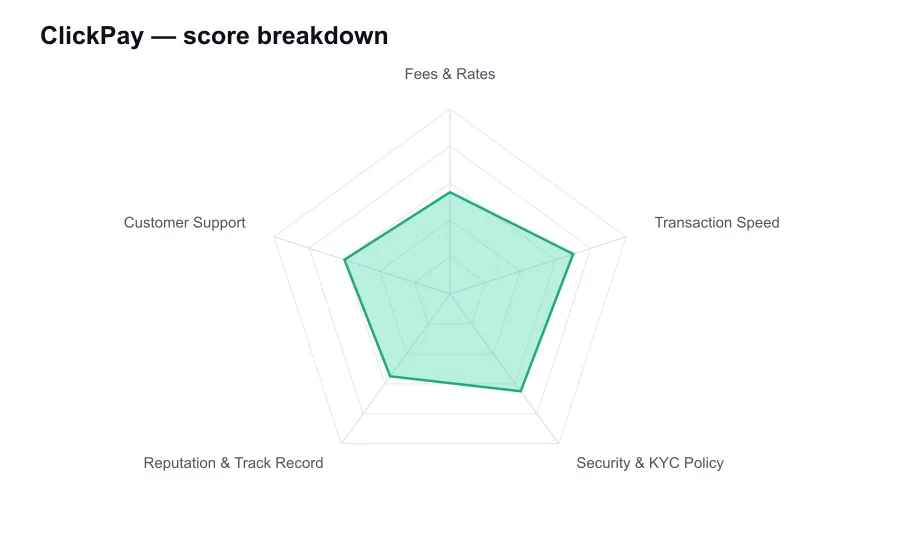
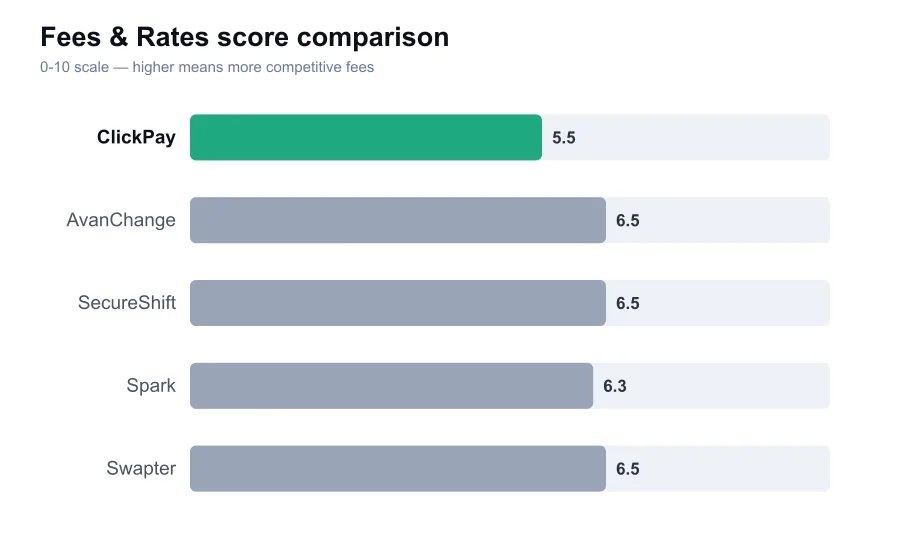
Fees are harder to judge than they are on a transparent retail crypto exchange. ClickPay does not present a universal public trading-fee table because merchant pricing is commonly shaped by country, payment method, business type, volume, chargeback profile, and settlement arrangement. A prospective merchant should get a written quote and ask for every component, including transaction fees, refund handling, chargeback fees, cross-border markups, reserve requirements, and payout charges.
That lack of a simple public rate card isn't automatically a red flag. Payment acquiring is often negotiated. Still, it makes apples-to-apples comparison more difficult, and it gives a small merchant less ability to assess value before starting a sales conversation. For a business with meaningful volume, negotiated pricing may be perfectly sensible. For a very small online seller, a processor with clearly published rates can be easier to budget.
There is no maker-taker schedule, spread disclosure, or blockchain network fee to assess here, because ClickPay is not executing cryptocurrency trades. A merchant shouldn't describe a checkout processing fee as a crypto conversion fee. Nor should a user assume that a payment accepted through ClickPay creates a crypto balance or provides any route to self-custody. It doesn't appear to be built for that purpose.
Speed should likewise be separated into two different questions. Card authorization at checkout is intended to be immediate, which is what an ecommerce merchant needs. Merchant settlement is a separate operational process and can depend on the contract, the acquiring bank, the payment rail, weekends, compliance checks, and reserve arrangements. Anyone promising same-minute access to card-sales proceeds is likely overselling how payment processing works.
For a customer paying at checkout, the experience can be quick and ordinary if the merchant has integrated the gateway properly. For the merchant, payout timing deserves direct scrutiny before signing. Ask whether settlement is on a next-business-day, weekly, or custom schedule, whether cut-off times apply, and whether refunds or disputes can delay a release. Those details matter far more than a glossy checkout demo.
Security has to be viewed through the lens of payment data rather than coin custody. A payment processor should be evaluated for secure hosted checkout, tokenization practices, access controls, PCI-related responsibilities, fraud tools, and clear merchant account permissions. ClickPay's role in handling card payments means a business should also understand which security tasks it retains, rather than assuming the gateway takes responsibility for every part of compliance.
KYC is not optional in this part of the market. Merchants should expect business verification, beneficial-owner checks, banking details, and documentation proportionate to their activity. That can feel onerous to a small operator, but it is normal for a regulated payment relationship. It is very different from the no-KYC crypto swap services some users seek, and anyone looking for anonymity should look elsewhere.
ClickPay's reputation is more naturally measured among regional ecommerce merchants than among crypto traders. It has a recognizable payments-oriented presence, but it does not carry the long, globally scrutinized exchange record of Coinbase or Kraken. That isn't a criticism of its core business. It is simply why a crypto-specific reputation score has to be modest: there is no demonstrated exchange track record to assess.
Support appears to be a merchant-service proposition, with onboarding and integration assistance being more relevant than retail live chat. Businesses should test responsiveness before committing. Send technical questions about APIs, refund workflows, settlement reporting, and dispute handling, then judge the quality of the reply. A provider can be polite during sales onboarding and still be slow once an urgent payment issue appears, so this small test is worthwhile.
The practical fit is clear. ClickPay may suit a regional merchant that wants conventional online payment acceptance and values local market coverage. It does not suit a trader, a long-term crypto holder, or a business that specifically needs Bitcoin, stablecoin, on-chain settlement, wallet support, or exchange liquidity. Calling it a crypto exchange would be inaccurate.
My take is straightforward: assess ClickPay as a regional payment gateway, not as an exchange. It may deserve consideration for a Gulf-focused checkout stack, particularly where local payment methods matter more than global brand recognition. But its opaque merchant pricing requires diligence, and its crypto relevance is effectively absent. If digital assets are central to the business, choose a provider whose product, licensing disclosures, custody model, and fee structure actually address them.