Spark occupies an awkward but potentially useful corner of the instant-swap market. It is aimed at people who want to convert one crypto asset into another without opening a conventional exchange account, placing an order on an order book, or handing over a full trading profile before making a small transaction. The pitch is familiar, but Spark's appeal is its relatively stripped-back flow. Pick a pair, enter a receiving address, send funds, and wait for the swap to settle.
That simplicity is also the first thing to examine critically. Instant exchanges are not exchanges in the Coinbase or Kraken sense. They are routing services. The rate a customer sees can reflect liquidity supplied by external venues, a provider's margin, network fees, and market movement while the deposit is being confirmed. Spark is convenient precisely because it hides this machinery. It cannot make the underlying risks disappear.
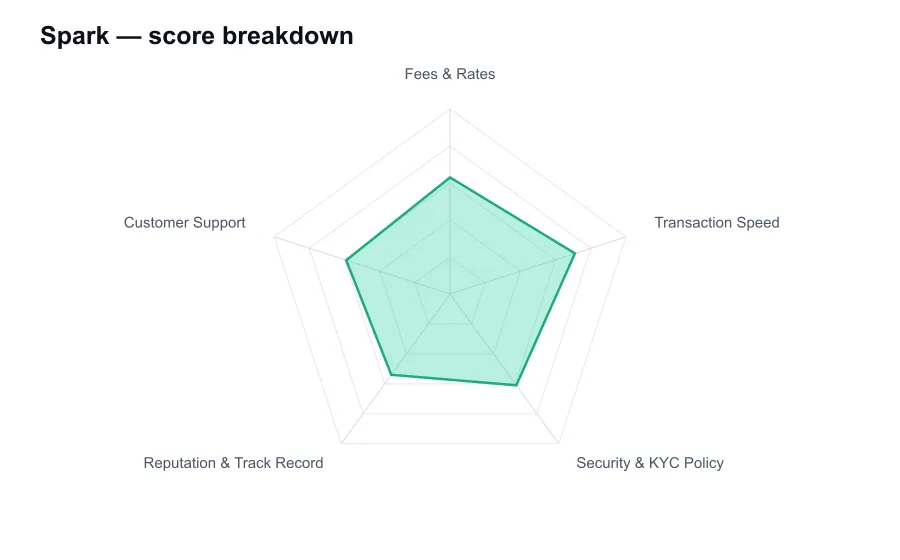
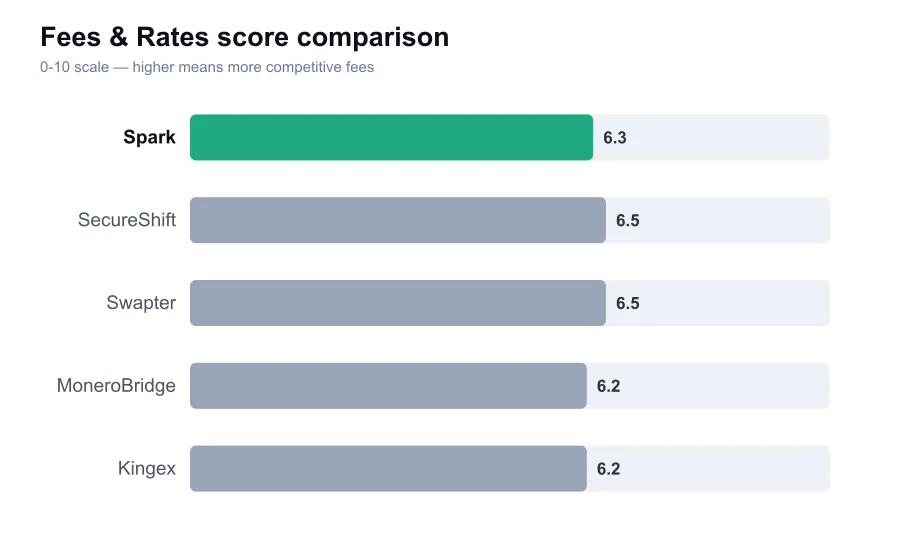
The fee picture needs more transparency than many casual users expect. Spark's quoted exchange rate is the practical price to judge, rather than assuming that a low or absent headline service fee means a cheap trade. On floating-rate transactions, the final amount can move between order creation and execution. The spread can be modest on liquid pairs such as BTC to ETH, but it may widen noticeably on smaller tokens, thin networks, or periods of sharp market volatility.
This is not unique to Spark, and it is not automatically unfair. Every instant-swap desk needs to manage price risk. The problem is that users comparing services often look only for a percentage fee. A 0.5 percent explicit fee with a competitive market rate can be better than a zero-fee label paired with a wider spread. Before sending anything significant, I would quote the same pair at Spark, StealthEX, ChangeNOW, and a major exchange. The final receive amount is the comparison that matters.
Spark is best suited to modest conversions where convenience is worth paying a small premium. It is much less persuasive for a large rebalance. If you are moving several thousand dollars' worth of BTC, ETH, SOL, or stablecoins, even a small difference in execution can cost more than the time needed to use an exchange with transparent spot pricing. Users who trade regularly should not confuse an instant swap page with a low-cost trading venue.
Speed is generally tied to the asset being deposited, not merely to Spark's own interface. A swap involving a fast chain can progress quickly once the incoming transfer reaches the required confirmations. Bitcoin deposits naturally take longer, and congested Ethereum transactions can add a frustrating delay before Spark can safely release the outgoing asset. A smooth transaction can complete in minutes, while a multi-confirmation deposit or a slow liquidity route can take considerably longer.
That distinction is important because support teams at instant services cannot accelerate a blockchain confirmation. What they can control is how clearly they report order status, whether they broadcast the payout promptly, and whether they explain a delay instead of leaving the customer staring at a transaction ID. Spark's model works best for users who understand that "instant" describes exchange processing, not a guaranteed end-to-end settlement time.
The custody arrangement is better than leaving coins on a centralized exchange for weeks, but it is not the same as self-custody at every second of the transaction. Spark receives the deposit, converts it through its liquidity process, then sends the acquired asset to the address supplied by the customer. That means an address typo, an unsupported memo, or selecting the wrong network can become a very expensive mistake. There is no account balance to recover later.
Spark is marketed around a light-friction experience, yet no responsible reviewer should describe any no-registration swap service as unconditional anonymity. Crypto businesses can apply anti-money-laundering checks when a transaction is flagged by risk systems, linked to sanctioned activity, or otherwise needs review. A user may be asked for information after sending funds. That is the uncomfortable edge of this category, and Spark should be judged by how openly it describes the possibility and how fairly it handles reviews.
I would not use an instant exchange for coins with an uncertain compliance history. It is better to know that a transfer could trigger scrutiny before you send it than to discover it after an order is paused. Clean-source funds, correct wallet details, and a small test transaction are sensible habits. They are particularly sensible with a provider that does not offer the depth of public disclosure, financial reporting, and long operating record available from the biggest regulated platforms.
Reputation is where Spark asks customers to make the largest leap of faith. It does not carry the long, easily auditable public track record of Kraken, Bitstamp, or Coinbase, nor the broad independent review footprint of established instant-swap names such as Changelly and ChangeNOW. That does not prove poor service. It does mean a good-looking website and a fast first swap should not be treated as proof of institutional reliability.
The practical approach is to start small and save everything. Keep the order ID, screenshots of the quoted rate, deposit hash, and payout hash. If a payout is delayed, those details make a support conversation much easier. It also pays to check recent discussion rather than relying on a provider's selected testimonials. Complaints about unavoidable network delays are one thing. Repeated reports of unexplained rate changes or slow resolution are a different and more serious signal.
Support is important here because a customer has no trading dashboard, account manager, or bank-style dispute process to fall back on. Spark's support channel is most useful for order-specific questions, deposit confirmation problems, and payout tracking. Expectations should stay realistic. Support can investigate a missing or delayed payout, but it cannot reverse a completed blockchain payment or repair an address entered incorrectly by the sender.
Spark can be a sensible tool for someone who values a quick, account-light conversion and understands how on-chain transfers work. I would use it for a small, straightforward swap after checking its quote against competitors. I would not choose it for a large treasury movement, a first-ever crypto transaction, or any situation where fixed execution and a long institutional record matter more than convenience. Its usefulness is real, but it is a specialist tool, not a financial home.