Changee is positioned in the crowded instant-exchange category, a space built for users who want to swap crypto directly from one wallet to another without learning a full trading platform. It sits closer to services such as Changelly, ChangeNOW, SimpleSwap, and StealthEX than to a conventional exchange. The proposition is simple, choose assets, accept a quote, send the deposit, and receive the output asset at a wallet address you control.
That kind of product has obvious appeal. It removes account dashboards, order-book terminology, and the temptation to leave money sitting on a centralized venue. For someone converting BTC to USDT, exchanging stablecoins between chains, or replacing one supported asset with another, the workflow can feel refreshingly direct. Changee is not trying to win over professional traders. It is trying to make a single conversion less cumbersome.
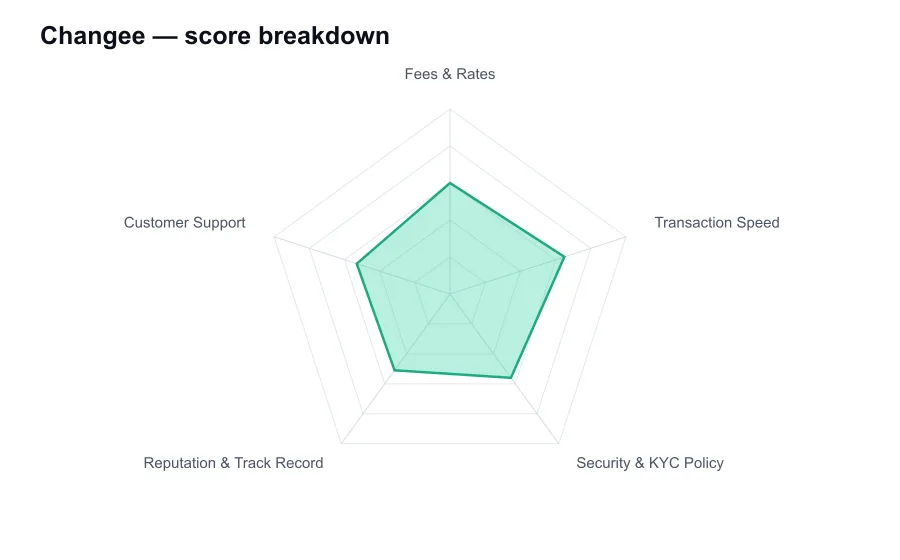
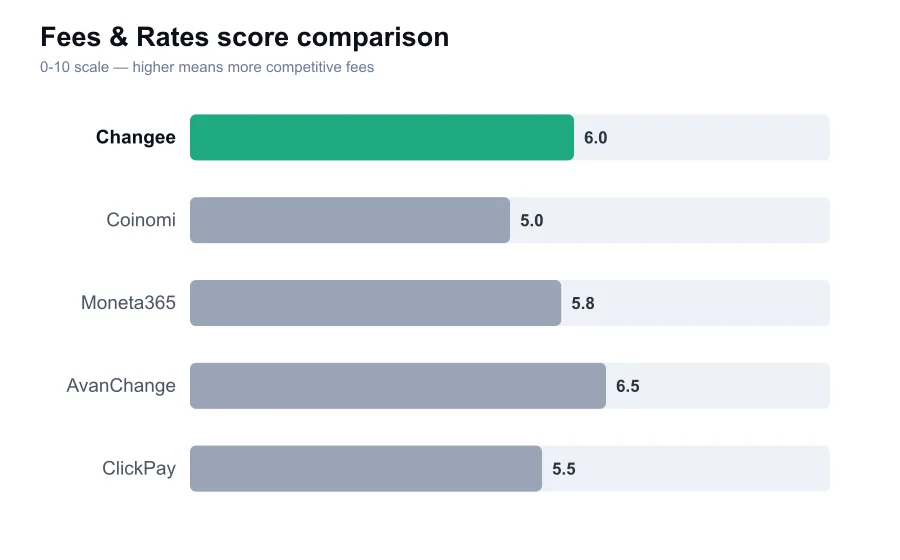
The problem with this entire category is that simplicity on the screen can hide complexity in the price. Changee's cost is not best understood as one clean percentage fee. The final offer can reflect liquidity-provider pricing, the spread between buy and sell markets, blockchain charges, and the choice of floating or fixed rate where that option is available. A user who sees only the initial rate and ignores the estimated payout is not comparing services properly.
I would not accept a conversion quote without checking at least one rival. ChangeNOW and SimpleSwap can occasionally produce noticeably different payouts for the same asset pair because they use different liquidity sources and spread policies. For liquid pairs, the difference may be modest. For smaller tokens or during a volatile market, it can be large enough to matter. Changee should earn the transaction with a competitive final amount, not with a claim that the process is fast or private.
Fixed-rate swaps deserve special attention. A fixed rate can be useful where the user wants certainty and is willing to pay for it, particularly with volatile assets. A floating rate may produce a better result in a stable market but leaves the final amount exposed to movement between quote and execution. Users should read exactly how long a quote remains valid and what happens if they send after that window. These details determine whether a price difference is an actual fee or simply market movement.
Speed is likely to be good on routine, liquid routes, but it is not magic. Changee must recognize the deposit, obtain or route liquidity, and broadcast the outgoing transaction. The source chain may be the slowest part. Bitcoin confirmation requirements, Ethereum congestion, and wallet-side delays can all make a conversion take longer than the customer expects. A stablecoin transfer on a lower-cost network can be much faster, but only if the network selection is correct at both ends.
The service should not be treated as an emergency bridge for a deadline. A swap that normally takes minutes can become much longer if the deposit needs additional confirmation, the token requires manual review, liquidity is thin, or the blockchain is under stress. This is true across instant exchanges, but smaller brands have fewer public operational metrics to reassure customers about their performance during market spikes. If time has financial consequences, use a route you have already tested.
Changee's wallet-to-wallet model is preferable to depositing and retaining a balance at a small exchange. The user supplies a destination address and should receive the converted asset there, which limits long-term custodial exposure. Still, the provider temporarily receives the deposit and coordinates the payout. A customer must trust it for the duration of the order. That is why using a hardware wallet or trusted self-custody wallet does not by itself make a swap risk-free.
KYC policy is another area where marketing language can mislead. A service may allow many ordinary transactions without account creation or routine document submission, while retaining the right to pause an order and ask for verification if risk systems identify a concern. This can arise from sanctions screening, suspicious transaction patterns, flagged source addresses, or liquidity-partner requirements. No responsible reviewer should present low-friction onboarding as a guaranteed anonymity service.
For users who care about privacy, the honest decision is whether they are prepared for that contingency before they deposit. If the answer is no, do not send funds. If the answer is yes, use a provider with terms you have read, retain evidence of the source and destination, and avoid mixing identities, payment instructions, or addresses in a way that creates a preventable compliance issue. A verification hold is inconvenient, but it is not automatically evidence of bad faith.
Changee's reputation is where it trails the biggest names in instant swaps. It has a smaller public profile and less independently available history than established competitors such as Changelly or ChangeNOW. A limited public footprint is not proof that the service is unsafe, but it does reduce the confidence a reviewer can assign. I would want to see consistent user feedback across time, clear terms, responsive support, and a pattern of handling difficult orders before putting it in the same trust bracket as larger providers.
Support should be viewed as part of the product, not a footer link. In a clean swap, nobody needs help. In a failed or delayed one, the user needs a team that can identify the inbound transaction, explain whether it is awaiting confirmation or review, and provide a realistic next action. Before using Changee for a material sum, I would send a precise question through its official support channel. The quality, speed, and specificity of the response are useful information.
The user experience is best for people who already understand basic crypto mechanics. They need to know that USDT exists on multiple networks, that an exchange address may require a memo or tag, and that a transaction cannot normally be reversed after broadcast. Changee can simplify the swap itself, but it cannot protect a customer who selects the wrong chain or pastes an attacker-provided address. The simplest interface in crypto still requires careful inputs.
Changee has a legitimate role as a convenience option, but it has not earned the same level of automatic trust as the largest instant-exchange brands or regulated centralized exchanges. If its rate is among the best, a small test is successful, and the user values direct delivery to self-custody, it can be a sensible tool. If the transaction is large, time-sensitive, or connected to fiat banking, the cautious choice is a provider with deeper disclosure and a longer public operating record.
My verdict is that Changee is promising as a lightweight swap service but not compelling enough to use blindly. Its direct model and potentially convenient asset coverage are attractive. The limiting factors are price opacity, unavoidable chain dependence, and a thinner reputation record than the market leaders. Use it for carefully checked swaps, not as a shortcut around due diligence.