Moneta365 presents itself as an always available cryptocurrency exchange service, aimed at users who want to swap assets without learning a professional trading terminal. That positioning puts it in a crowded part of the market. There are dozens of instant exchangers promising fast execution, broad coin lists, and no registration. The real challenge is not building a clean conversion form. It is proving that quotes are competitive, orders are handled consistently, and customer problems do not disappear into a contact inbox.
The service is most relevant to people who already own crypto and want a direct conversion. It is not the natural choice for someone buying their first bitcoin with a bank card, managing a diversified portfolio, or placing limit orders. The lack of a conventional exchange account can be appealing for privacy and speed, but it also means fewer account controls, less detailed reporting, and a different kind of risk if an order is delayed.
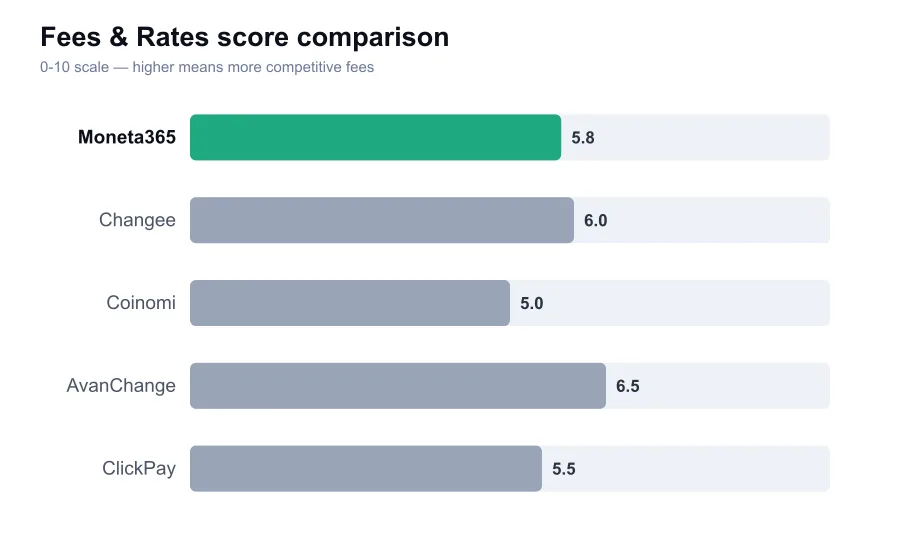
Pricing should be approached with discipline. Moneta365's exchange cost is best understood through the amount it promises to deliver, not through a headline percentage. Instant exchange platforms commonly combine liquidity provider costs, blockchain fees, risk buffers, and their own margin into a single quote. The customer sees an apparently simple rate but cannot always identify which component is responsible for a less favorable result.
That does not automatically make the service expensive. For some pairs and some order sizes, an aggregator can source a strong rate and beat an exchange after withdrawal fees are included. Yet that claim has to be checked order by order. Take the quoted output from Moneta365, compare it with at least two competing instant services, and compare all three against a liquid centralized exchange if you have an account. The difference is sometimes trivial. Sometimes it plainly is not.
Be especially wary of treating a floating quote as a promise. Crypto prices can move during the time it takes to create a deposit, broadcast it, and obtain confirmations. If the source asset drops or the destination asset rises, the final amount may be lower than the initial estimate. Fixed rate orders reduce that market uncertainty, provided the deposit arrives on time and in the requested amount, but fixed pricing often includes a larger protective margin.
The speed story is similarly route dependent. A swap involving a quick native coin can feel nearly immediate after the deposit is seen. Bitcoin, ERC 20 tokens, and transactions submitted with an inadequate network fee are a different proposition. Users often blame the exchange for a delay that began before the deposit reached it. Check the deposit transaction on a block explorer before opening a ticket and make sure the selected chain matches the address shown by the order.
Moneta365's simple order model is convenient, but it leaves little room for correcting user mistakes. Sending the wrong coin, omitting a required destination tag, or selecting USDT on the wrong network can create a manual recovery problem. Recovery may be possible, but it is never guaranteed and can take time. The sensible approach is a small test transfer whenever you are using an unfamiliar route or sending a larger amount than usual.
The privacy angle needs a realistic reading. A no account or low friction exchange flow means Moneta365 does not necessarily collect the same routine profile as a regulated custodial platform. It does not mean the service is outside financial crime controls. Transaction monitoring, sanctions screening, source of funds questions, and exceptional verification requests can still appear. Anyone who needs certainty around compliance treatment should use a fully regulated provider and ask before sending.
Its noncustodial structure is a genuine security positive. Users are not encouraged to park a balance for weeks, stake it, borrow against it, or keep an API key connected. The platform's exposure is limited to an active conversion. That reduces one category of counterparty risk. It does not solve the main hazards of instant swaps, which are phishing sites, copied wallet addresses, incorrect networks, and a provider holding funds while an exception is reviewed.
Use the official domain saved in your browser, not a sponsored search result or a link from a social media reply. Confirm the payout address before submitting the order and save every detail associated with it. If Moneta365 displays minimum and maximum limits, respect them. Orders outside stated limits are more likely to need manual work, and manual work is precisely what turns a supposedly instant product into a frustrating one.
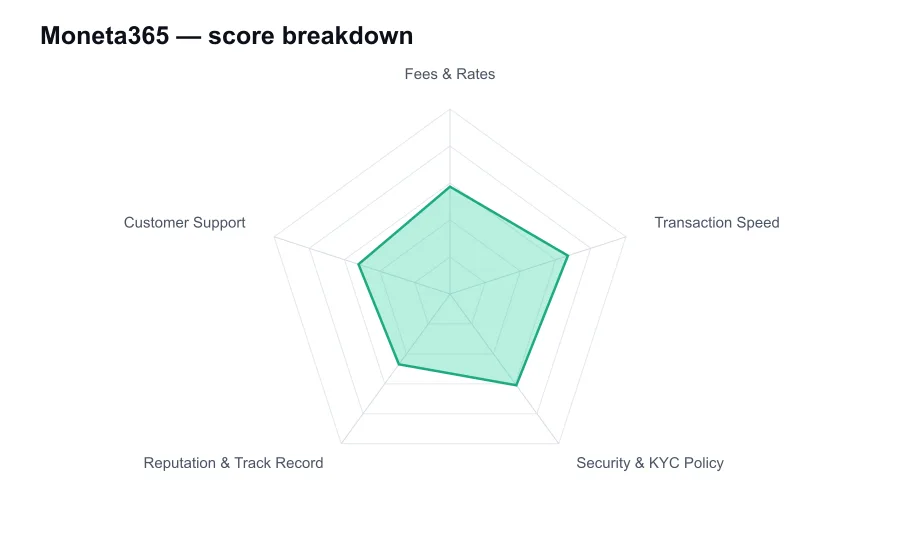
Reputation is where Moneta365 has work to do. It does not carry the institutional visibility, licensing footprint, or long public operating record of Coinbase, Kraken, or even some of the larger instant exchange names. Smaller providers can be perfectly functional, but reviewers should not award trust merely because a website is available around the clock. Sparse independent discussion makes it harder to distinguish a reliably executed service from one that simply has not faced much scrutiny.
Support is consequently a bigger factor than it would be at an established exchange. A polished FAQ can answer basic questions about confirmations and addresses, but it cannot resolve a stuck transaction. Before relying on Moneta365, locate its active support channel, understand what information it requests for an order investigation, and test the service with an amount you can afford to have delayed. That is a more honest evaluation method than trusting promotional claims.
I also would not confuse a broad list of displayed assets with deep liquidity in every pair. Many instant exchanges rely on external liquidity, so obscure tokens, thin networks, and volatile pairs may have wider spreads or restricted availability. The best experience is likely to be on familiar, liquid routes such as BTC, ETH, LTC, USDT, or other major assets, subject to the particular networks currently offered.
Moneta365 may be convenient, but convenience is its case, not established market authority. It can make sense for a user who values a quick crypto to crypto conversion and takes responsibility for checking terms. It is a poor fit for someone who needs named regulatory oversight, transparent published trading fees, bank transfers, or guaranteed phone support. Keep order sizes sensible until the service has earned your confidence through your own successful use.
My take is cautious rather than dismissive. The product category has real value, and Moneta365's account light approach will appeal to users tired of cumbersome exchange onboarding. But its quote based pricing, modest public footprint, and dependence on responsive support during exceptions leave little margin for carelessness. Use it for deliberate, well checked swaps. Do not make it the center of your crypto activity.