CoinCraddle is not a provider I can substantiate as an established cryptocurrency exchange, broker, wallet, payment processor, or market-data platform. That is the central finding, not a minor footnote. A name can circulate in directories, affiliate pages, or search results without representing a verifiable operating business, and the public footprint associated with CoinCraddle is not strong enough to support the kind of trust a financial service should earn.
This creates an immediate problem for prospective users. Before comparing spreads, withdrawal fees, order execution, or support queues, an investor needs to know who runs the service, where it is incorporated, what entity holds customer funds, and which regulator has meaningful oversight. I could not verify those fundamentals from reliable, authoritative information. That means a conventional exchange review cannot responsibly fill the gaps with assumptions.
The absence of a confidently verified official website is itself material. A legitimate crypto firm can change domains, redesign a site, or operate under a parent brand, but it should still leave a clear trail of company disclosures, terms, support contacts, legal jurisdiction, and security information. If search results lead to similarly named sites or promotional pages rather than a consistent official presence, stop before creating an account or sending money.
Crypto is full of polished interfaces that mimic legitimate platforms. A website can display live price charts, claim cold storage, show invented trading volume, and offer implausibly high yields without proving that a real exchange operation exists behind it. The visual quality of a site is not evidence of licensing, custody, liquidity, or solvency. CoinCraddle has not earned the benefit of the doubt on those points.
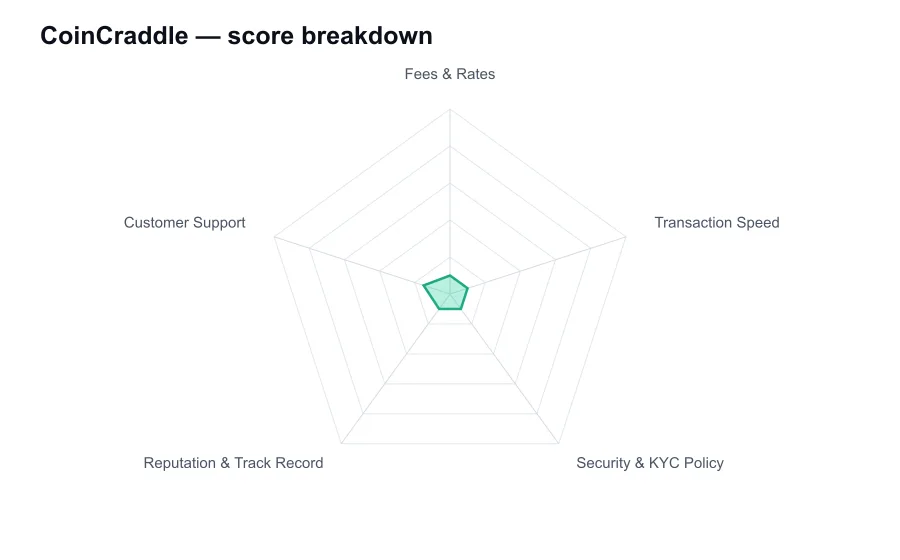
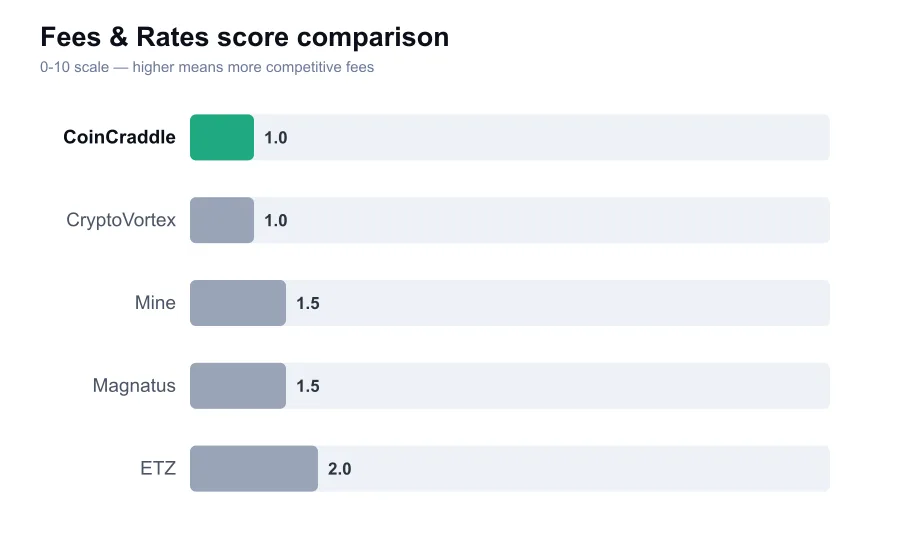
Fees cannot be scored positively where no dependable public fee schedule is available. An authentic exchange normally publishes spot fees, derivatives fees if applicable, deposit rules, withdrawal charges by network, conversion spreads, and conditions that may trigger additional costs. With CoinCraddle, I cannot confirm any of these. A low advertised trading fee would not compensate for uncertainty about whether withdrawals are honored.
The most dangerous fee pattern in this area is not a visible commission. It is the surprise demand for a tax, verification payment, liquidity release charge, insurance fee, or account-unlock deposit before a withdrawal is processed. Legitimate platforms may have compliance checks and network fees, but they do not ordinarily require customers to send extra crypto to unlock money already in their account. Any request of that kind should be treated as a serious warning sign.
There is also no reliable basis to assess transaction speed. Claims of instant deposits or rapid withdrawals mean little unless users can verify actual on-chain transactions and a documented withdrawal process. A dashboard credit is not proof that funds exist under your control. The relevant test is whether a user can withdraw a modest amount to a wallet they own, without unexplained delays, extra payments, or pressure from a supposed account manager.
Even that test should not be used as an invitation to deposit money merely to investigate. Scam operations sometimes permit a small early withdrawal to build confidence, then obstruct larger withdrawals. The safer approach is to avoid funding an unverified provider altogether. There are regulated or long-established alternatives where a user does not have to conduct a personal experiment with their savings.
Security claims are impossible to validate here. I cannot confirm an audited custody arrangement, proof of reserves, independent security testing, bug-bounty policy, two-factor authentication standards, withdrawal-address controls, or an incident-response process for CoinCraddle. A logo next to the phrase cold storage is not enough. Users should require evidence, and in crypto that evidence needs to be current, specific, and tied to a real legal entity.
KYC policy is equally unclear. A provider that says it is no-KYC can still demand identity documents later, particularly at withdrawal. A provider that asks for extensive documents without a clear legal entity creates a different danger, because users may expose passports, selfies, and address information to an unknown operator. Do not upload sensitive identity material until you have independently verified who receives it and why.
Reputation is where CoinCraddle fails most plainly. I could not establish a credible operating history, consistent independent coverage, recognized licensing record, or a track record comparable with known exchanges. A handful of reviews, referral posts, social comments, or testimonials is not enough. Those sources are easily manipulated, and they should never outweigh official regulatory records and long-term public accountability.
Customer support cannot rescue an unverified financial platform. A responsive Telegram contact or chat widget may feel reassuring, but it is not a substitute for a traceable support organization, published complaints process, legal address, and accountable management. In fact, persistent personal contact from someone urging a deposit, a larger trade, or an urgent withdrawal payment is more concerning than reassuring.
The responsible recommendation is not to look for a clever way to use CoinCraddle safely. It is to wait for independently verifiable corporate, regulatory, technical, and customer-service evidence that supports its claims. Until then, use established exchanges appropriate to your jurisdiction, enable two-factor authentication, and withdraw long-term holdings to a wallet you control.
My score reflects uncertainty, not an accusation of specific wrongdoing. An unverified provider cannot earn trust merely because negative evidence is hard to find. Financial platforms must do the work of proving who they are and how they protect customers. CoinCraddle has not provided enough verifiable information for me to recommend depositing funds, submitting KYC documents, or connecting a wallet.