Magnatus is a difficult provider to review in the conventional sense because it does not have the public footprint expected from a credible crypto exchange. I could not establish a clearly attributable corporate entity, regulatory registration, independently documented trading venue, or stable official website that can be confidently tied to a service called Magnatus. That is not a minor missing detail. In crypto, it is the starting point for deciding whether a platform deserves a deposit at all.
A recognizable exchange leaves evidence behind. It publishes legal terms, identifies the jurisdiction it operates from, explains custody arrangements, lists supported markets, and gives users a route to contact it that is not limited to a chat handle or anonymous form. Magnatus does not meet that basic standard from the information I could verify. Any reader encountering a Magnatus offer through social media, a referral link, or an unsolicited message should treat the lack of verifiable identity as a serious warning rather than a curiosity.
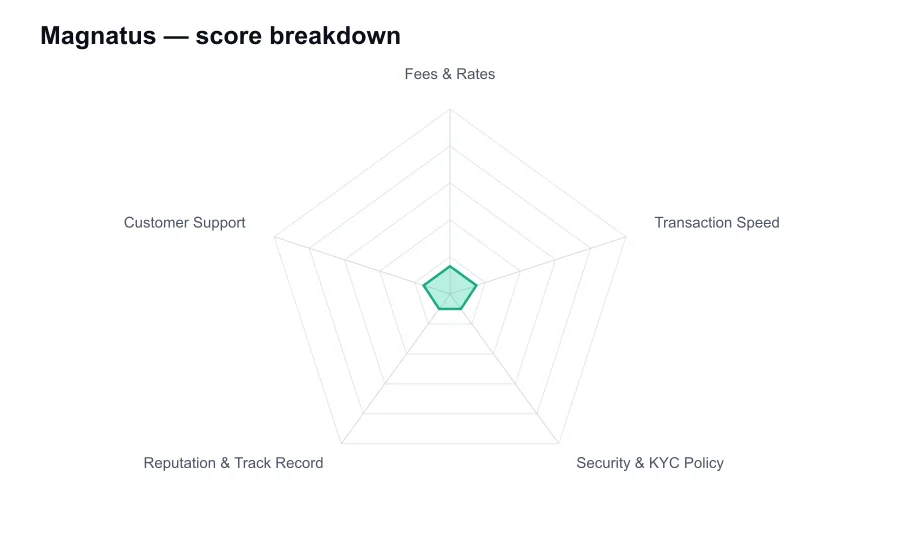
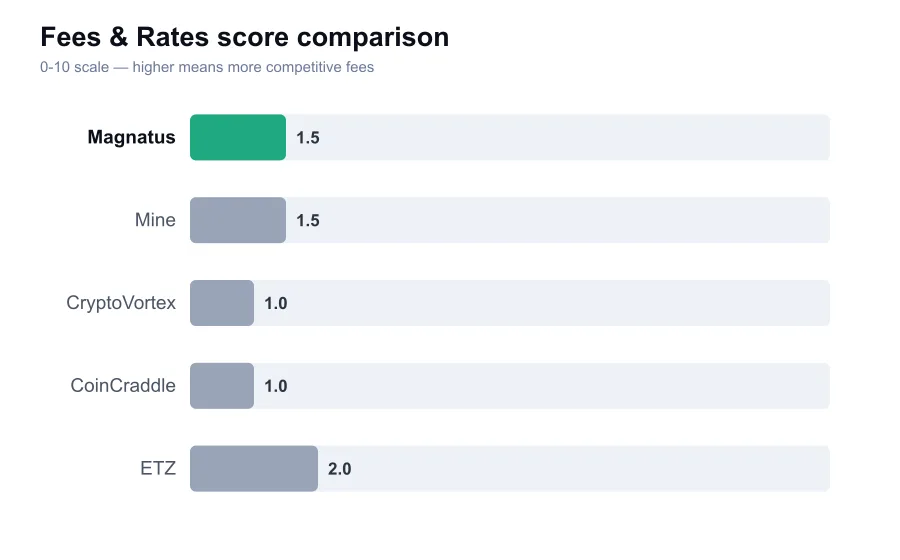
The fee picture is similarly opaque. There is no dependable public fee schedule that sets out maker and taker charges, spread methodology, withdrawal costs, network-fee treatment, or fiat conversion costs. A platform can advertise a low headline fee while making its money through a wide quote spread. Without a public schedule and a live, independently testable quote flow, users cannot calculate the real cost of a trade.
That uncertainty matters most for instant swaps. A quoted rate may look competitive until the final settlement arrives with a lower output amount, an unexplained service charge, or a delayed transaction. Established non-custodial swap services at least disclose whether a transaction uses a floating rate or a fixed rate. Centralized venues such as Kraken and Coinbase publish trading tiers and withdrawal charges. Magnatus has not earned the benefit of comparison because its pricing cannot be audited in the same way.
Transaction speed cannot be scored generously either. Fast settlement claims are cheap to make in crypto. The useful question is whether deposits are credited reliably, whether orders execute against visible liquidity, whether withdrawals are processed within a stated service level, and whether support can intervene if a transfer is held. I found no reliable body of public evidence showing Magnatus consistently handling those operational moments.
Blockchain confirmation time is not the same thing as exchange speed. Bitcoin may take time to confirm regardless of the venue, but an exchange controls how quickly it credits the deposit and releases a withdrawal. If the platform is using an internal ledger, a displayed balance may also say little about whether the asset can be withdrawn promptly. With Magnatus, users do not have enough transparent operational information to separate a functioning service from a polished front end.
Security is where the gap becomes decisive. There is no clearly documented proof-of-reserves process, named custody partner, insurance policy, external security audit, or detailed explanation of hot and cold wallet controls. None of those measures alone guarantees safety, but their absence makes it impossible to assess counterparty risk. Depositing coins with an unidentified operator is fundamentally different from using a well-known self-custody wallet or a regulated venue.
The KYC policy is also unclear. That can sound attractive to users who value privacy, but unclear is not the same as privacy respecting. A legitimate no-KYC or limited-KYC service explains its limits, transaction thresholds, sanctions policy, source-of-funds process, and the circumstances in which it may pause a transfer. A provider that reveals those rules only after taking custody of funds puts the user in a weak position.
Reputation is not merely a count of positive comments. Crypto review pages are easily manipulated, affiliate promotions can be purchased, and a handful of enthusiastic posts do not establish years of reliable withdrawals. I could not find the kind of durable, independently corroborated track record that would make Magnatus suitable for meaningful balances. There is no established history comparable with long-running regulated exchanges or even with better documented specialist swap providers.
That lack of history creates a practical problem if something goes wrong. Users need to know who receives a legal notice, which consumer authority has jurisdiction, and what records exist for a disputed transfer. A brand name without a verifiable legal operator offers very little recourse. The usual advice to keep screenshots and transaction IDs helps, but it does not create a recovery path where no accountable company can be identified.
Customer support cannot be assessed on responsiveness alone. A quick reply from an anonymous agent is not the same as a support system with ticket numbers, escalation procedures, published response targets, and a documented complaints route. I found no dependable evidence that Magnatus provides those safeguards. That makes a delayed deposit or an account restriction much more concerning than it would be at an established provider.
Some traders will still be tempted by the possibility of an undiscovered low-fee venue. That is the wrong calculation. The potential saving on a spread or trading charge is trivial compared with the downside of sending assets to a party whose ownership, custody model, and rules are not independently clear. Crypto users should be skeptical by default, particularly where a service asks for a deposit before it has demonstrated basic transparency.
If you are evaluating Magnatus because somebody offered guaranteed returns, exclusive access, copy trading, account management, or a recovery service, stop before sending funds. Those pitches are frequently linked to fraudulent operations that borrow generic financial branding. Independently verify every address and domain, never install remote-access software for a supposed support representative, and do not pay an additional fee to unlock an already blocked balance.
My view is straightforward. Magnatus has not supplied enough verifiable public information to be treated as a credible exchange provider. It might be a small or poorly marketed service, but users should not have to guess about an operator's identity, fees, custody, or withdrawal practices. Until those basics are publicly documented and independently corroborated, it belongs in the avoid category, not the experimental allocation category.