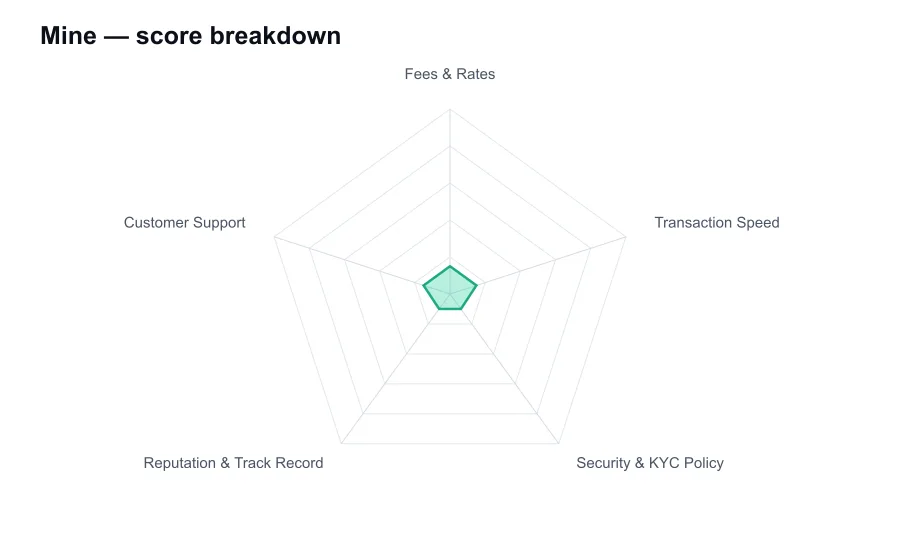
Mine is an ambiguous name in crypto. It has been used by multiple products, tokens, mining ventures, and services, and I could not reliably identify one current exchange provider operating simply as Mine with a clearly attributable official site, legal entity, and public operating record. That ambiguity makes a conventional exchange review impossible without risking the wrong service being credited with another company's policies or reputation.
This is more than a naming inconvenience. Crypto scams routinely exploit generic words such as Mine, Crypto, Global, Exchange, and Digital because they are hard to search and easy to imitate. A user who receives a link branded Mine should not assume it belongs to any similarly named business found online. The exact domain, company registration, jurisdiction, and wallet addresses need to be checked independently before a deposit or wallet connection.
A credible exchange operating under a generic name should work especially hard to establish identity. That means publishing its legal entity, licensing or registration details where applicable, physical jurisdiction, complete terms, privacy policy, fee schedule, security policy, and support contacts. I could not verify that complete package for a standalone provider called Mine. Without it, assigning an official URL would be irresponsible.
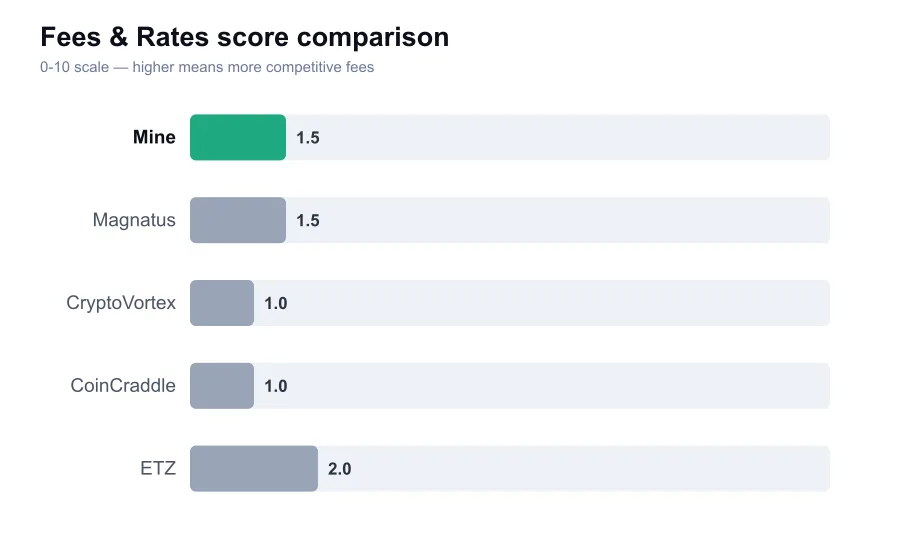
Fees are therefore impossible to assess fairly. There is no verified public schedule showing whether Mine charges trading commissions, spread markups, withdrawal fees, deposit fees, or account-management costs. A low advertised rate is meaningless if the service can alter the execution price, impose a withdrawal condition, or require a payment for verification after funds have arrived. Transparent exchanges let users inspect their costs before they trade.
The same applies to execution speed. Some sites display instant internal balances while withdrawals are manually reviewed or delayed. Others use a blockchain transaction as a visual prop while retaining control of the customer's account. What matters is a documented deposit-crediting policy, order-book or quote transparency, withdrawal processing standards, and an established record of successful customer withdrawals. None of that could be confirmed for Mine as a distinct provider.
Security information is the biggest missing piece. There is no dependable evidence tying the name Mine to audited wallet infrastructure, segregated client custody, proof of reserves, a reputable custodian, insurance coverage, mandatory two-factor authentication, or a published incident-response process. A security badge on a website is not evidence. Nor is an SSL padlock, which merely encrypts a connection and says nothing about who controls the funds.
KYC uncertainty is not a feature either. Some users look for platforms that avoid identity checks, but reputable services describe their verification requirements before accepting money. They explain residency restrictions, transaction limits, source-of-funds reviews, and the process for account appeals. If a provider advertises no verification and then freezes a balance pending a fee, tax payment, or extra deposit, that is a major danger signal.
Mine also has no verifiable reputation that can be separated from unrelated businesses sharing similar words. A handful of online reviews would not solve that problem, particularly if they appeared in a short time frame or used generic language. A credible reputation is built through years of visible operation, independently reported incidents, recognizable executives, regulatory records, and user reports that can be cross-checked. I found no such record that clearly belongs to this provider name.
Customer service is where an anonymous operation can become actively harmful. A real dispute process provides ticket references, named channels, documented escalation, and a complaint route. A chat account that asks users to send more crypto is not support. I could not verify a stable customer-service framework for Mine, so users should assume that recovery options would be extremely limited if a deposit were delayed or an account were restricted.
If you reached Mine through a romantic contact, a private investment group, a WhatsApp signal channel, or somebody promising managed returns, assume the possibility of an investment scam is high. The usual sequence involves early apparent profits, pressure to deposit more, then a fabricated tax, security, or unlocking payment. Legitimate exchanges do not require customers to pay a separate crypto fee to release their own balance.
There are simple precautions that reduce exposure. Type the address of a known exchange directly rather than following ads or messages. Verify licensing claims through the named regulator, not through a badge on the platform. Search the exact domain together with terms such as withdrawal, scam, and company name. Most importantly, send no meaningful funds until you can complete a small deposit and withdrawal, though even that test cannot prove long-term safety.
For users who mean a specific regional business with Mine in its legal or trade name, more identifying information is essential. A country, exact domain, and legal entity can materially change the assessment. It would be misleading to attribute the controls of Mine Digital, MinePlex, or any other similarly named operation to a service described only as Mine. Precision is a safety issue in this sector.
The absence of a positive recommendation is deliberate, not evasive. A review should not manufacture specifics to make an obscure platform appear established. There are plenty of exchange options with public ownership, transparent fees, demonstrated withdrawals, and recognizable compliance policies. Choosing one of those is a much more rational decision than trying to extract a bargain from an unidentified brand.
My recommendation is to avoid depositing with a provider identified only as Mine. Until the exact operator can be independently confirmed and its security, pricing, and support practices can be checked, the risk cannot be measured. In crypto, unmeasurable counterparty risk is usually just high counterparty risk with better marketing.