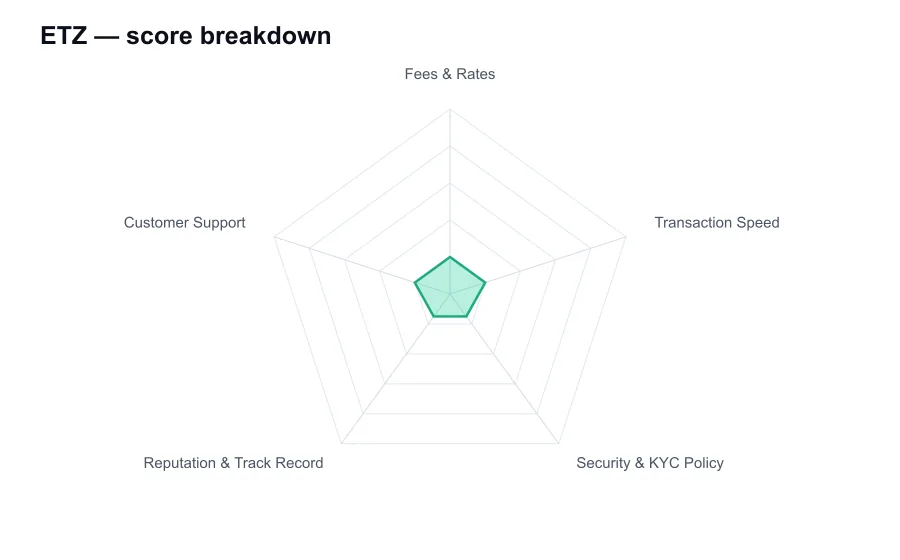
ETZ is a difficult provider to assess with the confidence expected from a serious crypto review, and that difficulty is itself the most important finding. The name is not associated with a widely documented, established exchange in the way Curve, DefiLlama, or EasyBit are. Crypto markets are full of short names, clone brands, wallet labels, and regional services, so identifying a platform solely as ETZ creates an avoidable verification problem.
A responsible reviewer should not fill that gap with invented corporate history, fee tables, licences, or security claims. I cannot confidently verify a single official website, operating entity, legal jurisdiction, published trading schedule, or independently established product record for an exchange identified only as ETZ. For that reason, users should not interpret the absence of documented criticism as a positive signal. It may simply mean there is too little reliable public evidence to assess.
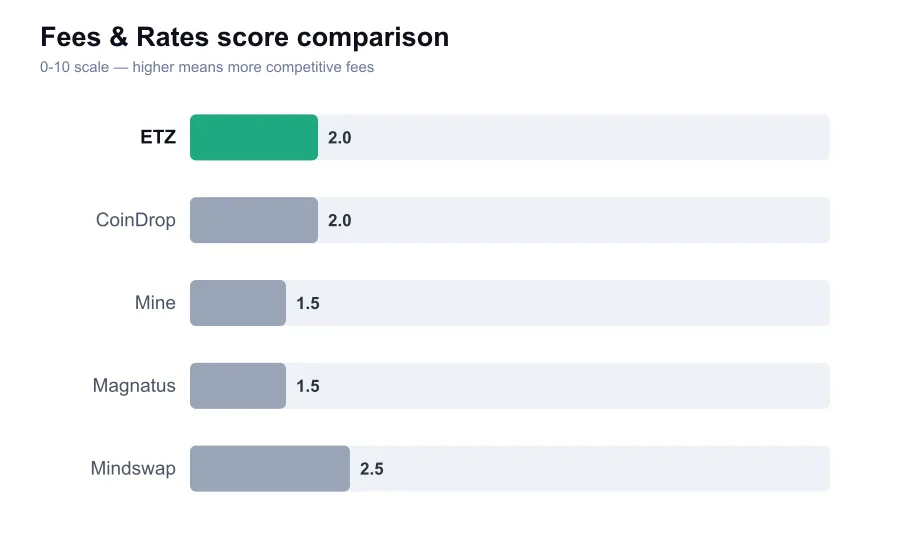
This changes how fees should be judged. A credible exchange publishes a clear fee schedule, explains maker and taker charges or conversion spreads, identifies withdrawal fees, and shows how network costs are handled. Without a verifiable ETZ fee page tied to a confirmed official domain, there is no honest basis to claim that its rates are cheap. Any service asking for a deposit before giving a final executable quote deserves particular suspicion.
Opaque pricing is more dangerous than a high advertised fee. A platform may display an attractive rate, then recover its margin through a spread, a withdrawal charge, a minimum amount, a network fee, or a worse price at execution. The only defensible way to test an unfamiliar provider is with a very small amount, but even that is not a substitute for verifying its legal identity. A low-cost claim from an unverified site has almost no value.
The same problem applies to transaction speed. It is easy for a website to promise instant processing, but a meaningful speed assessment needs evidence: on-chain withdrawal records, clear confirmation rules, user reports that can be traced to real people, and a known process for delayed transactions. Without those signals, there is no reason to assume ETZ can settle deposits or withdrawals reliably. A polished interface is not operational proof.
Crypto users should separate blockchain settlement from platform processing. Bitcoin can take time because of confirmations, while an exchange can add additional delay through risk screening, manual review, liquidity shortages, or withdrawal batching. Established services disclose at least some of these rules. An obscure provider that offers vague promises but no transparent confirmation policy leaves users unable to plan around a payment or respond if funds are delayed.
Security concerns are more serious still. There is no basis to confirm that ETZ maintains cold storage, segregation of customer assets, proof of reserves, independent penetration testing, audited smart contracts, two-factor authentication, withdrawal allowlists, or a meaningful incident response process. A site can display padlock icons, security badges, and generic claims about encryption without proving that client funds are protected. HTTPS is necessary, but it says almost nothing about solvency or custody controls.
KYC policy should also be treated as unverified unless it is clearly published by a confirmed operator. Some questionable platforms use no-KYC language to attract deposits, then request extensive documents once a withdrawal is attempted. Others collect identity material without giving users a clear privacy policy, legal entity, or retention practice. Neither outcome is acceptable. A legitimate service should state when verification is required, what documents it accepts, and how compliance disputes are handled.
The absence of a dependable reputation record is a major negative, not a neutral starting point. In crypto, a provider earns credibility through years of surviving volatile markets, handling withdrawals during stress, responding publicly to incidents, and building an independently visible user base. ETZ does not have a broadly recognisable track record that can be weighed against names such as Kraken, Coinbase, Bitstamp, or established non-custodial protocols. That leaves a prospective user with too much uncertainty.
Be especially careful about referral links, social-media testimonials, and review pages that contain only generic praise. These are easy to manufacture and often omit the hard questions: who owns the company, where is it registered, what happens if a transaction is held, and which regulator can receive a complaint? Search results alone are not due diligence. Look for consistent company records, longstanding public communications, named leadership where appropriate, and independent discussion that includes criticism as well as praise.
Customer support cannot be awarded much credit without a traceable support operation. An email form or chat bubble is not evidence that a team will resolve a frozen withdrawal. Before funding any exchange, test support with a basic question, inspect whether the response comes from the official domain, and ask for direct links to terms, privacy policy, and fee disclosures. Never let an agent move a conversation to Telegram or ask for a seed phrase, remote access, or an extra payment to release funds.
There are practical warning signs that should end the evaluation immediately. Walk away if ETZ requires a so-called tax, unlock charge, insurance deposit, liquidity verification payment, or additional crypto transfer before allowing a withdrawal. Do not send funds to prove ownership. Do not install remote-control software. A real exchange may perform compliance checks, but it does not need a customer to send more cryptocurrency to make an existing balance withdrawable.
If someone has already deposited money with a service branded ETZ, preserve everything: transaction hashes, wallet addresses, screenshots, chat records, emails, and the full URL. Do not send additional funds in response to pressure. Contact the receiving exchange or wallet provider promptly if funds passed through one, report suspected fraud to relevant local authorities, and seek specialist advice for material losses. Recovery services that demand upfront crypto are commonly another layer of the scam.
My view is blunt. ETZ should be treated as unproven until a user can independently establish the exact operator and its documented history. That does not prove malicious intent, but the evidentiary gap is too large for a positive recommendation. There are many providers with public fee disclosures, known ownership, long withdrawal histories, and established security practices. An exchange has to earn a deposit, and ETZ has not supplied enough verifiable information under this name to earn one.